Azdan Apps

NetSuite Project Costing
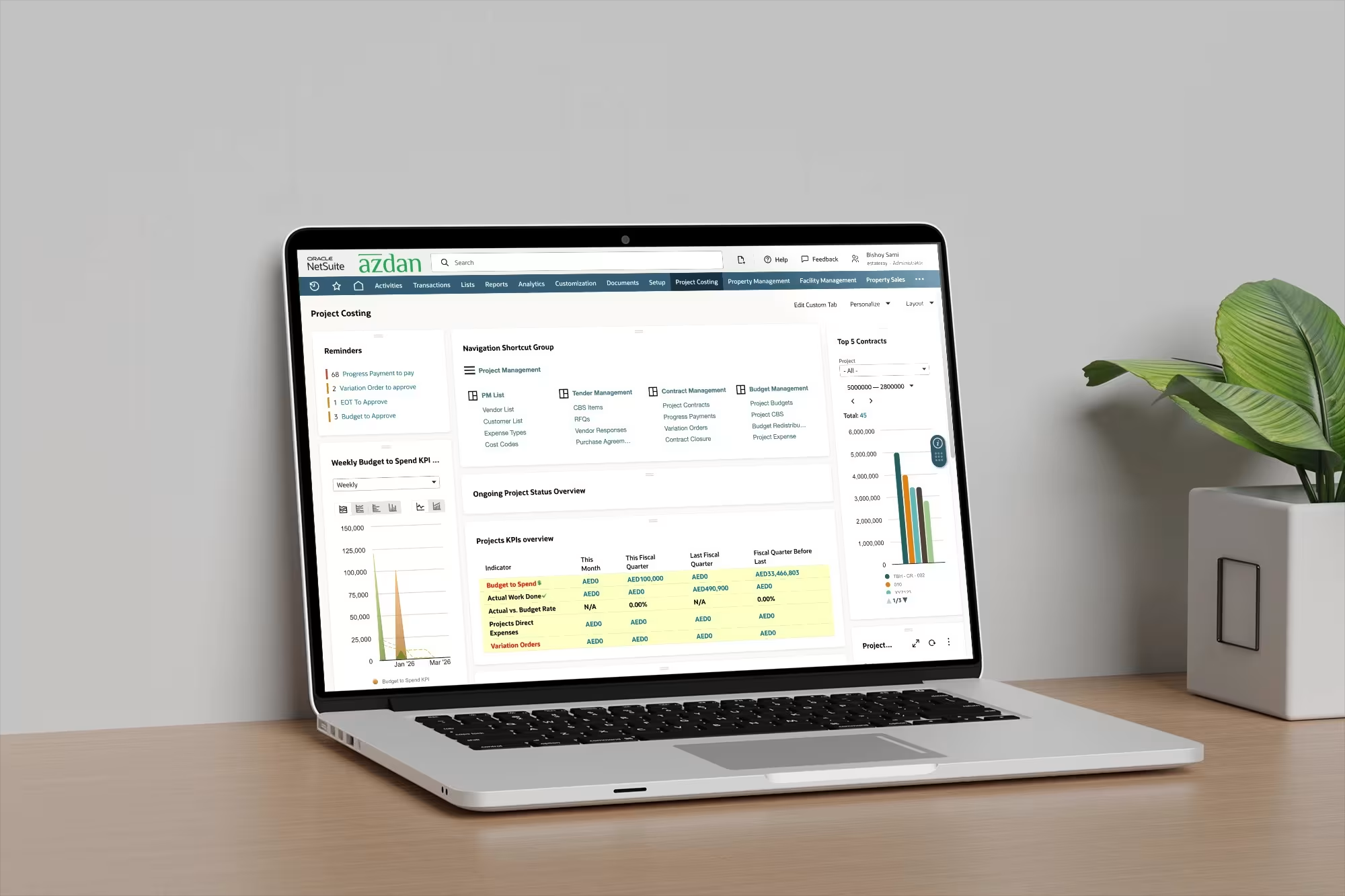
Manage the full project cost lifecycle inside NetSuite — from BOQ and CBS structure through contractor contracts, progress payments, variation orders, and real-time cost-to-complete visibility.
Progress Payments
Contractor Contracts
CBS Structure
BOQ Management
Variation Orders
EOT Requests
Real-time Forecasting
Cost-vs-Budget
Azdan Apps' NetSuite Project Costing solution gives construction and real estate developers full financial control over every active project — from BOQ and contractor contracts through progress payments, variation orders, and real-time cost-to-complete tracking, all inside NetSuite.
One source of truth
BOQ & CBS ready
Finance-connected
BOQ, CBS & Budget Management
Every project starts with a structured cost breakdown inside NetSuite — BOQ line items, CBS hierarchies, and budget allocations all configured natively. Real-time cost-vs-budget visibility and forecasting update automatically as work progresses, with no manual reconciliation against external systems.
- BOQ management — line items, quantities, and unit rates
- CBS structure — cost breakdown hierarchy per project
- Budget allocation and real-time cost-vs-budget tracking
- Real-time forecasting and cost-to-complete visibility
Get a Free Demo
Who it’s for
Project finance teams and development directors managing multiple active projects who need live cost visibility.
Outcome
Every project's cost position visible in real time — from initial BOQ through current spend to cost-to-complete.


Contractor Contracts, Payments & Variations
Contractor and subcontractor contracts are managed inside NetSuite — with structured progress payment processing, variation order approvals, EOT request tracking, and penalty management all connected to live project financials and AP.
- Contractor and subcontractor contract management
- Progress payment processing and advance payment tracking
- Variation orders and EOT request processing
- Penalty tracking and retention management
Get a Free Demo
Who it’s for
Procurement and contract managers at construction and real estate developers handling multiple contractor relationships across active project sites.
Outcome
Every contractor payment governed, every variation tracked, and every cost impact reflected in project financials — from inside NetSuite.
What’s Included
Everything in Azdan Apps NetSuite Project Costing

Project Cost Control
BOQ, CBS, and budget visibility
A fully native NetSuite solution for project cost management — BOQ line items, CBS structure, budget tracking, real-time cost-vs-budget, and cost-to-complete forecasting, all connected to NetSuite finance.
This includes:
- BOQ management and CBS structure
- Budget allocation and cost-vs-budget tracking
- Real-time forecasting and cost-to-complete
- Project-level financial reporting and drill-down

Contract & Payment Management
Contractors, variations, and retention
Contractor and subcontractor contract management inside NetSuite — progress payments, variation orders, EOT requests, and retention all tracked and connected directly to project financials and AP.
This includes:
- Contractor and subcontractor contract management
- Progress payments and advance payment tracking
- Variation orders, EOT requests, and penalty tracking
- Retention management and AP integration
.avif)
.png)
How Tatweer Gained Real-Time Cost Visibility Across Three Subsidiaries and an Active SAR 1.2B Development — Inside NetSuite
A Saudi real estate holding group with three subsidiaries consolidated project costing, BOQ management, contractor payments, and cross-entity reporting inside one NetSuite-native platform — replacing fragmented operations with a single source of truth.
Situation
Three subsidiaries running active development projects with no unified cost governance — no BOQ tracking, no structured contract management, no real-time view of budget vs. actual across active sites, and no consolidated financial visibility.
Solution
NetSuite ERP with Azdan Apps Project Costing — covering BOQ management, contractor and subcontractor contracts, progress payment processing, variation orders, penalty tracking, and real-time cost-to-complete visibility across all three Tatweer subsidiaries.
FAQ
Common Questions About NetSuite
We’ve worked with dozens of fast-moving teams—so we know what comes up before your first call. Here’s what you should know.
Get to Know More
How long does a NetSuite implementation take?
A NetSuite implementation with Azdan takes between 6 and 12 weeks for a focused single-entity deployment, and longer for multi-entity or multi-module projects.
What does the Azdan implementation process look like?
Every Azdan NetSuite implementation follows a structured seven-phase methodology: discovery and scoping, solution design, system configuration, data migration, user acceptance testing, end-user training, and go-live.
Does an Azdan implementation include data migration?
Yes. Every Azdan implementation includes a full data migration cycle covering extraction from the legacy system, transformation to NetSuite's data model, data quality validation, and controlled loading into the live environment.
How does Azdan handle customizations and third-party integrations?
Azdan builds all NetSuite customisations natively using Oracle's SuiteScript and SuiteFlow development frameworks, and delivers integrations through NetSuite's SuiteCloud platform. Before any custom development begins, Azdan consultants assess whether native NetSuite configuration or an existing module can achieve the same outcome.
What happens when requirements change during an implementation project?
Requirement changes are managed through a formal change control process. Any requirement that falls outside the agreed project scope is documented, assessed for timeline and budget impact, and formally approved before work begins.
How disruptive is a NetSuite go-live to business operations?
A well-managed NetSuite go-live causes minimal operational disruption. Azdan runs parallel testing and user acceptance phases before go-live, schedules the cutover during a low-activity window, and provides dedicated hypercare support for the weeks immediately following launch.
What post-go-live support does Azdan provide?
Azdan offers structured managed service agreements covering system monitoring, functional issue resolution, configuration changes, and Oracle NetSuite platform update management. Support is delivered by the same certified consultants who built the system — not a general helpdesk.
How does Azdan handle Oracle NetSuite's biannual platform updates?
Oracle releases two major NetSuite platform updates every year. Azdan managed service clients receive advance notification of changes relevant to their configuration, compatibility testing in a sandbox environment before each update is applied to production, and resolution of any post-update issues.
What are Azdan's support hours and geographic coverage?
Azdan operates managed service support across the Middle East with consultants based in the UAE, Saudi Arabia, and Egypt, covering the GCC working week. Support tiers and SLAs are defined in each client's managed service agreement.
Do Azdan clients get a dedicated consultant after go-live?
Yes. Managed service clients are assigned a named functional consultant with direct knowledge of their system configuration and business processes. Every support request is handled by someone who already understands the environment — not a new consultant reading from a ticket with no prior context.
Can Azdan support organizations that already have an internal NetSuite administrator?
Yes, and this is a common support model for Azdan clients. Internal administrators manage day-to-day system operations while Azdan handles complex configuration changes, custom development, integration maintenance, and Oracle platform update management.
What if an organization needs to add modules or entities after go-live?
NetSuite is architected to expand within a single platform — adding modules, subsidiaries, users, or integrations post-go-live does not require a new system or a new implementation. Azdan manages all expansion projects through the same scoped delivery methodology used for the original implementation.
How is Oracle NetSuite licensed?
Oracle NetSuite is licensed as an annual subscription. The licence fee is calculated by Oracle based on three variables: the number of named users, the modules activated on the account, and the number of legal entities or subsidiaries. License fees are set directly by Oracle and are separate from Azdan's implementation and managed service fees.
What determines the cost of a NetSuite implementation with Azdan?
NetSuite implementation cost with Azdan is determined by four factors: the number and complexity of modules being configured, the number of legal entities and subsidiaries in scope, the volume and quality of historical data being migrated, and the number of third-party integrations required.
Is there a minimum contract term for an Oracle NetSuite license?
Oracle's standard NetSuite licence is an annual subscription, renewed each year. Multi-year agreements are available from Oracle and may carry pricing advantages depending on user count and committed modules.
How does NetSuite licensing scale as an organisation grows?
NetSuite licensing scales additively within a single platform. Adding users, activating new modules, or bringing additional subsidiaries onto the account adjusts the annual license fee — it does not require migrating to a different system or restarting an implementation.
What is the difference between the Oracle NetSuite license fee and Azdan's fees?
The Oracle NetSuite license fee covers access to the platform, activated modules, Oracle's standard support, and biannual platform updates — paid annually to Oracle. Azdan's fees are separate and cover implementation services, custom development, third-party integration, and ongoing managed support.
Is NetSuite cost-effective for mid-market businesses in the Middle East?
Oracle NetSuite is designed for mid-market and enterprise businesses — organizations with revenue above USD 5 million, multiple entities, or complex operational requirements. For businesses in the UAE, Saudi Arabia, and broader Middle East operating across multiple subsidiaries or requiring compliance, NetSuite's single-platform architecture eliminates the cost and complexity of maintaining separate systems for ERP, HR, compliance, and reporting.