.svg)


10 ERP Systems That Support UAE E-Invoicing
Quick Answer
The UAE Federal Tax Authority (FTA) publishes an official register of Accredited Tax Accounting Software Vendors, currently listing 41 entries. This guide reviews ten of the strongest business platforms on the register: SAP S/4HANA, Epicor ERP, Sage, Odoo, Wafeq, TallyPrime, Focus Softnet, Zoho Books, Xero, and Daftra. Every solution featured below appears on the official FTA register at the time of writing.
One point of clarity: under the UAE e-invoicing mandate, your ERP does not send invoices to the government. It produces structured invoice data (PINT AE XML) that flows through a Ministry of Finance Accredited Service Provider (ASP) over the Peppol network. The real question is which FTA-accredited system produces clean, compliant data for your size and industry.
Why UAE E-Invoicing Makes Your ERP Choice Urgent
Mandatory e-invoicing is set out in Ministerial Decisions No. 243 and 244 of 2025. The pilot and voluntary phase opened on 1 July 2026. Businesses with annual revenue of AED 50 million or more must appoint an ASP by 30 October 2026 and go live by 1 January 2027. Businesses under AED 50 million follow by 1 July 2027, and government entities by 1 October 2027. Penalties under Cabinet Decision No. 106 of 2025 include AED 5,000 per month for missing the deadline. Free zone companies are in scope.
E-invoicing is fundamentally a data quality problem. If your system cannot hold correct TRNs, line-level VAT treatment, and a clean audit trail, no ASP can fix it downstream.
How this list was built. Every product below appears on the official FTA register at the time of writing. Rankings reflect editorial judgement on market recognition, ERP depth, UAE adoption, scalability, and product maturity, not an official FTA ranking. Some register entries show validity dates that have passed while remaining listed; verify current status with the FTA and vendor before buying.
Comparison Table
1. SAP S/4HANA
The deepest enterprise ERP on the FTA register and the finance backbone of many of the UAE's largest groups. The register lists SAP S/4HANA Advanced Compliance Reporting in two entries with historical validity dates (till August 2019), so confirm current status during due diligence. S/4HANA covers financials, treasury, procurement, supply chain, manufacturing, and consolidation, while SAP Document and Reporting Compliance manages e-invoicing formats across dozens of countries, including PINT AE data flowing to an accredited ASP. Implementations run in quarters, not weeks, and total cost is the highest on this list.
- Best for: large enterprises and multi-entity groups with complex operations
- E-invoicing path: SAP DRC plus accredited ASP connectors
- Pricing: quote-based subscription (RISE with SAP)
- Website: sap.com
- FTA proof
2. Epicor ERP (Kinetic)
The strongest dedicated manufacturing and distribution ERP on the register, listed as Epicor ERP 10.2.600 (validity shown till January 2023; verify current status). Now sold as Epicor Kinetic, it offers production scheduling, MES, quality, BOM management, supply chain, multi-company financials, and CRM, with a long-standing Dubai office. For the mandate, Epicor generates the line-level structured data PINT AE requires and connects through ASP integration. Manufacturers should test advance payment and retention scenarios, which the FTA guidance treats explicitly and Epicor handles at ERP level.
- Best for: mid-sized and large manufacturers and distributors
- E-invoicing path: structured invoice data via ASP connectors
- Pricing: quote-based, by users and modules
- Website: epicor.com
- FTA proof

3. Sage (X3, Sage 300, Business Cloud Accounting)
Sage is the only vendor with three products on the register: Sage X3 (V12), Sage 300 (6.6), and Sage Business Cloud Accounting (4.1.6), all showing validity till October 2020, so verification is essential. X3 is a genuine mid-to-large ERP with standout process manufacturing (formulas, batch traceability) for food, chemicals, and pharma. Sage 300 suits multi-entity holding and property structures, and Business Cloud Accounting covers small-business bookkeeping. Sage's GCC reseller network is among the deepest in the region, and your e-invoicing readiness will depend heavily on choosing a partner that has already scoped the UAE mandate.
- Best for: process manufacturers (X3), multi-entity mid-market (300), small businesses (Cloud)
- E-invoicing path: compliance updates plus partner-built ASP connectors
- Pricing: X3 quote-based; 300 per user via partners; Cloud subscription
- Website: sage.com
- FTA proof

4. Odoo
The world's most widely adopted open-source ERP, with a real Dubai operation: the register entry belongs to Odoo Middle East DMCC, listed for version 17 (validity shown till June 2025, now passed, so verify for your target version). Odoo's modular suite spans accounting with UAE localisation, inventory, purchasing, manufacturing, CRM, e-commerce, POS, HR, and UAE payroll, all on one database. It already runs Peppol e-invoicing in Europe, and the UAE path is the same architecture localised through an accredited ASP. Implementation quality varies with the partner, so vet carefully.
- Best for: SMEs and lower mid-market wanting one integrated system
- E-invoicing path: UAE localisation plus ASP connectivity
- Pricing: published per-user subscription; free single-app plan
- Website: odoo.com
- FTA proof
5. Wafeq
Wafeq is one of the fastest-growing cloud accounting platforms built specifically for businesses operating in the GCC and is listed on the UAE Federal Tax Authority's Accredited Tax Accounting Software Vendors register. Unlike global accounting products that require extensive localisation, Wafeq was developed around regional tax requirements, making it a natural fit for UAE businesses preparing for mandatory e-invoicing.
The platform combines accounting, invoicing, purchasing, expense management, inventory, fixed assets, bank reconciliation, and financial reporting in a modern cloud interface. It also supports UAE VAT workflows and is actively preparing businesses for the Ministry of Finance's e-invoicing framework through Accredited Service Provider (ASP) connectivity.
Because Wafeq focuses exclusively on the GCC market, businesses benefit from faster localisation updates and features designed specifically for regional compliance rather than global templates adapted later.
- Best for: startups, SMEs, professional services, trading companies, and GCC-based businesses
- E-invoicing path: UAE-compliant invoice data with Accredited Service Provider (ASP) integration
- Pricing: subscription-based cloud pricing
- Website: wafeq.com
- FTA proof

6. TallyPrime
By installed base, likely the most used business software on the register in the UAE. Tally appears twice: the Dubai entity (Tally Software Solutions FZCO) holds a current accreditation for TallyPrime 6.2 till November 2026. It is accounting software, not ERP, but its VAT tooling is deep: VAT201-aligned returns, FTA Audit File generation, emirate-wise reporting, inventory with location tracking, and multi-currency. Nearly every UAE accountant can run it, which makes hiring and outsourcing trivial. Its e-invoicing track record in India and Saudi Arabia suggests UAE connectivity through ASPs will be well supported before the SME deadline of 1 July 2027.
- Best for: UAE trading businesses, contractors, and cost-conscious SMEs
- E-invoicing path: VAT-ready data plus ASP integration; vendor guidance published
- Pricing: published fixed licences (Silver single user, Gold multi-user)
- Website: tallysolutions.com/mena
- FTA proof

7. Focus Softnet (Focus8 / Focus X)
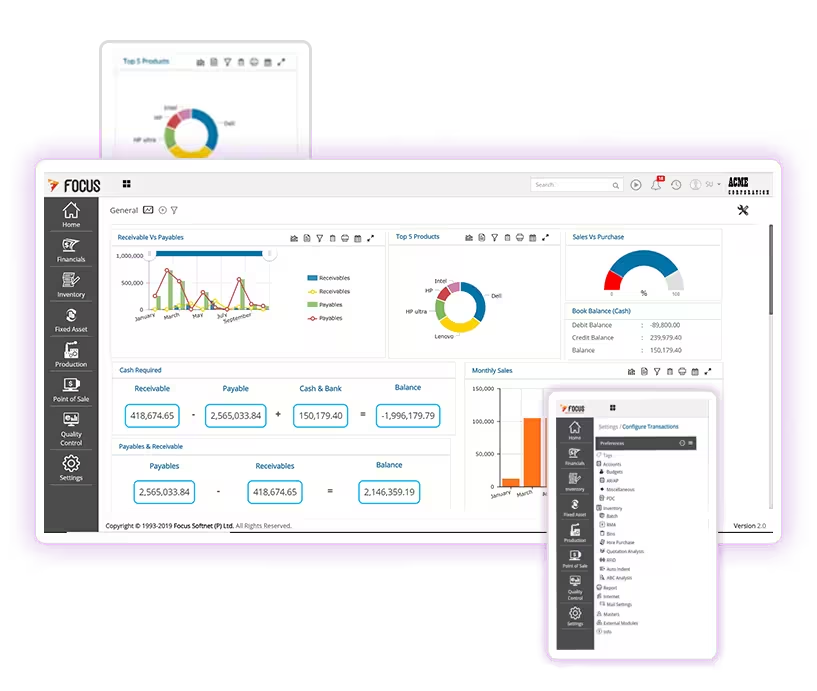
The strongest GCC-grown ERP on the register, listed as Focus8 v9 (validity shown till April 2024; the current flagship is Focus X, so confirm status). Focus has implemented ERP in the Gulf since the 1990s, with vertical editions for retail POS, restaurants, healthcare, logistics, and distribution on top of core financials, inventory, manufacturing, CRM, and UAE payroll. Its direct production experience with Saudi Arabia's ZATCA e-invoicing regime, the closest regional analogue to the UAE mandate, is a practical advantage: structured, validated tax invoice data is an existing engineering competence.
- Best for: GCC retail chains, F&B groups, healthcare, and distributors
- E-invoicing path: regional e-invoicing experience, ASP integration
- Pricing: quote-based, by users and modules
- Website: focussoftnet.com
- FTA proof
8. Zoho Books
The highest-profile pure accounting product with a currently valid entry, accredited till November 2026. Books delivers VAT-compliant invoicing, VAT201-aligned reporting, FTA audit files, bank feeds, inventory basics, and multi-currency at SaaS pricing that includes a free plan for very small businesses. Its wider suite (Zoho Inventory, CRM, People, Zoho One) lets a growing company approximate ERP scope without switching vendors. Zoho has engaged early with the UAE mandate, publishing e-invoicing readiness material and building structured-exchange connectivity, making it one of the lowest-friction compliance paths for the 1 July 2027 SME wave.
- Best for: startups, free zone companies, and SMEs on a budget
- E-invoicing path: UAE edition with FTA-aligned reporting, ASP connectivity
- Pricing: published monthly tiers, including a free plan
- Website: zoho.com/ae/books
- FTA proof
.avif)
9. Xero
Xero's register entry (version 2026, valid till March 2027) carries the longest validity of any global name on the list. It is cloud accounting at its most usable: automated bank feeds, clean reconciliation, invoicing, fixed assets, project tracking, and a thousand-plus app marketplace. Xero already operates Peppol e-invoicing at scale in Singapore, Australia, and New Zealand, so the architecture the UAE requires is familiar territory, delivered here through ASP and marketplace connectors. Its UAE-specific localisation is thinner than Tally's or Zoho's, and there is no native UAE payroll, so confirm your exact compliance pathway during planning.
- Best for: startups, service businesses, and advisor-led free zone SMEs
- E-invoicing path: Peppol-proven platform, UAE connectivity via ASP and partners
- Pricing: published monthly subscription tiers
- Website: xero.com
- FTA proof
.webp)
10. Daftra
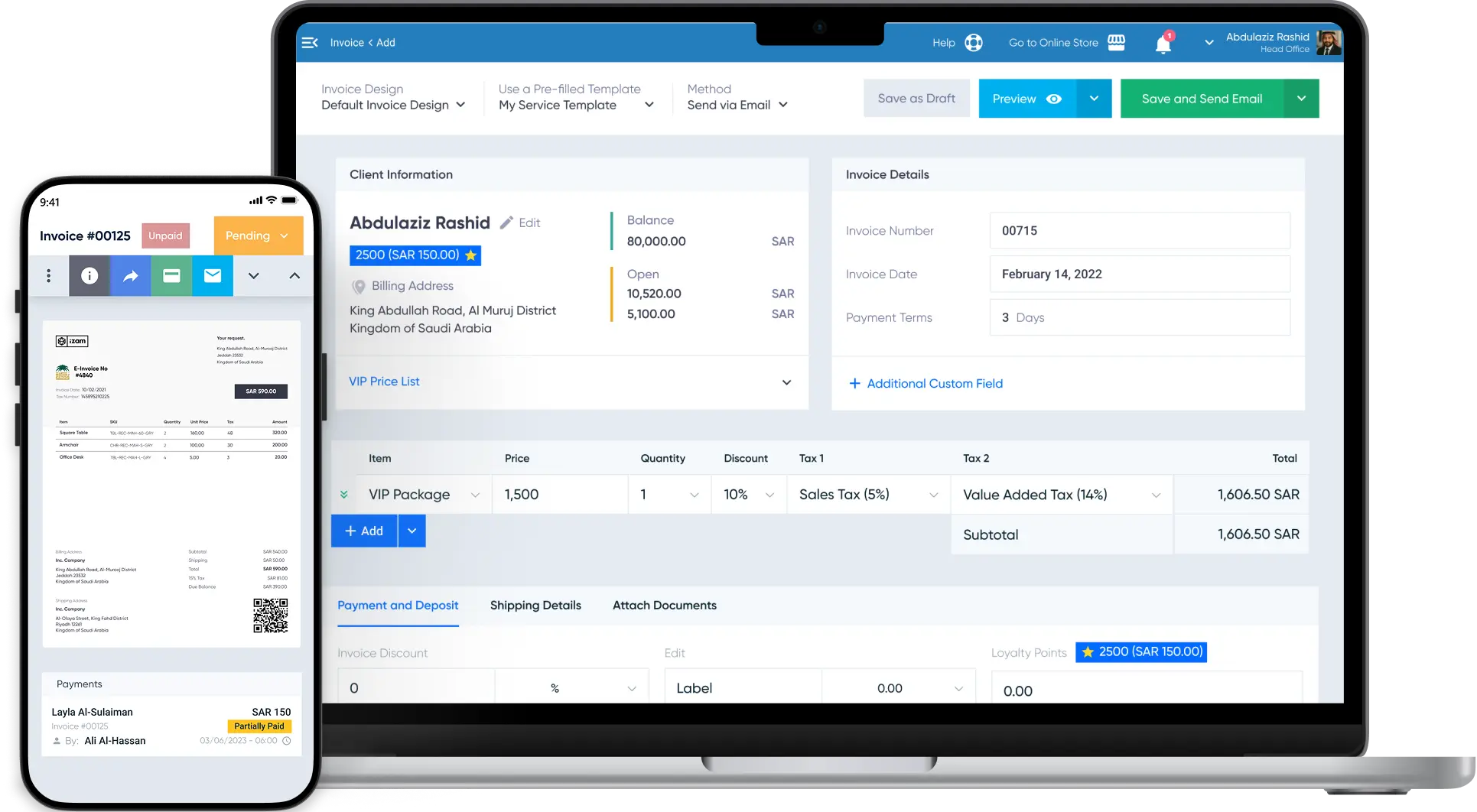
Daftra is one of the best-known Arabic cloud ERP and accounting platforms in the Middle East and is included on the UAE FTA Accredited Tax Accounting Software Vendors register. Designed primarily for SMEs, Daftra combines accounting with CRM, inventory, purchasing, HR, payroll, POS, project management, manufacturing, and e-commerce in a single cloud platform.
Its Arabic-first design and broad business management capabilities have made it especially popular among companies across the GCC. For UAE e-invoicing, Daftra provides structured accounting data required for compliance while supporting integration with Ministry of Finance Accredited Service Providers under the Peppol framework.
Businesses looking for an affordable cloud-based ERP with regional localisation and broad operational functionality will find Daftra a practical alternative to larger enterprise systems.
- Best for: SMEs, retailers, distributors, service companies, manufacturers, and Arabic-speaking businesses
- E-invoicing path: UAE-compliant invoice generation with Accredited Service Provider connectivity
- Pricing: subscription-based pricing
- Website: daftra.com
- FTA proof
How to Choose the Right ERP for UAE E-Invoicing
Start from your mandate wave. Revenue of AED 50 million or more means an ASP appointed by 30 October 2026 and go-live on 1 January 2027; that timeline no longer supports a full ERP replacement first, so stabilise compliance on your current system, then re-platform. Smaller businesses have until 1 July 2027, enough for a considered selection starting now.
Match tool to structure and industry. Multi-entity groups need real consolidation and intercompany handling. Inventory businesses should test batch tracking and landed costs natively. Manufacturers should demo BOMs and costing with their own products. UAE payroll (WPS, gratuity) should be native, not a spreadsheet.
Demand proof, not promises. Ask every vendor to show a live VAT201-aligned return, emirate-wise reporting, and an FTA Audit File export, then ask which accredited ASPs they already have working connectors for and what that integration costs.
Vet the implementation partner. For partner-delivered products (Sage, Odoo, Epicor, Focus), interview the actual delivery team and get two references in your industry, specifically on e-invoicing work.
Model five-year total cost of ownership. Licences, implementation, ASP fees, support, hosting, training, and internal time. Cloud looks cheap in year one and compounds; perpetual looks expensive in year one and amortises.
FAQ
What is UAE e-invoicing? Mandatory issuance and exchange of invoices as structured PINT AE XML through Ministry of Finance Accredited Service Providers on a Peppol five-corner network, with tax data reported to the FTA in near real time.
Is UAE e-invoicing mandatory? Yes, phased: voluntary from 1 July 2026, mandatory 1 January 2027 for businesses at AED 50 million+ revenue, 1 July 2027 below that, 1 October 2027 for government entities. B2C is currently excluded.
What is an FTA-accredited software vendor? A vendor whose software is accredited on the FTA's Tax Accounting Software Register for UAE tax compliance capabilities. It is distinct from an MoF-accredited ASP, which transmits e-invoices under the mandate.
Do I need ERP software for UAE e-invoicing? No. You need software that produces complete structured invoice data and connects to an ASP. ERPs justify their cost through operations, not the mandate.
Can accounting software support UAE e-invoicing? Yes. Zoho Books, TallyPrime, Xero, and others on the register are building or offering ASP connectivity. Data completeness is what matters.
Which software is best for SMEs? Wafeq offers one of the strongest GCC-native accounting experiences, Zoho Books delivers excellent cloud value, Xero suits advisor-led businesses, TallyPrime remains a favourite for UAE trading companies, while Odoo and Daftra are ideal for businesses that need accounting together with inventory, CRM, HR, and operations in one platform.
Which software is best for enterprises? SAP S/4HANA for large multi-entity organisations, Epicor for manufacturers, Sage X3 for process manufacturers, and Odoo for growing mid-sized businesses. SMEs looking for cloud-native accounting should consider Wafeq, Zoho Books, Xero, or TallyPrime depending on their operational needs.
How do I choose the right software? Fix your deadline, define operational requirements, demand live UAE compliance demos, verify register status, confirm ASP connectors, check references, and model five-year cost.
Does every ERP support UAE e-invoicing? No. Practical support means maintained UAE localisation, PINT AE data mapping, and working ASP connectivity. Without those, budget for custom integration.
What should businesses prepare before implementation? Clean master data first (TRNs, addresses, item-level VAT treatment), then an invoice process map, ASP selection, testing against the FTA's mandatory field list, training, and a cutover plan clear of VAT filing deadlines.
Conclusion
There is no single ERP that fits every UAE business. SAP and Epicor remain the leading choices for large enterprises, Sage X3 excels in process manufacturing, while Odoo and Focus Softnet provide strong mid-market ERP capabilities. For SMEs, Wafeq delivers a modern GCC-focused accounting platform, Daftra combines accounting with broader ERP functionality, and TallyPrime, Zoho Books, and Xero continue to offer proven cloud accounting solutions. The right choice depends on your organisation's size, industry, operational complexity, and readiness for the UAE e-invoicing rollout.
Sources: UAE FTA Accredited Tax Accounting Software Vendors register (tax.gov.ae, 41 entries, last updated 19 May 2026); Ministerial Decisions No. 243 and 244 of 2025 and No. 56 of 2026; Cabinet Decision No. 106 of 2025; vendor official websites. Validity dates as shown at the time of writing, July 2026.