.svg)


Why planning software matters more than ever in the UAE
Budgeting in the UAE is no longer a once-a-year spreadsheet exercise. Since the 9% federal corporate tax took effect for financial years starting on or after 1 June 2023,and the 15% Domestic Minimum Top-up Tax (DMTT) began applying to large multinationals from 1 January 2025, finance teams need forecasts that hold up to scrutiny and models that can test the tax impact of every decision.
On top of that ,the Federal Tax Authority's phased e-invoicing mandate ramps up through 2026and 2027 — with large businesses (revenue of AED 50 million or more) required to appoint a service provider by 31 July 2026 and go live by 1 January 2027.That pushes companies toward connected, structured financial data rather than static reports. Add 5% VAT, IFRS reporting, multi-currency operations across the GCC, Arabic-language needs, free-zone structures and Economic Substance rules, and the case for proper planning and budgeting software becomes hard to ignore.
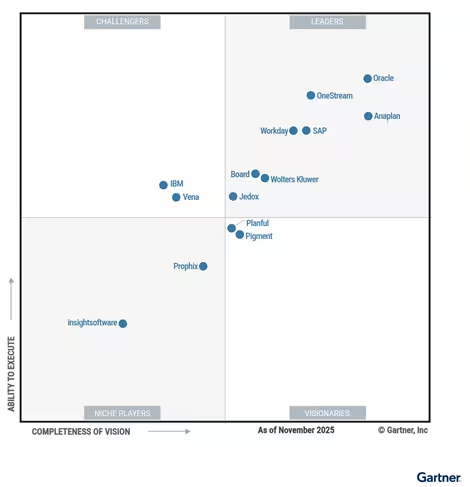
The shortlist below is grounded in the 2025 Gartner Magic Quadrant for Financial Planning Software (published 1 December 2025), localized for what actually matters to UAE finance leaders: tax and IFRS alignment, multi-entity and multi-currency consolidation, data residency, and how well each platform connects to the ERP you already run. It is an even-handed roundup — every vendor here is credible, and the right choice depends on your ERP, industry and complexity. We open with Oracle's platform because so many UAE businesses already run Oracle, then walkthrough nine more enterprise options.
The 10 best planning and budgeting platforms
1. Oracle NetSuite Planning & Budgeting (Oracle Fusion Cloud EPM)
Gartner Leader (Oracle Fusion Cloud EPM) · Visit website
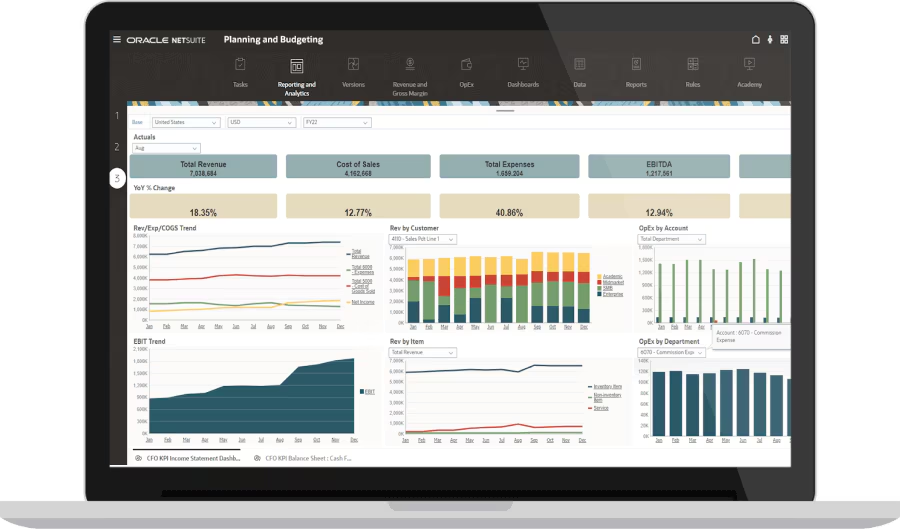
One thing worth clearing up first, because it trips up a lot of finance teams here: Oracle's EPM engine is the same platform underneath, whichever Oracle ERP you run. On NetSuite it shows up as NetSuite Planning & Budgeting (NSPB),pre-integrated with the ledger; on Oracle Fusion Cloud ERP it's Oracle Fusion Cloud EPM. Same modelling engine, same planning capabilities — so you're not choosing a different tool depending on your ERP, and you avoid a separate integration project either way.
In practice that ERP proximity is the main draw. Actuals flow straight in rather than being re-keyed, the named-user pricing folds Oracle's core AI agents into the base subscription (helpful for budgeting the tool itself), and Monte Carlo scenario planning lets you put a probability around targets when you're stress-testing tax, FX and cost assumptions. Picture a Dubai group with both free-zone and mainland entities: it can consolidate AED and multi-currency actuals, run a rolling forecast, and model corporate-tax and DMTT outcomes before the board meeting, all off the ERP data it already trusts. The usual caveat applies — an EPM platform is only as good as its implementation, so scope the rollout and local support carefully.
For UAE organisations, NetSuite Planning & Budgeting is commonly localised to support:
• Multi-company consolidation
• AED and multi-currency planning
• VAT-aware budgeting
• Project budgeting
• Real estate budgeting
• Construction cost planning
• Manufacturing forecasting
• Equipment and rental planning
• Group financial consolidation
• Oracle NetSuite ERP integration
• AI-powered forecasting
• Rolling forecasts
• Workforce planning
Best for: Multi-entity groups already on Oracle — professional services, retail and distribution, financial services, and real estate and construction.
2. Anaplan
Gartner Leader · Visit website
Anaplan is a cloud-native platform for integrated business planning, budgeting and forecasting, built on its proprietary Hyper block engine for large, multidimensional models. Its sweet spot is the organisation that wants finance, supply chain, HR and go-to-market planning living on one connected model rather than in separate silos — a regional retailer, for instance, aligning store-level demand with headcount and margin on a single platform. Scenario planning pulls in real-time data feeds for event-driven recalculation, and there's a serious multiyear investment roadmap behind it. The thing to budget for: several of the prebuilt applications are licensed separately from the base subscription, so the sticker price is rarely the whole picture.
Best for: Retail and consumer goods, supply-chain-heavy manufacturing, and large enterprises pursuing integrated business planning.
3. Board
Gartner Leader · Visitwebsite
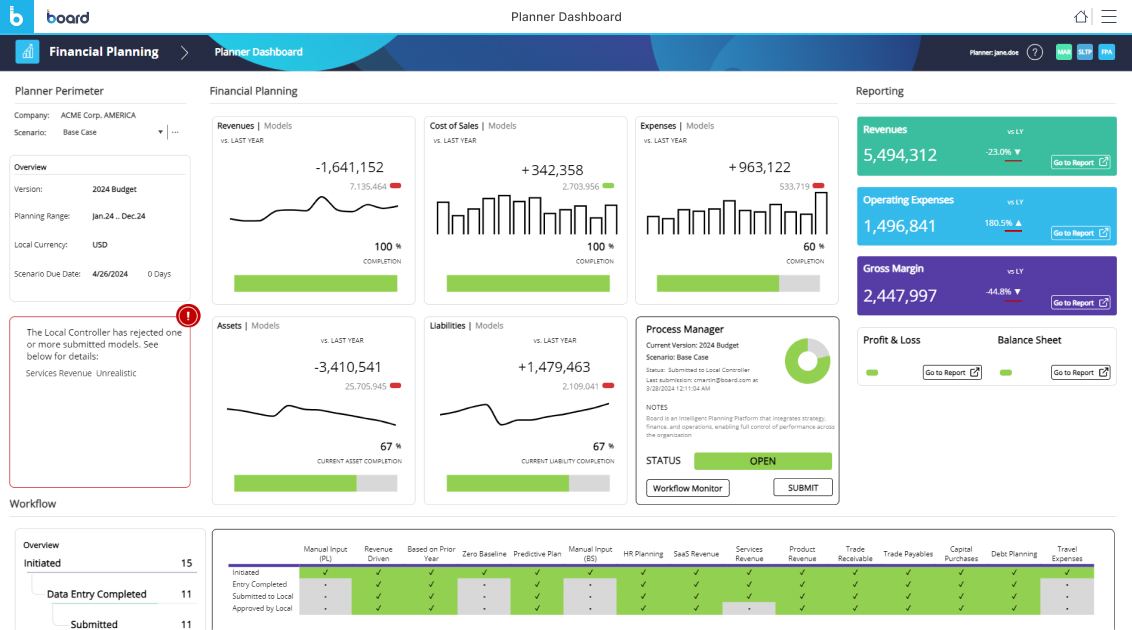
Board pulls strategic, financial and operational planning into one platform with near-real-time analysis, and its IBP solution was built with Oliver Wight. What tends to win people over is the Flex Grid — an Excel-like, self-service grid manufacturer can use to build detailed production and demand forecasts without leaving a familiar interface — plus Board Foresight, which correlates millions of external datasets against your internal time series, and AI/ML balance-sheet forecasting that flags working-capital pressure early. Worth checking before you commit: the customer base is heavily European, so delivery in this region often runs through partners, and local support arrangements are worth pinning down up front.
Best for: Manufacturing and retail, and teams that want planning and BI in the same tool rather than two.
4. Jedox
Gartner Leader · Visitwebsite
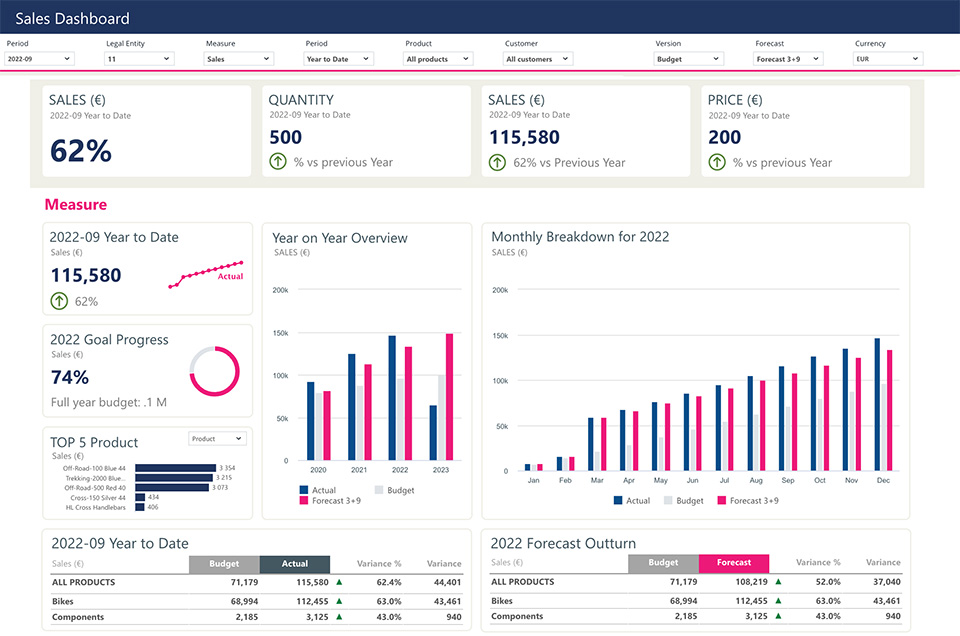
Jedox handles budgeting, forecasting and reporting on an in-memory database, with customizable prebuilt models and Jedox AI layered on top for explainable, contextual insight. Its real advantage is automation that doesn't lean on IT: a distribution business can use the AI-assisted wizards to generate demand forecasts, catch outliers in sales data and take the grind out of repetitive consolidation, while the GenAI governance keeps each client's environment isolated. Two things to price in — several capabilities (workforce and sales modules, and premium connectors like SAP, Salesforce and Snowflake) are licensed on top, and there's no built-in library of external economic drivers, so you'll source those yourself.
Best for: Retail, manufacturing and mid-to-large enterprises that want AI-assisted planning on an in-memory engine.
5. OneStream
Gartner Leader · Visit website
One Stream's calling card is Extensible Dimensionality, which lets you hold summarised and detailed planning and reporting inside a single application. For a multi-entity industrial group, that means statutory and management reporting can sit alongside demand, capital and profitability planning without stitching systems together — which is exactly why it lands well with organisations that need consolidation and planning under one roof. Dynamic Cube Services sync external data in near real time without replication, and the Sensible AI portfolio brings forecasting and AI agents into the workflow. Budget-wise, note that Sensible AI Forecast and Studio carry extra license fees, and the industry starter kits are partner-built through the Solution Exchange rather than included.
Best for: Manufacturing and complex multi-entity groups that want planning, consolidation and reporting in one place.
.avif)
6. SAP Analytics Cloud (SAC)
Gartner Leader · Visit website
If you already run SAP, SAC is hard to look past. It combines BI, planning and predictive analytics in one cloud environment and integrates through SAP Business Data Cloud to centralise curated data. The pragmatic wins are the 300-plus prebuilt planning and analytics content packages included for planning users (which take real weeks off an implementation), Monte Carlo simulation for pessimistic-realistic-optimistic modelling, and a global delivery network with localised data-centre options that suits multinational footprints. Keep an eye on two things: advanced AI features are priced on consumption, and reconciliation leans on structures your team has to define rather than getting there automatically.
Best for: Manufacturing and large enterprises — above all, existing SAP ERP customers in the region.

7. Wolters Kluwer — CCH Tagetik
Gartner Leader · Visit website
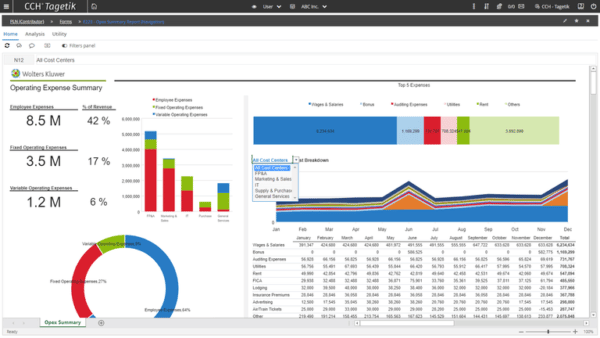
CCH Tagetik is an AI-based planning solution with near-real-time analysis, modelling and predictive forecasting, and it's genuinely broad — a regional group can run enterprise-wide planning alongside profitability, cash-flow and ESG analytics in the same place. The point that tends to matter most to GCC buyers is data residency: country-level data-centre selection on AWS and Azure means in-country storage is achievable, which simplifies the compliance conversation. Its Digital Adoption Platform also helps teams get productive faster. The cost to watch is modular — operational planning modules are priced as separate per-user add-ons, so a multi-module footprint adds up.
Best for: Manufacturing, financial services, and anyone who needs planning, consolidation, ESG and regulatory reporting to sit together.
8. Workday Adaptive Planning
Gartner Leader · Visit website
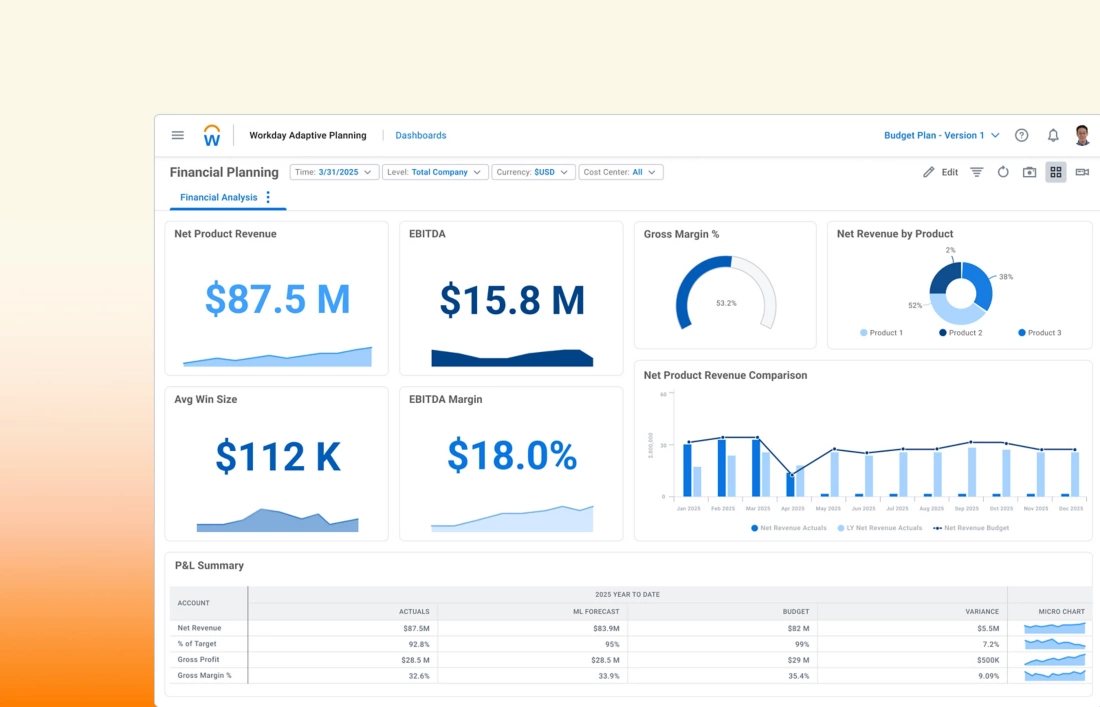
Workday Adaptive Planning applies AI to driver-based planning, and it's strongest where the business is people and projects — a regional consultancy, say, planning billable hours, utilisation rates and project margins, then sharing what-if scenarios across delivery and finance leads. A quietly useful detail is the unlimited view-only licences at no extra cost, which makes it easy to put dashboards in front of the wider team, and its partner-certification regime is strict enough to keep implementation quality consistent. Two limits to know going in: predictive forecasting is capped at a few data levers per run, and capital-planning metrics like NPV and IRR aren't native — you'll configure those.
Best for: Professional services and services-led firms built around project margin, utilisation and workforce planning.
9. IBM Planning Analytics
Gartner Challenger · Visit website
This is the platform you reach for when the models get genuinely large. IBM Planning Analytics runs a high-performance in-memory engine that chews through heavy workloads, so a large retailer can run SKU-level planning and product-profitability models at a scale that would bog down lighter tools, with agentic AI helping automate the workflow around them. A compressed data structure and multithreaded, auto-scaling processing keep performance steady, and the containerised architecture aims for near-zero planned downtime on updates. Two considerations for the region: pricing is per-user with advanced AI features charged separately, and there's no native master data management, so you'll integrate an external MDM.
Best for: Retail and large enterprises running high-volume, complex models — SKU planning, matrix reporting, product profitability.
.avif)
10. Vena
Gartner Challenger · Visit website
Vena's whole premise is meeting finance teams where they already work. It sits natively on Microsoft 365, turning Excel, PowerPoint and Teams into an FP&A platform, which means the change-management hurdle is low — a mid-sized manufacturer can keep budgeting and forecasting inside Excel and Teams and barely change its habits. Vena Copilot writes up variance narratives automatically for management reviews, and the multi cloud setup (Azure and AWS) gives you data-residency and security options. Just two caveats: the advanced AI/ML features are gated by package tier, and there's no Google Workspace integration at all, so a Google-based team should look elsewhere.
Best for: Mid-market manufacturers and finance teams that effectively live in Excel and Microsoft365.
How to choose
For UAE financeleaders, the most important takeaway is fit, not just features. The bestplanning and budgeting software is the one that connects cleanly to yourexisting ERP, handles multi-entity and multi-currency consolidation, alignswith IFRS and the UAE's tightening tax and e-invoicing rules, and can besupported locally. Every platform above is credible; the right pick depends onyour ERP, your industry and how much complexity you actually need.
A practicalfilter: shortlist two or three platforms that integrate natively with your ERP,then run a short proof-of-concept on your own entities, currencies and taxscenarios before committing. Existing SAP shops will find SAC hard to ignore;Microsoft 365-centric teams may prefer Vena; Oracle NetSuite or Fusion usersget the closest data fit from Oracle's own EPM; and organisations needingconsolidation and reporting alongside planning should look closely at OneStreamand CCH Tagetik. Whatever you choose, weight ERP integration, data residencyand local implementation support heavily — they tend to determine success morethan any single feature.
Frequently asked questions
What is thebest planning and budgeting software in the UAE?
There is nosingle winner — the best fit depends on your ERP, industry and complexity.Among the platforms rated highest in the 2025 Gartner Magic Quadrant, Oracle,OneStream, Anaplan, Workday, SAP, Board, Wolters Kluwer (CCH Tagetik) and Jedoxare all Leaders. UAE companies already running Oracle NetSuite or Oracle Fusionoften get the fastest value from Oracle's own EPM (NetSuite Planning &Budgeting), because it reuses ERP data they already trust.
Does OracleNetSuite include budgeting and forecasting?
Yes. NetSuitePlanning & Budgeting (NSPB) is Oracle's EPM planning application deliveredfor NetSuite customers. It supports multi-company consolidation, AED andmulti-currency planning, rolling forecasts, workforce planning and scenariomodelling, and integrates directly with the NetSuite ledger. It is the sameunderlying engine Oracle offers Fusion Cloud ERP customers as Oracle FusionCloud EPM.
What shouldUAE companies look for given corporate tax and e-invoicing?
Prioritisemulti-entity and multi-currency consolidation, IFRS-aligned reporting, scenariomodelling that can test 9% corporate tax and the 15% DMTT, and cleanintegration with your ERP so actuals and structured financial data flow throughautomatically. With the FTA's phased e-invoicing mandate rolling out from 2026,connected data matters more than static spreadsheets.
Is Excelenough for budgeting and forecasting?
For a singlesmall entity, sometimes. For multi-entity groups dealing with consolidation,multiple currencies, audit trails, version control and tax scenario modelling,spreadsheets become risky and slow. Dedicated planning software addsgovernance, automation and a single source of truth — several tools above(Vena, Jedox, Board) keep an Excel-like experience while removing the fragilityof standalone spreadsheets.
How much doesplanning and budgeting software cost in the UAE?
Pricing isusually subscription-based and varies widely by users, modules and add-ons, somost vendors quote on request. Watch for capabilities licensed separately fromthe base subscription (advanced AI, workforce or sales modules, premiumconnectors) and factor in implementation and local support, which ofteninfluence total cost of ownership more than the licence itself.