.svg)

.webp)
TL;DR: The 5 leading CRM and sales management platforms for UAE real estate developers are Azdan's NetSuite Property Sales Management (native NetSuite, off-plan to handover, DLD Mollak integration), Yardi (enterprise property operations across residential, commercial, and investment portfolios), Property-xRM (Microsoft Dynamics 365 based, developer-to-buyer sales cycle), Oracle CX via Shahgaron (enterprise Oracle CRM for large developers), and Odoo (modular ERP/CRM for smaller or cost-constrained developers). Choose based on whether you prioritize ERP connectivity, off-plan depth, DLD compliance, or implementation budget.
Dubai recorded property sales of AED 682.49 billion in 2025, a 30.64% increase from the previous year and the highest annual transaction value in the emirate's history. Off-plan sales account for approximately 65% of all residential transactions in the market, driven by developer payment plans, flexible installment structures, and continued demand from international investors seeking long-term capital appreciation.
Behind every off-plan sale is a CRM problem. A developer launching a new tower in Business Bay or a master-planned community in Dubai South faces a management challenge that general-purpose CRMs are not built to handle: unit inventory across multiple phases and buildings, reservation workflows with deposit collection, SPA generation and lifecycle tracking, installment billing tied to construction milestones, post-dated cheque monitoring, broker commission management, and the eventual handover process, all connected to finance.
This guide covers the five platforms most deployed by UAE real estate developers to manage that cycle. Each one approaches the problem differently.
What UAE Real Estate Developers Actually Need from a CRM
Before comparing platforms, it helps to define what "CRM" means in a UAE developer context. The requirements are considerably more specific than standard lead management.
A developer CRM must handle the full buyer journey:
- Unit inventory: Real-time availability matrix showing status (available, reserved, under SPA, sold, held) by building, floor, and unit type
- Reservation management: Deposit collection, reservation period, expiry and release workflows
- SPA lifecycle: Sales Purchase Agreement generation, signature tracking, amendment management
- Payment plans: Installment schedule creation against construction milestones, automated billing, PDC (post-dated cheque) tracking and clearance alerts
- Broker and channel management: Channel partner registration, unit allocation by broker, commission calculation, payout tracking
- DLD compliance: Oqood registration for off-plan sales, Mollak integration for community management, RERA-regulated plan management
- Handover: Unit completion checklists, snagging, key handover linked to final payment confirmation
- Finance connectivity: Every stage of the buyer journey reflected in AR, revenue recognition, and project cost reporting
A CRM that covers lead-to-reservation but drops the handover or leaves payment plans in a spreadsheet has not solved the developer's problem. It has shifted it.
The 5 Platforms at a Glance
1. Azdan NetSuite Property Sales Management
Best for: UAE real estate developers managing off-plan sales, payment plans, and community handover on Oracle NetSuite, who want every stage of the buyer lifecycle connected to finance without a separate CRM platform.
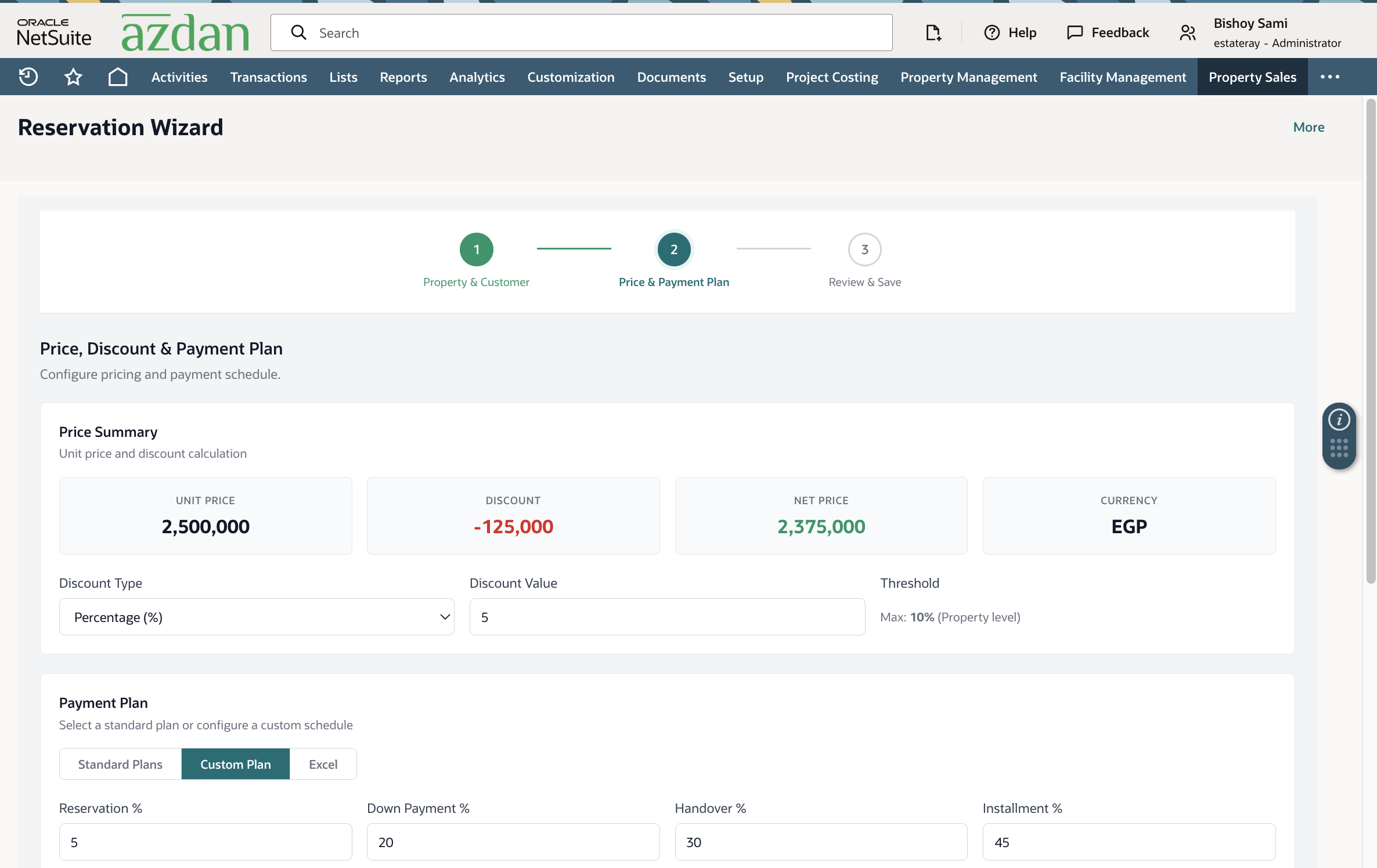
Azdan's Property Sales Management is a native Oracle NetSuite SuiteApp that manages the full developer sales cycle from unit inventory through SPA, payment plan billing, and handover, all inside NetSuite. There is no data sync between a CRM and an ERP: the unit sale, the payment plan, the PDC schedule, and the AR entry are all in the same system.
Key strengths:
- Unit inventory matrix across all developments showing real-time availability, pricing, and reservation status
- Reservation and SPA lifecycle management: deposit collection, agreement generation, amendment and cancellation workflows
- Payment plan and PDC management: installment schedules tied to construction milestones, automated billing, alert triggers for cheque deposit dates and missed payments
- Integrated CRM for lead and opportunity management: 360-degree view of the buyer journey from initial inquiry through unit sale
- Handover management: unit transfers linked to finance entries, ensuring handover reflects the cleared balance in AR
- DLD Mollak integration for community management, proven through Azdan's implementation for Deyaar across 8,000+ units, which resulted in a 70% reduction in repetitive tasks
- Multi-entity support for developers with multiple subsidiaries or project companies, with consolidated group reporting
- Regional e-invoicing compliance for UAE VAT built into the same NetSuite environment
- Community Management SuiteApp for residential, commercial, and retail communities post-handover
Azdan has implemented NetSuite for real estate across the Middle East for developers including Deyaar (UAE) and Mohammad Al-Habib Real Estate (Saudi Arabia, one of the Kingdom's largest property investment companies, established in 1972). In the Al-Habib implementation, management gained real-time KPI visibility across a diversified portfolio spanning residential, commercial, and hospitality assets, with project reports that previously took days generated in minutes.
For developers who want ERP and CRM in the same environment, with finance-connected unit tracking from first reservation to final handover, this is the most tightly integrated option available for Oracle NetSuite.
Limitation: Azdan's NetSuite-based solution requires a NetSuite implementation. Developers not currently on NetSuite or evaluating a standalone CRM without ERP scope should evaluate the other options first or explore an implementation project with Azdan's team.
See: Property Sales Management | Property Lease Management | Book a demo
2. Yardi
Best for: Large real estate companies in the UAE managing diverse portfolios across residential, commercial, retail, and investment assets, where a single enterprise platform for property operations and investor reporting is the priority.
Yardi is one of the most established property management platforms in the world, with a dedicated Middle East presence (yardi.ae) and a client base spanning major UAE property firms. Its product suite covers property management, marketing and leasing, asset performance analytics (Yardi Elevate), procurement, investment management, and workplace solutions across residential, commercial, retail, industrial, coworking, airports, and ports.
Key strengths:
- Comprehensive residential management from leasing through renewals, maintenance, and community operations
- Yardi Elevate: asset performance analytics combining operational data with predictive insights and recommended actions
- Commercial and retail suite for office, industrial, and retail portfolio management
- Investment management suite: investor reporting, capital call management, waterfall calculations, and full transparency from investor to asset level
- Marketing and leasing tools integrated with the property management platform
- Cloud deployment via Yardi SaaS with dedicated Middle East support
- Covers airports and ports, reflecting the depth of its UAE-specific market adaptation
- Strong presence among institutional and large-scale operators in the UAE
Yardi's strength is breadth: for a large property conglomerate managing residential towers, retail malls, and commercial buildings simultaneously, with investor reporting requirements and procurement workflows, it provides a single operational environment. Its Middle East positioning and local support make it a viable choice for enterprise-scale UAE operators.
Limitation: Yardi is primarily a property management and operations platform, not a developer CRM. Its strength is in lease management, maintenance, and investor reporting rather than the off-plan developer sales cycle (SPA management, installment billing tied to construction milestones, broker commission tracking). Developers whose primary challenge is managing off-plan sales and payment plans will find Yardi's feature orientation less directly aligned with that specific workflow.
3. Property-xRM
Best for: UAE real estate developers and property companies already operating in the Microsoft ecosystem who want a CRM built specifically for the developer sales cycle on Microsoft Dynamics 365.
Property-xRM is a real estate CRM and property management platform built natively on Microsoft Dynamics 365. It describes itself as a Microsoft-preferred real estate CRM and covers the full developer lifecycle: lead management, unit inventory, sales and reservation, broker management, marketing management, document management, and handover. It also extends to leasing (residential and retail), facility management, HOA management, and community management.
Key strengths:
- Lead management pipeline from first inquiry through unit reservation and SPA
- Inventory management: unit availability matrix by building, floor, and unit type
- Broker management: channel partner registration, allocation, commission tracking
- Marketing management: campaign tracking, source attribution for inbound leads
- Document management: SPA, title deeds, and supporting documentation in one record
- Handover module: structured handover process linked to unit completion status
- Resident Portal and Sales App add-ons for buyer-facing self-service
- Built on Microsoft Dynamics 365, giving access to Microsoft's broader ecosystem (Power BI, Azure, Office 365)
For developers that have standardized on Microsoft infrastructure and want a CRM purpose-built for the developer sales cycle, Property-xRM provides the most complete Dynamics-based option in the UAE market. The Microsoft Dynamics foundation also means integration with finance tools like Microsoft Business Central is achievable.
Limitation: Property-xRM sits on top of Microsoft Dynamics 365, which means the total cost of ownership includes both the Property-xRM licensing and the underlying Dynamics 365 licensing. Finance connectivity depends on how deeply the Microsoft ecosystem is implemented; developers using a separate ERP for accounting may find bidirectional sync between Property-xRM and their finance system requires integration work. The solution is less deeply finance-native than ERP-based alternatives.
4. Oracle CX via Shahgaron
Best for: Large UAE real estate developers who are already on Oracle infrastructure (Oracle Fusion ERP, Oracle E-Business Suite, or Oracle EPM) and want a unified CRM that integrates tightly with their existing Oracle environment.
Oracle CX (Customer Experience) is Oracle's enterprise cloud CRM suite, covering sales automation, marketing, customer service, and loyalty management. In the UAE real estate market, it is deployed by major developers through specialist implementation partners. Shahgaron, a UAE-based Oracle implementation partner, has implemented Oracle CX for a client list that includes BT Properties, Imtiaz, Modon, Samana, VICC, and YAS Holdings, among other UAE real estate organizations.
Key strengths:
- Oracle Sales Cloud: sales force automation, opportunity management, forecasting, and quoting for large developer sales teams
- Oracle Marketing Cloud: campaign management, lead scoring, and buyer journey automation
- Oracle Service Cloud: post-sale and community management requests
- Deep native integration with Oracle Fusion ERP, Oracle EPM, and Oracle E-Business Suite for finance-connected operations
- Enterprise-grade user management, role-based access, and security controls
- AI-driven insights via Oracle Analytics Cloud
- Supported by a partner ecosystem of specialist Oracle implementers like Shahgaron with UAE real estate deployment experience
For large developer groups that have already committed to Oracle infrastructure and want CRM operations managed within that ecosystem, Oracle CX eliminates the integration gap between sales activity and finance reporting. The existing Oracle expertise within the organization also reduces the implementation risk.
Limitation: Oracle CX is enterprise-grade software with enterprise pricing and enterprise implementation complexity. It is not suited for mid-sized or growing developers looking for a faster or more budget-accessible path to CRM. The cost and timeline of implementation is higher than purpose-built real estate CRM solutions, and the real estate-specific configuration requires deep Oracle expertise to deliver correctly.
5. Odoo
Best for: Smaller UAE real estate developers, early-stage development companies, or businesses that need a modular ERP/CRM with real estate capability at a lower total cost of ownership than enterprise platforms.
Odoo is an open-source ERP platform with a modular CRM, sales, inventory, accounting, and HR suite. Its real estate module handles property records, sales pipeline management, lease and rental tracking, and basic financial reporting. Trend SI, a UAE-based Odoo partner operating across Dubai, KSA, and Egypt, has implemented Odoo for real estate companies including Al Rasikhoon Real Estate, connecting manufacturing, inventory, sales pipeline, and purchasing into a single ERP environment.
Key strengths:
- CRM module covers leads, pipeline stages, activity tracking, and customer communication
- Sales module manages quotations and order tracking for property units
- Inventory module tracks materials and assets across project sites and warehouses
- Accounting module provides integrated financial management, invoicing, and reporting
- HR and payroll modules for developer workforce management
- Open-source licensing model with lower entry cost than proprietary enterprise CRM
- Highly customizable through Odoo Studio or partner-delivered development
- Strong module ecosystem covering most business operations in one platform
For a development company that is earlier in its digital transformation journey and needs an affordable, unified platform rather than a specialized real estate CRM, Odoo provides a practical starting point. The flexibility of the platform means it can be configured to handle basic developer sales workflows, though specialist modules for UAE real estate compliance require additional configuration by an experienced partner.
Limitation: Odoo is not purpose-built for the UAE real estate developer sales cycle. Features like Oqood registration, DLD Mollak integration, PDC tracking, payment plan billing tied to construction milestones, and RERA-regulated payment schedule management require custom development by a qualified Odoo partner rather than being available out of the box. Developers managing large off-plan portfolios will find the configuration and customization effort substantial compared to purpose-built developer CRM platforms.
How to Choose the Right CRM for Your Development
1. Is your primary challenge off-plan developer sales or property operations?
The distinction matters. Developer CRM covers the period from unit launch through reservation, SPA, payment plan, and handover. Property management CRM covers the period after handover: leasing, maintenance, tenant management, and community operations. Many developers need both, but the dominant challenge should drive the primary platform selection.
For developers managing active off-plan sales, the CRM must handle unit inventory, SPA lifecycle, payment plan billing, PDC tracking, and broker commission management. Azdan's NetSuite Property Sales Management and Property-xRM are purpose-built for this workflow. Yardi is stronger on the property operations side.
2. Do you need ERP and CRM in the same system?
Every payment plan, SPA, and reservation eventually hits your accounts receivable. If that transaction is in a CRM and your AR is in a separate ERP, reconciliation becomes a manual process at each stage of the sales cycle. Developers who want to eliminate that reconciliation should evaluate platforms where the CRM is native to the ERP: Azdan's NetSuite solution connects reservation, SPA, payment plan, and AR in the same Oracle NetSuite environment. Oracle CX via Shahgaron achieves the same with Oracle Fusion ERP. Odoo integrates CRM and accounting natively within the Odoo platform, though at a lower feature depth.
Property-xRM requires a separate accounting integration unless the developer is also using Microsoft Business Central as the ERP.
3. How important is DLD and regional compliance connectivity?
UAE developers must handle Oqood registration for off-plan sales and, for completed communities, Mollak integration for service charge management. Developers in Abu Dhabi operate under ADREC and ADLD regulations. Both require structured data flows between the CRM, the finance system, and the regulatory portal.
Azdan's implementation experience with DLD Mollak is documented through the Deyaar case study covering 8,000+ units. Oracle partners like Shahgaron have deployed Oracle Fusion for UAE-regulated developers. Yardi has UAE-specific modules. Property-xRM's DLD connectivity depends on configuration by the implementation partner. Odoo's DLD integration requires custom development.
Frequently Asked Questions
What is the difference between a real estate CRM and a property management system?
A real estate CRM manages the buyer-facing sales process: lead capture, unit availability, reservation, SPA, payment collection, and handover. A property management system manages the occupancy lifecycle after handover: lease agreements, rental collection, maintenance, and community operations. In the UAE, developers typically need both, either from a single integrated platform or from two connected systems. The right starting point depends on whether the developer's immediate challenge is managing active sales or managing operational properties.
Does DLD Oqood integration require a specialized system?
Oqood is the Dubai Land Department's registration platform for off-plan property sales in the emirate. Developers selling off-plan properties in Dubai must register each sale on Oqood within 60 days of the SPA execution. Systems that handle this natively or through a verified integration reduce the manual re-entry risk and ensure timely registration. Platforms with established UAE developer implementations, such as Azdan on NetSuite or Oracle CX deployed by UAE-experienced partners, are more likely to have structured Oqood workflows in place.
How do UAE developers typically manage post-dated cheques?
PDC management is one of the most operationally complex requirements for UAE real estate developers. Buyers commonly issue 12 to 24 post-dated cheques against installment payment plans. The developer's system must track each cheque's deposit date, alert the finance team ahead of clearance, and reflect the cleared amount in AR. Cheques that bounce must trigger a defined workflow: fee calculation, legal notice, SPA amendment, or cancellation. A CRM that captures the payment plan but does not manage the PDC lifecycle forces the finance team to maintain a parallel spreadsheet, creating reconciliation risk at each payment milestone.
Can a UAE real estate developer use NetSuite as both ERP and CRM?
Yes. Oracle NetSuite includes native CRM functionality covering lead, opportunity, quote, and order management as part of the core platform. Azdan's Property Sales Management SuiteApp extends that native CRM with UAE real estate developer-specific features: unit inventory, reservation management, SPA lifecycle, payment plan billing, PDC tracking, and handover management. Finance connectivity is native: a reservation deposit, SPA execution, or installment payment is reflected in AR without exporting data or running a sync. For developers who want ERP and CRM in a single Oracle environment, NetSuite with Azdan's property SuiteApps is the configured option.
What should a UAE developer prioritize when evaluating CRM vendors?
Off-plan developer-specific requirements should be the evaluation filter, not generic CRM features. Ask whether the system handles unit inventory matrices rather than just contacts, whether SPA lifecycle tracking is standard or requires customization, whether PDC tracking is built in or relies on a manual process, whether payment plan billing connects to AR automatically, and whether the vendor has specific experience with UAE DLD requirements (Oqood for off-plan registration, Mollak for community management). A vendor with documented UAE developer case studies carries lower implementation risk than one adapting a general-purpose CRM to real estate for the first time.
UAE Real Estate Is Moving Too Fast for Manual Processes
Dubai delivered 44,000 residential units in 2025, the highest annual volume in five years. Off-plan sales account for 65% of all residential transactions. A developer managing a multi-phase project in that environment is handling hundreds of active reservations, payment plans, and broker relationships simultaneously. The CRM holding that data needs to be connected to finance from day one.
Azdan has implemented Oracle NetSuite for real estate developers across the UAE and the wider Middle East, with property SuiteApps covering the full cycle from unit inventory through SPA, payment plans, and DLD-compliant community management.
Explore NetSuite for Real Estate | See Property Sales Management | Book a free demo