.svg)


Top 5 Oracle NetSuite Solutions for the Poultry Industry in 2026
Poultry is one of the most operationally demanding industries to run on an ERP. A single integrated producer manages breeder farms, hatcheries, feed mills, broiler grow-out, processing plants, and cold chain distribution — all financially linked, all requiring real-time visibility.
Generic ERP cannot track feed conversion ratios at the flock level, calculate cost per saleable chick, allocate joint processing costs by net realisable value, or automate contract grower settlement. You need a partner who has already solved these problems.
This article reviews the five NetSuite partners with the strongest documented poultry credentials in 2026.Every entry is based on publicly verifiable evidence only.
What Poultry Companies Actually Need From an ERP
Poultry is not manufacturing. It is not food and beverage. It sits in its own category — biologically driven, multi-stage, and financially complex in ways that standard ERP design does not account for.
Here is the full scope of what a poultry-ready NetSuite implementation must cover:
Feed Mill — The system must maintain versioned, dated feed formulas with nutrient targets per ingredient. Every production order records both formula quantity and actual quantity issued — and the gap between them posts immediately as a usage variance to the income statement. Purchase price variances between standard and actual ingredient cost post in the same period. Nothing capitalises into inventory that should be expensed. Closed production records cannot be reopened.
Breeder Operations — Male and female populations are tracked separately from placement through rearing (0 to 20 weeks) and into the laying period. Daily data per house captures mortality, feed consumed, weight, and egg production by grade — all compared to breed standard curves in real time. At point of lay,the accumulated rearing cost does not hit the income statement. It capitalise as a biological asset on the balance sheet and amortises over the flock's expected egg output. Mortality is always a period loss at accumulated cost perbird — never absorbed into the cost of surviving birds.
Hatchery — Eggs transfer from the breeder farm as approved documents at actual cost — not a standard rate. At setting, losses are recorded separately by cause: damage, rejection, waste. Candling mid-incubation is a predictive sample only — it must not create an inventory movement. At pullout, chicks are graded, culls and mortality are recorded, and break-open analysis of unhatched eggs captures failure modes by type. Cost per saleable chick is then calculated from full accumulated hatch cost, using saleable chicks as the denominator — not eggs set.
Broiler Operations — Day-old chicks are placed and daily batch data records birds, feed balance, weight, and FCR against breed standard continuously. At lifting, cage-level weighing provides the authoritative count and weight for both revenue recognition and inventory valuation — not an estimate. For contract farming, grower inputs stay in the integrator's inventory. Advances are tracked as recoverable receivables. Settlement calculates automatically from actual FCR and livability performance against agreed incentive and penalty bands, and is auditable line by line.
Layer Operations — A real-time egg balance per grade must be maintained at all times: opening stock, movements in and out, production, and closing. Commercial eggs and cracked eggs are tracked as separate, separately valued inventories. HDEP calculates daily against breed standard. Medication withdrawal periods are enforced against egg and bird sale — they cannot be overridden.
Processing Plant — Live birds arrive at the weighbridge. Transport shrinkage and DOA are recorded with supplier claim support. The kill line opens as WIP. Condemnation by reason is captured and recognised as a period loss — never absorbed into saleable output. Live-to-dressed yield is calculated against standard per shift and source flock. Multiple outputs — whole birds by weight class and skin colour, cut-up portions, offal, and by-products — each carry an individually allocated cost based on net realisable value using a maintained reference price. Weight-based allocation alone is not acceptable where output shave materially different market values. Finished lots carry full traceability back to the source flock, and FEFO is enforced on all perishable inventory.
Distribution and Van Sales — Routes are planned, vehicles loaded from stock, and drivers operate fully offline for a complete day — selling, invoicing, collecting payment, and processing returns — with automatic sync on reconnection and no duplicate postings. Customer-specific pricing applies automatically. End-of-day settlement reconciles both stock and cash before releasing the driver. Undeposited cash ages by driver and escalates above a defined threshold.
Finance and Multi-Entity — Every cost attributes to a production unit and is available as a reporting dimension on every financial transaction. Standardcosts are maintained where practical; variances are classified by type andposted to the income statement. Cost per unit is calculable at any point in theproduction cycle — not only at completion. Multiple legal entities operate withindependent charts of accounts, functional currencies, and period close.Statutory e-invoicing and indirect tax requirements are met by jurisdiction.

1.Azdan
HQ: Dubai, UAE | Status: Oracle NetSuite Solution Provider | Coverage: UAE, Saudi Arabia, Egypt
Azdan is one of the most established Oracle NetSuite Solution Providers in the Middle East, with certified consultants on the ground in the UAE, Saudi Arabia, and Egypt. Their food manufacturing and agribusiness capabilities — batch management, production costing, traceability, cold chain logistics, multi-entity consolidation — map directly to the operational and financial requirements of integrated poultry businesses.
Their regional compliance expertise across ZATCA e-invoicing (Saudi Arabia), UAE Corporate Tax, and the Egyptiane-invoicing mandate is a practical and material advantage for any GCC-based poultry producer. Having a partner who understands local regulatory requirements reduces implementation risk and post-go-live compliance exposure significantly.
Services: Fixed-fee implementation scoped to client processes, SuiteScript and SuiteFlow customisation, regional compliance configuration,SLA-backed managed services with named support contacts.
Best for: GCC-based poultry companies that need a regionally grounded, compliance-ready NetSuite partner with food manufacturing depth andon-the-ground presence across the three largest MENA markets.
.webp)
2.Xelerate Business Solutions
HQ: Cairo, Egypt | Status: Oracle Solution Partner | Coverage: Egypt, Saudi Arabia, MENA
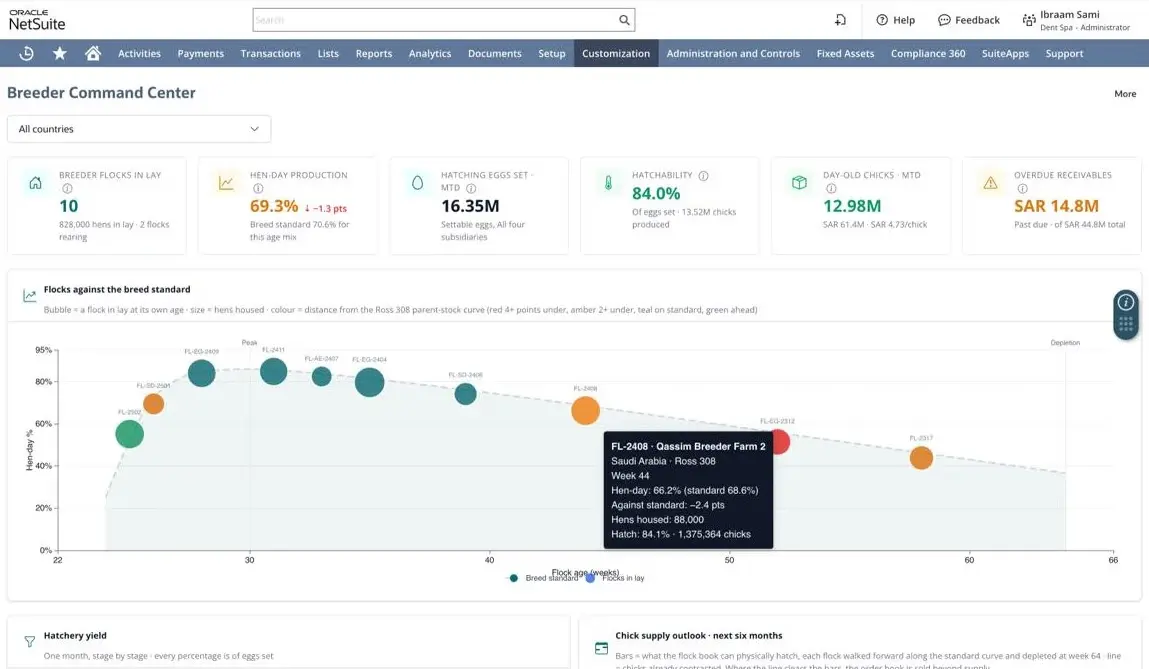
Xelerate is the most visiblypoultry-focused NetSuite partner in the MENA region. Poultry is one of fournamed verticals on their homepage, and their X-Tech Poultry Management System covers the full integrated value chain: breeder farms, hatcheries, feed mills,slaughterhouses, fleet management, and van sales. The system tracks feed consumption, flock health, and mortality in real time and delivers cost andmargin analysis down to the individual bird or kilogram. Two named poultryproducers in Saudi Arabia have gone live on the platform.
Services: Implementation, custom poultry modules, Arabisation, integration, post-go-live support and optimisation.
Best for: Integrated poultry producers in Egypt, Saudi Arabia, andthe wider MENA region who want a proven, Arabic-capable partner with a productised poultry solution already in production use.
3.Folio3 AgTech
HQ: Karachi, Pakistan / Dubai, UAE | Status: Oracle NetSuite Certified Partner | Coverage: Global (MENA, US, Australia)
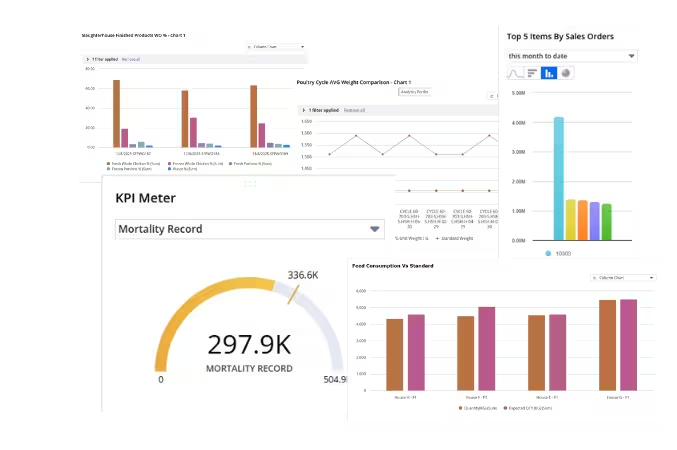
Folio3 has the deepest global portfolio of poultry-specific NetSuite work of any partner on this list. Their dedicated AgTech and FoodTech practices have built custom modules for bird management, quality management, feed tracking, fixed assets, and HR payroll —all deployed as part of a full NetSuite implementation for Arabian Farms, one of the UAE's largest poultry producers, across three subsidiaries.
Services: NetSuite implementation (SuiteSuccess), custom module development, SuiteCommerce, third-party integration, managed services and post-go-live support.
Best for: Large integrated poultry producers globally — particularly in the UAE and MENA — who need a partner with proven, deep customisation capability and a published poultry case study.

4.Citrin Cooperman
HQ: New York, USA | Status: Oracle NetSuite Partner | Coverage: United States
Citrin Cooperman has three documented hatchery and poultry implementations in the US. Their published casestudy for a commercial hatchery involved 800+ hours of custom scripting tobuild the right financial foundation for poultry lifecycle accounting. A second project delivered an integrated NetSuite and ecommerce solution for Hoover's Hatchery and Moyer's Chicks. Their NetSuite Now! methodology delivers a phased go-live in under 90 days, prioritising the most critical functionality first.
Services: NetSuite Now! rapid implementation, custom scripting, ecommerce integration, ongoing managed services and support.
Best for: North American hatcheries and poultry processors replacing QuickBooks or legacy systems with a finance-first NetSuite implementation.

5.RTT Srl
HQ: Italy | Status: Oracle NetSuite Partner | Coverage: Italy and Europe
RTT Srl is an Italian Oracle partnerfocused on Fashion and Food and Beverage. Their poultry-adjacent credential isa published NetSuite implementation for Yoeggs (Sunrise s.r.l.), an Italian egg-white food brand producing protein drinks, desserts, and gelatos. The project replaced fragmented accounting and Excel processes with a unified NetSuite platform covering financial management, warehouse digitalisation, and integrated order-to-production workflows.
Services: NetSuite implementation, Oracle JD Edwards, Oracle Cloud Infrastructure, application management services.
Best for: European food manufacturers in the egg-product or protein-food space evaluating NetSuite as their first cloud ERP.
How to Choose the Right Partner
Ask for poultry-specific proof. Request a named poultry reference, not a generic food andbeverage case study. Ask how they handle biological asset accounting, cost per saleable chick, and NRV joint cost allocation. If they hesitate, they have notdone it before.
Match the partner to your geography. A Cairo or Dubai-based partner is the right fit for a GCCor Egypt producer. A New York firm is the right fit for a US hatchery. Regional presence reduces implementation risk and ongoing support friction.
Understand what is built versus what will be built. A productised poultry solutionreduces cost and risk. A partner building from scratch on standard NetSuitemodules increases both.
Confirm financial controls, not just features. The right partner should understand that rearing costs capitalise, mortality is a period loss, condemnation never absorbs into saleable output, and NRV drives joint cost allocation — without you having to explain it.
Frequently Asked Questions
Can NetSuite handle the full poultry value chain?
- Not out of the box. Core financials, inventory, and procurement are native. Poultry-specific workflows — biological asset accounting, hatchery cost per chick, contract grower settlement, NRV joint cost allocation — require partner-built modules or significant custom development.
What is biological asset accounting?
- Breeder and layer flocks are biological assets underi nternational accounting standards. Rearing costs accumulate as WIP, capitalise to the balance sheet at point of lay, and amortise over expected egg output. This must be specifically configured — it does not work like standard manufacturing WIP.
How long does a poultry NetSuite implementation take?
- A single-site operation using a productised solution: 4 to 6 months. A full integrated producer with multiple entities and countries: 8 to 14 months.
What does it cost?
- A single-entity hatchery or grow-out operation: $25,000 to$60,000. A full integrated producer with custom modules and data migration:$100,000 to $300,000+.
Is NetSuite available in Arabic?
- Yes. Partners like Azdan and Xelerate offer full Arabisation including translated workflows, reports, and right-to-left interfaces.
Conclusion
The five partners in this articlere present the clearest documented credentials in NetSuite for poultry in 2026. Azdan leads with the broadest regional footprint across UAE, KSA, and Egypt and deep food manufacturing capability. Xelerate is the strongest dedicated poultry specialist in MENA. Folio3 brings the deepest global portfolio. Citrin Cooperman is the right choice for North American hatcheries. RTT Srl serves European egg-product manufacturers.
Before signing with any partner, ask for a live demonstration of their poultry-specific functionality, a reference call with a named poultry customer, and a clear explanation of how they handle biological asset accounting and NRV joint cost allocation.