.svg)

.jpg)
Top NetSuite Solutions for Agriculture and Crop Management (2026)
Running a farm or agribusiness is very different from running a factory. You deal with growing seasons, living assets, unpredictable weather, and harvests that produce multiple grades from a single field.
Most ERP systems were not built for that. NetSuite can handle it, but only when it is set up by a partner who truly understands agriculture.
This guide covers the top NetSuite solutions for agriculture and crop management, what makes agricultural costing unique, and what to look for before you choose a partner.
Why Agricultural Costing Differs From Manufacturing
Most ERP systems were designed for factories, where you put in raw materials, run a process, and get a finished product. Agriculture does not work that way.
Here are four things that make agricultural costing different:
Cost builds up over time, not all at once. A crop uses inputs across an entire season. That cost must be tracked continuously, not just at one point in the process.
Biological loss is expected and must be recorded. Crops die. Weather damages fields. Disease hits flocks. These losses need to be measured and costed, not hidden inside the cost of what survived.
One input produces many outputs of different value. A single harvest produces several quality grades. Splitting cost equally by weight across those grades gives you the wrong numbers. Cost must follow the value of each grade.
Living assets belong on the balance sheet. Orchards and vineyards are long-term assets. They need to be capitalised, depreciated over their productive life, and written off properly when they are removed.
Any NetSuite partner working in agriculture must understand all four of these before they start any configuration.
How Agriculture Operations Actually Work
Crop Production
Every season starts with a plan. A crop cycle is opened for a specific field, crop, variety, and season. From there:
- All field work, such as land prep, planting, irrigation, fertilisation, spraying, and labour, attaches to that cycle as a cost in progress.
- The system must block harvest until the required waiting period after chemical application has passed.
- Harvest is logged by quantity, area, and labour. More than one harvest event per field per season is normal.
- Any loss from weather, pest, or disease is recorded by cause and area, and recognised when it happens.
- At the end of the cycle, the system calculates yield, cost, and margin per hectare and compares them to the original plan.
None of these costs are expensed immediately. They all accumulate until harvest, then transfer to inventory, split across output grades.
Permanent Crops and Orchards
Orchards and vineyards follow a different financial path:
- During the early years before the crop bears fruit, all costs are added to the asset on the balance sheet.
- When the orchard reaches maturity, that accumulated cost becomes a fixed asset and depreciation begins.
- From that point, annual growing costs are expensed to the crop cycle, and depreciation is absorbed into harvest cost.
- If plants are lost or removed, the asset value is reduced accordingly.
Harvest Grading, Packing, and Trading
Once the harvest arrives:
- Each lot is inspected and split into quality grades.
- Cost is allocated to each grade based on its expected selling price, not just its weight.
- Waste and rejected produce are valued at what they can actually be sold for, which may be nothing.
- Perishable stock moves on a first-expired-first-out basis.
- For goods that are bought and resold, all costs including freight, duty, and handling attach to that inventory lot. Trading margin is always reported separately from own production margin.

What to Look for in a NetSuite Agriculture Partner
Before you sign with any partner, make sure they can clearly answer these questions:
- Can they build crop cycle costing? All field costs must accumulate as work in progress and only transfer to inventory at harvest. Ask them to show you, not just describe it.
- Can they handle multi-grade output allocation? Cost must follow the value of each grade, not be split equally by weight.
- Do they understand bearer plant accounting? Establishment costs must capitalise, trigger at maturity, and be depreciated correctly.
- Can they trace a packed unit back to the field and every input applied? This is essential for food safety and recalls.
- Can they record and value biological loss in the right period? This must post to the correct accounting period, not be absorbed elsewhere.
- Can they enforce pre-harvest intervals? The system must block harvest transactions until the required waiting period after spraying has passed.
If a partner cannot walk through all six of these clearly, they have not done this before.
Top NetSuite Solutions for Agriculture and Crop Management
1. Azdan
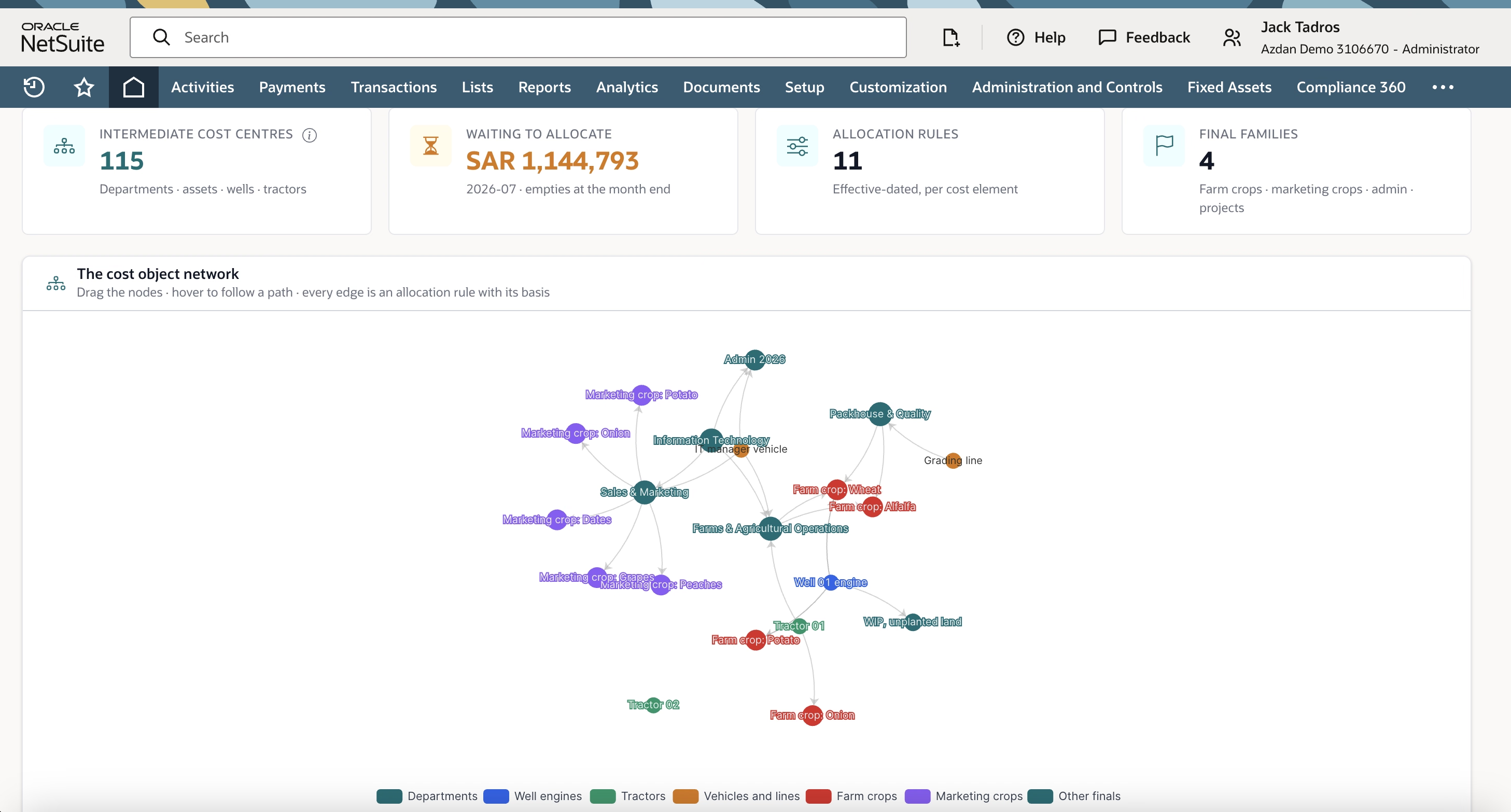
Overview: Azdan is a NetSuite partner with deep experience in agriculture and agribusiness across the Middle East and Africa. Their work covers crop production, permanent crops, harvest grading, and agri-trading businesses.
Key Strengths
- Crop cycle costing built on NetSuite, with all field costs tracked as work in progress until harvest
- Cost allocation across output grades using net realisable value, not weight
- Full bearer plant lifecycle: capitalise, transition to fixed asset, depreciate, and write down on plant loss
- Pre-harvest interval enforcement linked to crop protection records
- End-to-end traceability from packed unit back to field and all applied inputs
- Loss event recording by cause and area, posted to the correct period
- Separate margin reporting for own production versus traded goods
- First-expired-first-out enforcement for perishable stock
Best For: Mid-market to enterprise agribusinesses in fresh produce, permanent crops, integrated trading, and food processing who need clean financials and field-level margin visibility.
Considerations: Primarily serves businesses in the MENA region.

2. Xelerate
Overview: Xelerate is a certified Oracle NetSuite Alliance Partner based in MENA with 15 years of ERP experience. They have a strong focus on poultry and agribusiness, with a dedicated NetSuite Poultry Management System covering the full value chain.
Key Strengths
- Their poultry system connects farms, feed mills, hatcheries, slaughterhouses, fleets, and van sales in one platform
- Tracks feed consumption, flock health, and mortality, with cost and margin analysis down to the bird or kilogram
- Over 50 customers served across 15 years of implementation and support
- Arabisation and mobile field extensions available
- Strong post-go-live support with dedicated team continuity
Best For: Poultry producers, livestock businesses, and agri-food companies in MENA looking for a partner with deep sector knowledge and a proven regional track record.
Considerations: Their agriculture expertise is strongest in poultry and livestock. Crop production businesses should confirm the depth of their crop cycle costing capability.
%20(1).png)
3. Folio3 AgTech
OverviewFolio3 AgTech is a specialist agriculture technology partner with over 20 years in the AgTech industry and 600 projects completed worldwide. They are a NetSuite Alliance, Success, and Commerce Partner with a dedicated farm management solution built on NetSuite.
Key Strengths
- Farm management solution covering the full seed-to-sale cycle: planning, planting, growing, harvesting, packaging, and compliance
- Crop planning and scheduling with work orders assigned to field crews
- Ag-specific modules for crop lifecycle, livestock health, and field data capture built as native extensions
- ISO 9001, ISO 27001, and ISO 27701 certified
- Offices across the US, Australia, UAE, Mexico, and more
Best For: Growers, processors, and distributors in North America, Australia, and international markets who want a technology-forward partner with broad crop and livestock coverage.
Considerations: A large global organisation, so confirm the specific team and their agricultural costing depth for your region before committing.

4. JS Boss (AG Boss)
Overview: JS Boss is a certified NetSuite Solutions Provider in the US with a dedicated agriculture focus. Their product, AG Boss, is a farm management system built entirely on NetSuite, covering the full journey from seed to harvest to accounting.
Key Strengths
- Seed-to-harvest execution: track operations, inputs, and yields in one place
- Block-level profitability so growers can see true margins per block
- Audit-ready financial accuracy built into daily operations
- Licensing sized for the seasonality and cycles of agriculture, avoiding unnecessary modules
- Same small team from first conversation to go-live and beyond
Best For: US growers, ag retailers, and cooperatives who want a farm-native product on NetSuite with a hands-on, consistent implementation team.
Considerations: Coverage is focused on North America. Businesses outside the US should confirm support availability.

5. Doozy Solutions
Overview: Doozy Solutions is a US-based NetSuite partner that built "NetSuite for Agriculture", a farm management product developed on the NetSuite platform. It gives farmers one system for the entire operation.
Key Strengths
- End-to-end farm management: compliance, accounting, crop management, and supply chain in one solution
- Purpose-built by an agriculture-focused team to replace outdated and manual farm processes
- Positioned as an affordable option, costing less than a full-time employee
- Full visibility into every part of the operation from a single platform
Best For: Small to mid-sized farms and agribusinesses looking for an affordable, ready-made agriculture product on NetSuite rather than a custom build.
Considerations: Best suited to standard farm operations. Complex requirements like bearer plant accounting or multi-grade NRV allocation should be validated first.

How to Choose the Right Partner
The right partner is not just about size or geography. Ask these questions before you decide:
Have they built crop cycle WIP costing on NetSuite before? Ask for a walkthrough. If they cannot show you how field operations accumulate against a cycle and transfer to inventory at harvest, they are learning on your project.
Can they show NRV-based multi-grade allocation in a live system? This is the hardest part of agricultural costing. A proposal is not proof.
Do they understand bearer plant accounting? Treating orchard establishment as an operating expense will create audit problems.
What does their post-go-live support look like? Agriculture runs on seasons. A system failure at harvest or planting cannot wait. Ask about seasonal support capacity specifically.
Can they give you a reference client in agriculture? A peer reference from a similar business is the most reliable test of genuine expertise.
Conclusion
NetSuite works well for agribusiness when the implementation is done right. A crop cycle is not a production order. A bearer plant is not a standard fixed asset. Biological loss is not a rounding error.
The five solutions on this list cover different needs and regions:
- For field-level cost control and agricultural financial compliance in MENA, Azdan has the deepest crop-specific configuration.
- For poultry and livestock operations in MENA, Xelerate brings proven sector expertise.
- For global crop and livestock coverage with strong technology depth, Folio3 AgTech is a solid choice.
- For US growers wanting a farm-native product with a hands-on team, JS Boss and AG Boss fit well.
- For smaller farms wanting an affordable ready-made product, Doozy Solutions is worth a look.
Choose the partner who understands your crop, not just your chart of accounts.
FAQ
What is NetSuite used for in agriculture?
NetSuite helps agribusinesses manage crop cycle costing, inventory, traceability, harvest grading, bearer plant accounting, and financial reporting. It brings field operations and finance into one system.
Can NetSuite handle crop cycle costing? Yes, with the right setup. NetSuite needs to be configured to accumulate field costs as work in progress, enforce pre-harvest intervals, and transfer cost to inventory at harvest across output grades. This requires a partner with real agricultural costing experience.
What is NRV-based cost allocation? NRV stands for net realisable value. It means splitting joint production costs across harvest grades in proportion to what each grade can actually be sold for. This gives a more accurate cost per unit than splitting by weight alone.
What is bearer plant accounting? Bearer plants are productive crops like orchards and vineyards. Their setup costs are capitalised on the balance sheet, transitioned to a fixed asset at maturity, depreciated over their productive life, and written down when plants are lost or removed.
How does traceability work in NetSuite for agriculture? Traceability links each packed or traded unit back to the harvest lot, crop cycle, field, and all inputs applied during the growing season. This supports product recalls, buyer compliance, and food safety audits.
What is IAS 41 and does it affect my ERP? IAS 41 is the international accounting standard for biological assets. It governs how bearer plants, livestock, and harvested produce appear on the balance sheet. Your ERP must support this standard for your financial statements to be audit-ready.
How long does a NetSuite agriculture implementation take? A single-entity crop business might go live in four to six months. A multi-entity business with permanent crops, grading, and trading typically takes nine to twelve months.
What is the difference between a crop cycle and a production order? A production order in standard NetSuite is designed for manufacturing: fixed inputs, fixed output, defined time. A crop cycle is open-ended. It accumulates cost over a season, absorbs loss events, supports multiple harvests, and closes only when the season ends. These need different configuration logic entirely.