.svg)


End-to-End Business Process for Advertising: The Agency Value Chain
Most of the money that moves through an advertising business is not the advertising business's money. Media buys, production, print, talent, and third-party fees pass through the agency on their way to someone else. That single fact breaks the standard value chain model, because the classic version assumes the business owns what flows through it. This guide maps the advertising value chain as it actually runs, end to end, and shows where agency value is created rather than merely handled.
The Short Answer
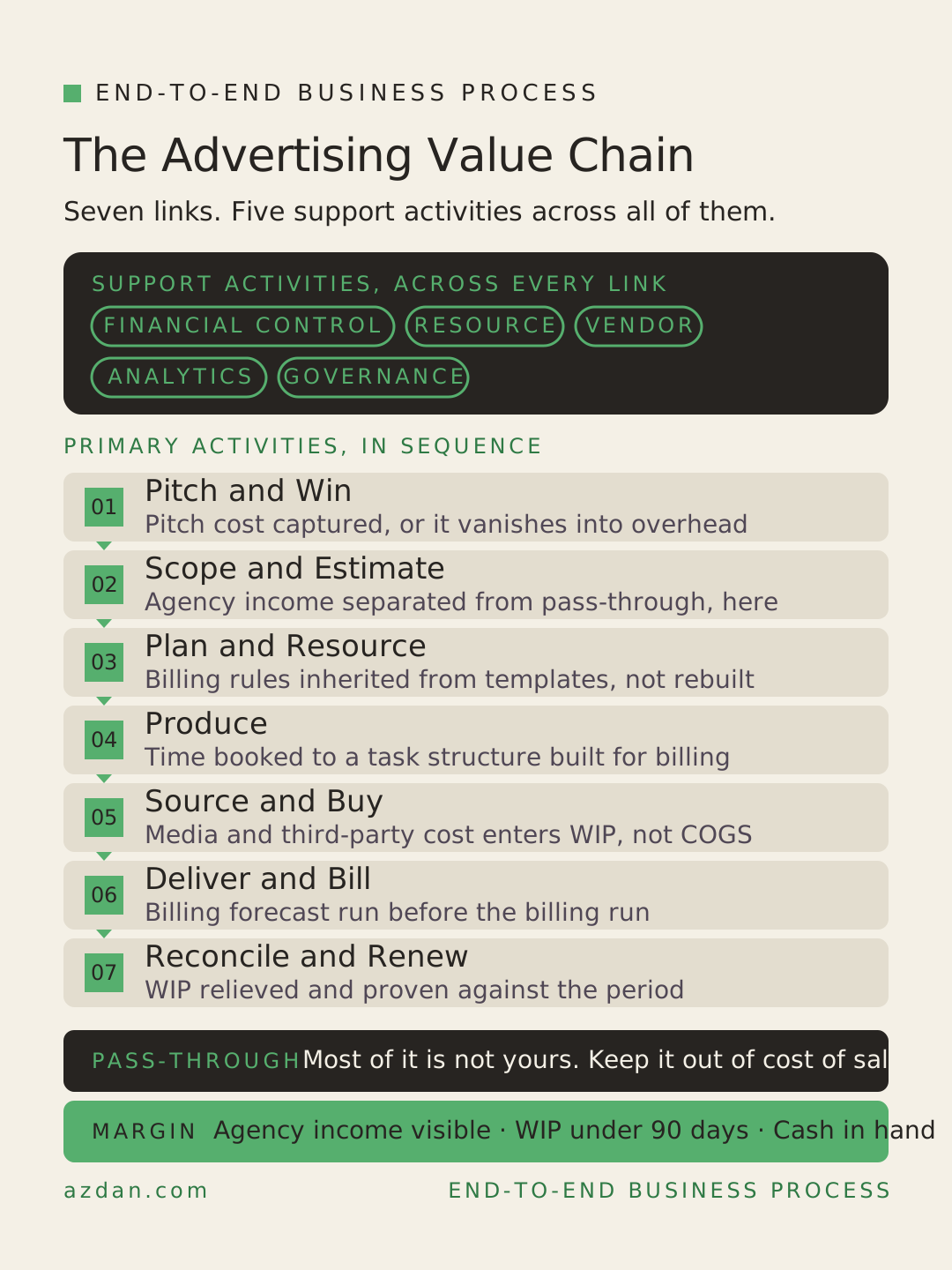
The advertising value chain runs in seven links:
Pitch and Win → Scope and Estimate → Plan and Resource → Produce → Source and Buy → Deliver and Bill → Reconcile and Renew
What makes it distinct from a manufacturing or distribution chain is that gross billings and value created are almost unrelated. An agency can double its billings by winning one large media client and add almost nothing to margin, because the additional money is pass-through. So the useful question is not the classic one of where cost exceeds value added. It is which links are ours, and which are just money moving through us.
The accounting mechanism that makes that distinction visible is work in progress. Pass-through cost is parked in a WIP holding account rather than hitting cost of sales when incurred, and released only when the client is invoiced. Get that wrong and the agency cannot tell profitable months from busy ones.
Methodology note. This maps the end-to-end process using the value chain model, applied to the agency and media process design Azdan works with across its NetSuite delivery in the UAE, Saudi Arabia, and Egypt. Where a point reflects delivery experience rather than measured data, it is labeled as a recommendation.
Why the Standard Value Chain Does Not Fit an Agency
The value chain model comes from Michael Porter's 1985 book Competitive Advantage, and its argument still holds: competitive advantage cannot be understood by looking at a firm as a whole, because it comes from the discrete activities a firm performs. Porter's insight was to analyze value rather than cost, since firms often deliberately raise cost to command a premium.
The model's standard shape, though, is built around a physical product. Its five primary activities are inbound logistics, operations, outbound logistics, marketing and sales, and service, supported by infrastructure, technology development, human resources, and procurement.
Read that list against an agency and three problems appear immediately.
The last two matter most. Business development is not a support function in an agency, it is the opening link and frequently an unbilled one. And buying media is not back-office procurement, it is the single largest movement of money in the business. A chain that files both in the wrong place will point improvement effort at the wrong links.
The Advertising Value Chain
Primary activities, in sequence:
Support activities, running across every link:
- Financial control and WIP management
- Resource and talent management
- Vendor and media partner management
- Data, analytics, and campaign reporting
- Client governance and compliance
The margin: agency income visible separately from pass-through, WIP aged inside 90 days, and enough cash on hand to fund the next media buy.
Financial control earns its place at the top of the support list because in this vertical it is not a reporting function sitting behind the work. It is load-bearing. An agency that loses track of which costs are its own is not producing slightly worse reports, it is unable to price the next pitch.
The Seven Links
1. Pitch and Win
Leads become opportunities, opportunities become pitches. Leading practice is one opportunity per prospect, with each opportunity able to spawn multiple quotes so that pricing variations do not fragment the pipeline.
The link that most agencies fail to measure: pitch cost. Creative time spent on unsuccessful pitches is real cost against real capacity, and if it is not captured against a non-billable internal project it disappears into overhead. Recommendation: give business development its own project structure so pitch investment and win rate are visible per client and per sector. An agency that cannot state its cost per win is negotiating blind.
2. Scope and Estimate
Agencies routinely run several estimates in parallel while negotiating, moving through numerous versions and pricing iterations. Leading practice is to keep that negotiation outside the system and enter only the final estimate, because a system holding six live versions of the same job produces a pipeline number nobody trusts.
The estimate carries the line items for everything being provided, associated to the correct client record where parent and child relationships exist. Once approved it converts to a sales order, which carries the billing and revenue detail forward. Where a project already exists, forecast charges from task assignments and billing rules can be pulled back into the estimate so the quote reflects the plan rather than a guess.
The link that decides the rest of the chain: whether each line is agency income or pass-through. That classification, set here, determines the accounting treatment at every subsequent link.
3. Plan and Resource
The approved order generates a project, and the project is where billing parameters live. Leading practice is to bill from the project rather than the order, and to ensure every sales order carries a project for tracking and reporting.
Project templates carry the standard billing rules for each type of work, so a project that always passes through expenses inherits an expense billing rule rather than having one built by hand. Recommendation: invest in templates early. The alternative is that every project manager reinvents billing rules, and the resulting inconsistency surfaces months later as unexplainable margin variance between similar jobs.
Resourcing sits here too: who is available, at what rate, with what skills, and what the staffing gap looks like across the pipeline.
4. Produce
The creative and production link, and the one clients think they are buying. Time is captured against project tasks, which drives both cost and, where the engagement is time-based, billing.
Keep the task structure to what billing and reporting genuinely require. A task list copied from a delivery plan gives a designer thirty options at the moment of entering time, and time booked to the wrong task is worse than time not booked at all, because it looks correct.
5. Source and Buy
Media buying, print, production houses, talent, and freelance capacity. This is the link that distinguishes the vertical.
Purchase orders raise commitments, vendor bills record them, and matching rules check bill against order before payment. Two-way matching compares rate and quantity between purchase order and bill; three-way adds the receipt. Recommendation: set tolerance checking by amount percentage rather than quantity, because discrete quantities vary, exchange rates move on cross-border media, and unit price changes do not always affect what was delivered. Percentage tolerance covers more of the real cases.
And this is where WIP begins, covered in its own section below.
6. Deliver and Bill
Campaign delivery, insertion orders, and the billing run.
Charge-based billing is the mechanism that suits agency work, because it handles labor, expense, and fixed fee in one model. Expense-based rules allow any employee expense or purchase against the project to be rebilled, with items filtered where they do not apply and a percentage markup applied where the commercial terms allow it.
Recommendation: run the billing forecast before the billing run, not after. It shows expected income by client and project for the period, and discrepancies found there are corrected at source, in time entries and vendor bills, rather than as credit notes later.
7. Reconcile and Renew
The link most often treated as an afterthought, and the one that decides whether the agency knows what it earned.
Reconciliation means proving that the pass-through costs inside the billing period match the cost being relieved against the project for that period. Renewal means campaign reporting the client can act on, and the account conversation that follows from it. Recommendation: treat the reconciliation as a closing task with a named owner, because a WIP balance that drifts is not a reporting problem, it is unbilled work nobody has noticed.
Where the Margin Actually Is
Here is the part that makes advertising different from every other project-based business.
An agency's revenue line contains two economically unrelated things. There is agency income, which is fee, retainer, studio time, markup, and commission. And there is pass-through, which is media and third-party cost recovered from the client at or near cost. Both appear as revenue. Only one of them is the business.
The consequence is that gross billings is close to meaningless as a performance measure, and any KPI built on it will mislead. Two agencies with identical billings can have completely different economics depending on their media-to-fee ratio. Worse, the same agency can look like it is growing strongly while its actual income is flat, because it won a client with a large media budget and a thin fee.
The practical implication for process design: every link in the chain has to preserve the distinction between agency income and pass-through. It is set at the estimate, carried on the item, enforced through the billing rule, and proven at reconciliation. Lose it at any point and it cannot be recovered downstream, because by then both are just revenue.
The WIP Mechanic
The mechanism that keeps the distinction visible is a work in progress holding account, and it works against the intuition of anyone arriving from ordinary project accounting.
The industry practice is that expenses incurred for projects, whether through expense reports or vendor bills, are held immediately in a WIP account rather than a cost of sale account. The WIP account holds them as liabilities against the project until they are invoiced, at which point invoicing the client relieves them and moves them to cost of sales.
Why this matters: without it, a media buy placed in March and billed in May puts cost in March and revenue in May. March looks unprofitable, May looks excellent, and neither is true. With it, cost and revenue land together and the margin on each job is readable.
Three configuration points that decide whether it works:
- The accounting impact is determined by the item. Which items post to WIP, and which expense account relieves it, is set on the item record. Recommendation: treat the item setup as the design deliverable it is, and record the WIP account and relief account on each item deliberately rather than by copying an existing record.
- Markups need an analogous expense category. Where a pass-through cost carries a markup, the expense or purchase item applied to the project must have an associated expense category, and that same category is used both to create the invoice and to relieve the WIP balance. Miss it and the relief does not happen cleanly.
- Not everything is automated. Standard fee and progress billing relief of non-labor costs is handled, but advance-billed balances and pre-bill or retainer situations, where invoices are relieved against client prepaid balances, need their own treatment. Agencies that run substantial retainers should assume manual handling here and design a control for it.
The Cash Problem Underneath
WIP is also a cash instrument in this vertical, which is why the leading practice target is to keep WIP aging inside 90 days.
The structural squeeze: agencies pay media vendors on vendor terms and get paid on client terms, and the gap is funded by the agency. A growing agency with healthy margins can run out of cash purely from timing. This is why project-level cash checking exists, verifying available funds against a project before vendor bills are released for payment, and why WIP aging is a survival metric rather than a housekeeping one.
Recommendation: review WIP aging by project weekly, not monthly. A month is long enough for a single large media buy to move the whole company's cash position.
Reading Your Own Chain: Four Questions
Value chain analysis is only useful if it changes a decision. Four questions that make it concrete for an agency:
- What proportion of our revenue is pass-through? If nobody can answer immediately, the chain is not preserving the distinction and every margin number is suspect.
- What does a win cost us? Pitch cost against win rate, by sector. This prices the first link, which is usually the only unbilled one.
- How old is our WIP, by project? Anything past 90 days is either unbilled work or a reconciliation failure, and the two need very different responses.
- Which link would we defend if a competitor copied us? Usually creative or strategic planning. Rarely media buying, which is largely a scale and terms game. That answer should shape where investment goes.
What Breaks: Recurring Failures
These are patterns that recur in agency and media businesses. They are drawn from delivery experience and offered as recommendations rather than measured findings.
- Pass-through cost hitting cost of sales directly. The defining failure. Margin swings by period for reasons nobody can explain, and job-level profitability is unavailable.
- Items configured without WIP account detail. The accounting impact runs through the item, so an item copied from another without checking its accounts quietly posts to the wrong place.
- Markup without a matching expense category. The invoice is created but WIP does not relieve cleanly, and the balance drifts.
- Every estimate version entered into the system. Six live versions of one job produce a pipeline number the business stops trusting, and then stops using.
- Pitch cost invisible. Business development is the first link in the chain and the only reliably unbilled one, yet it is usually the least measured.
- Retainers assumed to be automated. Prepaid balance relief is not covered by the standard WIP workflow and needs a designed control.
- WIP reviewed monthly. In a business where one media buy can move the cash position, a month is too long a feedback loop.
Which Advertising Business Are You
The chain above is common to the sector, but the weight of each link shifts considerably by model, and Azdan maintains separate industry practices for each.
- Agencies and media. Fee and retainer income, heavy pass-through, project-based delivery, and insertion order management against advertiser campaigns. The WIP mechanic matters most here. See NetSuite ERP for Advertising and Media.
- Outdoor advertising. An asset-heavy variant where the chain bends around inventory rather than projects. Sites, panels, and screens are financial assets with permits, leases, occupancy history, and maintenance cost, and revenue is recognized against booked display periods rather than delivered work. See NetSuite ERP for Outdoor Advertising.
- Events and experiential. The chain compresses into a hard deadline, with exhibitor contracts, registration income, and a production spend that lands almost entirely before revenue does. Cash timing is the dominant constraint. See NetSuite ERP for Event Management.
Recommendation
If you are mapping an advertising business end to end, do one thing before analyzing anything else: split the revenue line into agency income and pass-through, and find out how far back you can do it accurately. That number tells you whether the rest of the analysis is worth running.
Then check WIP aging by project. Those two figures, the pass-through ratio and the WIP age profile, describe the economics of an agency more honestly than any growth number on the top line.
Sources
- Oracle NetSuite, What Is Value Chain? An Expert Guide, for the value chain model and Porter's primary and support activity structure
- Oracle NetSuite, ERP for Advertising and Marketing Agencies
- Michael E. Porter, Competitive Advantage: Creating and Sustaining Superior Performance, 1985, for the original value chain framework
Process content reflects agency and media leading practice as applied by Azdan, checked August 2026.
Related Azdan Resources
- NetSuite ERP for Professional Services
- How to Implement NetSuite for Services Companies
- Oracle NetSuite Implementation
Published by Azdan, an Oracle NetSuite Solution Provider operating across the UAE, Saudi Arabia, and Egypt. Guidance in this article reflects Azdan's process design work with agency and media businesses. Content checked August 2026.