Healthcare is the one industry in this series where the central activity happens outside the finance system on purpose. Care is delivered and recorded in a clinical system, and what crosses into the ERP is the consequence: what was consumed, what can be billed, what it cost. So the process areas here are the business around the care, and the order in which they are built matters more than usual, because the capability that connects the two sides arrives in two stages rather than one. This is the leading practice reference for healthcare organizations: every process area, the flow it follows, the rules that govern it, and a copy-ready skill file for each one.
How to Use This
Each process area below carries three things. A flow, which is the sequence the process actually runs in. A short set of rules specific to healthcare organizations rather than generic ERP advice. And a skill file you can copy straight out of the page, written as markdown so it can be handed to an AI assistant, dropped into a project repository, or used as the basis for a design document.
The skill files are deliberately short. They are checklists for people who already know the domain, not tutorials. Each one names the roles that own the process, the flow, the rules, what to verify before go-live, and the failure modes that recur.
Methodology note. Unlike most posts in this series, this one is not built from a documented edition leading practice. It draws on NetSuite's published healthcare capabilities and the NetSuite stairway for healthcare, applied through Azdan's delivery work across the UAE, Saudi Arabia, and Egypt. NetSuite notes that some of the capabilities it describes require partner integrations, so confirm what your own configuration includes before treating any capability as available. Where a point is Azdan's recommendation rather than a published NetSuite capability, it is labeled as one. Health data protection and residency rules differ substantially between markets, so confirm those against the relevant authority rather than against this article.
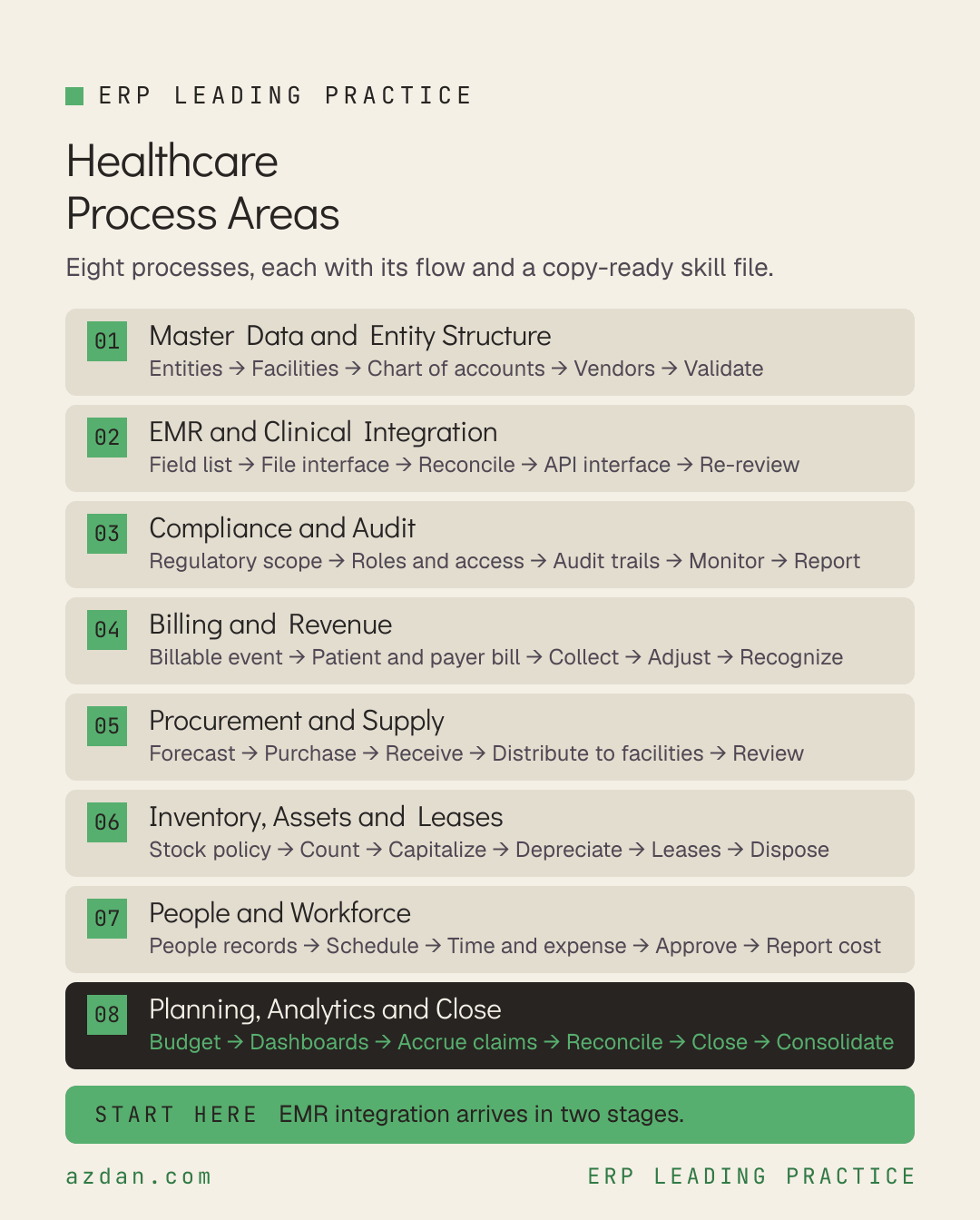
The 8 Process Areas
Master Data and Entity Structure → EMR and Clinical Integration → Compliance and Audit → Billing and Revenue → Procurement and Supply → Inventory, Assets and Leases → People and Workforce → Planning, Analytics and Close
Process area
Primary owner
What it covers
Master Data and Entity Structure
Controller
Accounts, facilities, vendors and the legal entities behind them.
EMR and Clinical Integration
Controller
The connection between the clinical system and the finance system, and the process area that defines healthcare.
Compliance and Audit
Compliance
Regulatory tracking, audit trails and access control.
Billing and Revenue
Controller
Patient balances, payer claims and the revenue that follows.
Procurement and Supply
Purchasing
Buying medical supplies and pharmaceuticals, where the cost of getting it wrong is asymmetric: overstocking wastes money, understocking stops care.
Inventory, Assets and Leases
Controller
What is held across facilities, and the equipment and property the organization runs on.
People and Workforce
Human resources
Staff, their time and their expenses.
Planning, Analytics and Close
Controller
Budgeting, reporting and the period end.
1. Master Data and Entity Structure
Accounts, facilities, vendors and the legal entities behind them. Provider organizations restructure more often than most businesses, because they grow by acquiring practices rather than by opening branches.
Define entities and subsidiaries → Set facility and department structure → Conform the chart of accounts → Load vendors → Validate
Leading practice rules
NetSuite consolidates financial and multicurrency transactions for providers with multiple locations and international operations, to comply with regional regulations and internal record-keeping rules.
Intercompany management sits at the foundation tier of the NetSuite healthcare stairway, not as a later addition.
Recommendation: build a repeatable entity onboarding pattern after the first acquisition, covering the conformed chart of accounts, the facility structure and the reporting pack, then reuse it.
Recommendation: keep facility, department and service line as separate reporting dimensions, since a site, a cost center and a clinical service are three different questions.
Skill file: Master Data and Entity Structure
---
name: healthcare-master-data-and-entity-structure
description: NetSuite leading practice for Master Data and Entity Structure in healthcare organizations
---

# Master Data and Entity Structure - Healthcare

## Roles
Controller, Finance leadership, Administrator

## Process flow
Define entities and subsidiaries → Set facility and department structure → Conform the chart of accounts → Load vendors → Validate

## Leading practice rules
- NetSuite consolidates financial and multicurrency transactions for providers with multiple locations and international operations, to comply with regional regulations and internal record-keeping rules.
- Intercompany management sits at the foundation tier of the NetSuite healthcare stairway, not as a later addition.
- Recommendation: build a repeatable entity onboarding pattern after the first acquisition, covering the conformed chart of accounts, the facility structure and the reporting pack, then reuse it.
- Recommendation: keep facility, department and service line as separate reporting dimensions, since a site, a cost center and a clinical service are three different questions.

## Check before go-live
- [ ] A documented entity onboarding pattern, reused rather than rebuilt
- [ ] Facility, department and service line agreed as distinct dimensions before go-live

## Known failure modes
- Each acquisition onboarded as a bespoke project, so the second takes as long as the first

## Scope note
This reflects NetSuite's published healthcare capabilities and stairway, some of which
require partner integrations. Confirm against your own licensed modules, your
configuration, and the health data rules of each market you operate in.
2. EMR and Clinical Integration
The connection between the clinical system and the finance system, and the process area that defines healthcare. The stairway is explicit that it arrives in two stages.
Roles: Controller, IT leadership, Administrator, Compliance
Process flow
Agree the field list → Build the file-based interface → Reconcile daily → Move to an API interface → Re-review the field list
Leading practice rules
A CSV-based integrated EMR and EHR capability sits at foundation tier of the NetSuite healthcare stairway, and an API-based option is marked at expand tier. The file-based stage is the documented starting point, not a workaround.
NetSuite integrates with electronic health records, laboratories, insurance information and other IT systems, so managers can reach them without the data living in separate silos.
NetSuite is an ERP rather than a replacement for an electronic health record. The two serve distinct functions and are designed to work together.
Recommendation: treat the file-based stage as a designed phase with a cut-off time, an owner and a daily reconciliation, rather than as an interim state nobody documents.
Recommendation: agree the field list as an interface contract before either stage is built, and re-review it when moving from files to an interface, because that migration is the moment scope quietly grows.
Skill file: EMR and Clinical Integration
---
name: healthcare-emr-and-clinical-integration
description: NetSuite leading practice for EMR and Clinical Integration in healthcare organizations
---

# EMR and Clinical Integration - Healthcare

## Roles
Controller, IT leadership, Administrator, Compliance

## Process flow
Agree the field list → Build the file-based interface → Reconcile daily → Move to an API interface → Re-review the field list

## Leading practice rules
- A CSV-based integrated EMR and EHR capability sits at foundation tier of the NetSuite healthcare stairway, and an API-based option is marked at expand tier. The file-based stage is the documented starting point, not a workaround.
- NetSuite integrates with electronic health records, laboratories, insurance information and other IT systems, so managers can reach them without the data living in separate silos.
- NetSuite is an ERP rather than a replacement for an electronic health record. The two serve distinct functions and are designed to work together.
- Recommendation: treat the file-based stage as a designed phase with a cut-off time, an owner and a daily reconciliation, rather than as an interim state nobody documents.
- Recommendation: agree the field list as an interface contract before either stage is built, and re-review it when moving from files to an interface, because that migration is the moment scope quietly grows.

## Check before go-live
- [ ] A named owner and a daily reconciliation for the file-based stage
- [ ] The field list re-reviewed at the move from CSV to API, not carried over unchanged

## Known failure modes
- Holding out for the API interface before go-live, which delays the whole program and skips the reconciliation discipline the file stage teaches
- Fields added to the interface one reasonable request at a time, until the finance system holds more clinical data than any finance process needs

## Scope note
This reflects NetSuite's published healthcare capabilities and stairway, some of which
require partner integrations. Confirm against your own licensed modules, your
configuration, and the health data rules of each market you operate in.
3. Compliance and Audit
Regulatory tracking, audit trails and access control. The stairway puts this at foundation tier, which is the most useful single signal in it: in healthcare compliance is not a later phase.
Roles: Compliance, Controller, Administrator, IT leadership
Process flow
Define the regulatory scope per market → Configure roles and access → Enable audit trails → Monitor continuously → Report
Leading practice rules
Compliance 360 sits at the foundation tier of the NetSuite healthcare stairway.
NetSuite's regulatory tracking, customizable reporting and continuous audit-trail capabilities support compliance with HIPAA and payer rules as well as internal standards.
NetSuite protects clinical and financial information with role-based security, advanced access controls and encryption, in line with regulations including HIPAA and GDPR.
Recommendation: confirm the health data protection and residency rules of every market you operate in before the integration is designed, because they differ and can constrain where data may be held. Do not assume one market's regime applies to another.
Recommendation: review who can see what on a schedule rather than at audit, since access tends to widen quietly as people change roles.
Skill file: Compliance and Audit
---
name: healthcare-compliance-and-audit
description: NetSuite leading practice for Compliance and Audit in healthcare organizations
---

# Compliance and Audit - Healthcare

## Roles
Compliance, Controller, Administrator, IT leadership

## Process flow
Define the regulatory scope per market → Configure roles and access → Enable audit trails → Monitor continuously → Report

## Leading practice rules
- Compliance 360 sits at the foundation tier of the NetSuite healthcare stairway.
- NetSuite's regulatory tracking, customizable reporting and continuous audit-trail capabilities support compliance with HIPAA and payer rules as well as internal standards.
- NetSuite protects clinical and financial information with role-based security, advanced access controls and encryption, in line with regulations including HIPAA and GDPR.
- Recommendation: confirm the health data protection and residency rules of every market you operate in before the integration is designed, because they differ and can constrain where data may be held. Do not assume one market's regime applies to another.
- Recommendation: review who can see what on a schedule rather than at audit, since access tends to widen quietly as people change roles.

## Check before go-live
- [ ] Regulatory scope confirmed per market with the relevant authority, not inferred
- [ ] A scheduled access review with a named owner

## Known failure modes
- Compliance treated as a go-live task rather than a foundation capability, so the audit trail starts later than the data does

## Scope note
This reflects NetSuite's published healthcare capabilities and stairway, some of which
require partner integrations. Confirm against your own licensed modules, your
configuration, and the health data rules of each market you operate in.
4. Billing and Revenue
Patient balances, payer claims and the revenue that follows. The person receiving care is usually not the person paying for it, which makes this unlike billing anywhere else in the series.
Capture the billable event → Bill patient balance and payer claim → Collect → Post adjustments → Recognize and report revenue
Leading practice rules
NetSuite consolidates billing, accounting and budgeting in one platform, with organization-wide visibility and automated processes.
NetSuite's patient relationship management centralizes clinical data for coordinated scheduling, and its customizable payment rules and online portals give patients and providers control over the payment relationship.
Revenue management sits at the expand tier of the NetSuite healthcare stairway.
Recommendation: report receivables by payer as well as by age, because an aggregate aging report cannot tell you which contract is slow.
Recommendation: hold contracted rates somewhere structured and queryable, so what a payer paid can be compared with what the contract said. The companion end-to-end guide covers this and the claim lifecycle in detail.
Skill file: Billing and Revenue
---
name: healthcare-billing-and-revenue
description: NetSuite leading practice for Billing and Revenue in healthcare organizations
---

# Billing and Revenue - Healthcare

## Roles
Controller, Revenue cycle, Accounts Receivable

## Process flow
Capture the billable event → Bill patient balance and payer claim → Collect → Post adjustments → Recognize and report revenue

## Leading practice rules
- NetSuite consolidates billing, accounting and budgeting in one platform, with organization-wide visibility and automated processes.
- NetSuite's patient relationship management centralizes clinical data for coordinated scheduling, and its customizable payment rules and online portals give patients and providers control over the payment relationship.
- Revenue management sits at the expand tier of the NetSuite healthcare stairway.
- Recommendation: report receivables by payer as well as by age, because an aggregate aging report cannot tell you which contract is slow.
- Recommendation: hold contracted rates somewhere structured and queryable, so what a payer paid can be compared with what the contract said. The companion end-to-end guide covers this and the claim lifecycle in detail.

## Check before go-live
- [ ] Receivables reported by payer, not only in aggregate
- [ ] Contracted rates held in a queryable form rather than in documents

## Known failure modes
- Underpayment against contract going undetected, because there is no reference rate to compare against

## Scope note
This reflects NetSuite's published healthcare capabilities and stairway, some of which
require partner integrations. Confirm against your own licensed modules, your
configuration, and the health data rules of each market you operate in.
5. Procurement and Supply
Buying medical supplies and pharmaceuticals, where the cost of getting it wrong is asymmetric: overstocking wastes money, understocking stops care.
Purchasing sits at the foundation tier of the NetSuite healthcare stairway, with fuller procurement management at expand tier.
NetSuite combines timely procurement with demand forecasts to optimize stock levels for medical supplies and pharmaceuticals, which matters most for items with short shelf lives.
NetSuite describes the supply chain capability for healthcare as automated inventory tracking, vendor management and real-time supply monitoring, to avoid shortages and reduce waste.
Recommendation: classify items by clinical criticality as well as by value, because a cheap consumable with no substitute carries a higher stockout consequence than an expensive one with alternatives.
Skill file: Procurement and Supply
---
name: healthcare-procurement-and-supply
description: NetSuite leading practice for Procurement and Supply in healthcare organizations
---

# Procurement and Supply - Healthcare

## Roles
Purchasing, Supply chain, Controller

## Process flow
Forecast demand → Purchase → Receive → Distribute to facilities → Review vendor performance

## Leading practice rules
- Purchasing sits at the foundation tier of the NetSuite healthcare stairway, with fuller procurement management at expand tier.
- NetSuite combines timely procurement with demand forecasts to optimize stock levels for medical supplies and pharmaceuticals, which matters most for items with short shelf lives.
- NetSuite describes the supply chain capability for healthcare as automated inventory tracking, vendor management and real-time supply monitoring, to avoid shortages and reduce waste.
- Recommendation: classify items by clinical criticality as well as by value, because a cheap consumable with no substitute carries a higher stockout consequence than an expensive one with alternatives.

## Check before go-live
- [ ] A criticality classification that is not just an ABC analysis by cost
- [ ] Expiry-sensitive items identified and managed on their shelf life

## Known failure modes
- Stock ranked by value alone, so the item that stops a clinic sits low on the reorder list

## Scope note
This reflects NetSuite's published healthcare capabilities and stairway, some of which
require partner integrations. Confirm against your own licensed modules, your
configuration, and the health data rules of each market you operate in.
6. Inventory, Assets and Leases
What is held across facilities, and the equipment and property the organization runs on. Both sit at the expand tier, and both behave differently from their equivalents in other sectors.
Set facility stock policy → Count and track → Capitalize equipment → Depreciate → Manage leases → Dispose
Leading practice rules
Inventory management and asset and lease management both sit at the expand tier of the NetSuite healthcare stairway.
NetSuite's dashboards give real-time insight into inventory levels and resource utilization alongside financial performance.
Recommendation: hold facility-level stock views rather than one organization-wide figure, since a consumable available across town is not available to the clinic that needs it.
Recommendation: treat leased clinical equipment as its own category with its own review, because lease terms and clinical useful life rarely align.
Skill file: Inventory, Assets and Leases
---
name: healthcare-inventory-assets-and-leases
description: NetSuite leading practice for Inventory, Assets and Leases in healthcare organizations
---

# Inventory, Assets and Leases - Healthcare

## Roles
Controller, Supply chain, Facilities, Accounting

## Process flow
Set facility stock policy → Count and track → Capitalize equipment → Depreciate → Manage leases → Dispose

## Leading practice rules
- Inventory management and asset and lease management both sit at the expand tier of the NetSuite healthcare stairway.
- NetSuite's dashboards give real-time insight into inventory levels and resource utilization alongside financial performance.
- Recommendation: hold facility-level stock views rather than one organization-wide figure, since a consumable available across town is not available to the clinic that needs it.
- Recommendation: treat leased clinical equipment as its own category with its own review, because lease terms and clinical useful life rarely align.

## Check before go-live
- [ ] Stock visible per facility, not only in total
- [ ] Lease renewal dates tracked against equipment replacement plans

## Known failure modes
- Organization-wide stock figures that hide a stockout at a single site

## Scope note
This reflects NetSuite's published healthcare capabilities and stairway, some of which
require partner integrations. Confirm against your own licensed modules, your
configuration, and the health data rules of each market you operate in.
7. People and Workforce
Staff, their time and their expenses. Labor is the dominant cost in a provider organization, and the constraint is not availability alone but who is qualified and currently credentialed.
Roles: Human resources, Finance, Facility management
Process flow
Maintain people records → Plan and schedule → Capture time and expense → Approve → Report cost by facility and service
Leading practice rules
People management and expense management sit at the expand tier of the NetSuite healthcare stairway, with talent management and workforce management at lead tier.
Recommendation: attribute labor cost to facility and service line, not only to department, so the cost of a service can be seen where it is delivered.
Recommendation: hold credential and license expiry somewhere it triggers a reminder, wherever that system sits, because an expired credential is a coverage problem before it is an administrative one.
Skill file: People and Workforce
---
name: healthcare-people-and-workforce
description: NetSuite leading practice for People and Workforce in healthcare organizations
---

# People and Workforce - Healthcare

## Roles
Human resources, Finance, Facility management

## Process flow
Maintain people records → Plan and schedule → Capture time and expense → Approve → Report cost by facility and service

## Leading practice rules
- People management and expense management sit at the expand tier of the NetSuite healthcare stairway, with talent management and workforce management at lead tier.
- Recommendation: attribute labor cost to facility and service line, not only to department, so the cost of a service can be seen where it is delivered.
- Recommendation: hold credential and license expiry somewhere it triggers a reminder, wherever that system sits, because an expired credential is a coverage problem before it is an administrative one.

## Check before go-live
- [ ] Labor cost attributable to facility and service line
- [ ] Credential expiry tracked with a reminder, in whichever system owns it

## Known failure modes
- Labor reported only by department, so a loss-making service line stays hidden inside a profitable facility

## Scope note
This reflects NetSuite's published healthcare capabilities and stairway, some of which
require partner integrations. Confirm against your own licensed modules, your
configuration, and the health data rules of each market you operate in.
8. Planning, Analytics and Close
Budgeting, reporting and the period end. Healthcare closes against a revenue figure that is still moving, because claims adjudicate after the period they belong to.
Budget by facility and service → Report through dashboards → Accrue for claims in flight → Reconcile → Close → Consolidate
Leading practice rules
In the NetSuite healthcare stairway, analytics, reporting and dashboards sit at foundation tier, financial planning and budgeting at expand tier, and business insights with close and reconciliation automation at lead tier.
NetSuite reports up-to-the-minute insight into financial performance, resource utilization, inventory levels and patient turnover.
NetSuite states that integrated financials accelerate the period-end close and produce compliant statements.
Recommendation: agree an accrual method for claims submitted but not adjudicated before the first close, rather than deciding it under pressure at the first month end.
Recommendation: budget at the level you manage, which in a provider group is usually facility and service line rather than legal entity.
Skill file: Planning, Analytics and Close
---
name: healthcare-planning-analytics-and-close
description: NetSuite leading practice for Planning, Analytics and Close in healthcare organizations
---

# Planning, Analytics and Close - Healthcare

## Roles
Controller, Chief Financial Officer, Finance leadership

## Process flow
Budget by facility and service → Report through dashboards → Accrue for claims in flight → Reconcile → Close → Consolidate

## Leading practice rules
- In the NetSuite healthcare stairway, analytics, reporting and dashboards sit at foundation tier, financial planning and budgeting at expand tier, and business insights with close and reconciliation automation at lead tier.
- NetSuite reports up-to-the-minute insight into financial performance, resource utilization, inventory levels and patient turnover.
- NetSuite states that integrated financials accelerate the period-end close and produce compliant statements.
- Recommendation: agree an accrual method for claims submitted but not adjudicated before the first close, rather than deciding it under pressure at the first month end.
- Recommendation: budget at the level you manage, which in a provider group is usually facility and service line rather than legal entity.

## Check before go-live
- [ ] An accrual policy for claims in flight, agreed before the first close
- [ ] Budget dimensions matching how the organization is actually managed

## Known failure modes
- Closing on cash received and restating later, because no accrual policy was set for claims still with payers

## Scope note
This reflects NetSuite's published healthcare capabilities and stairway, some of which
require partner integrations. Confirm against your own licensed modules, your
configuration, and the health data rules of each market you operate in.
Where to Start
Master data and the entity structure first, because provider groups grow by acquisition and the structure changes more often than in other sectors. Compliance next, not last, since the stairway places it at foundation tier alongside financials. Then the clinical integration, procurement and supply, and billing. Assets, people, planning and the close follow. The companion end-to-end guide covers the clinical boundary document and the payer relationship in full, and both are worth reading before designing anything here.
The single highest-value planning point is one the stairway states and most teams miss: EMR and EHR integration arrives in two stages, not one. A CSV-based integration sits at foundation tier and an API-based option at expand tier. Treat the file-based stage as a designed phase with its own controls, cut-off and reconciliation, rather than as a temporary failure to be rushed past. Teams that hold out for the interface before going live usually wait longer and reconcile less.
Published by Azdan, an Oracle NetSuite Solution Provider operating across the UAE, Saudi Arabia, and Egypt. Guidance in this article reflects Azdan's process design work with healthcare organizations. Content checked August 2026.
Blog
News & Insights
Fresh thinking and real-world advice to help you scale smarter, faster, and with more clarity
.svg)