.svg)


How to Implement NetSuite for Software Companies: Steps and AI Skill
A software company runs on contract terms, not on stock. That single difference changes the order in which a NetSuite implementation has to be sequenced, and it is the reason software projects fail in a way that distribution projects do not. This guide sets out the consultant-level steps, the configuration decisions that carry the most downstream weight, and a machine-readable skill file you can hand to an AI assistant to run the same method.
The Short Answer
Short answer: Implement NetSuite for a software company in seven phases:
Discovery and Scoping → Solution Design → System Configuration → Data Migration → User Acceptance Testing → End-User Training → Go-Live and Hypercare
What makes the software version distinct is that revenue management is not a late-stage module. It is a design-phase decision that has to be resolved before a single item record is built, because in NetSuite the item record is where revenue behavior is defined. Get the item strategy wrong and every subscription, renewal, and professional services engagement inherits the error, retrospectively, at month-end close.
The three process areas a software implementation genuinely turns on are Order to Cash, Revenue Management, and Financial Management, sitting on top of Master Data Management. Inventory, warehousing, and production are almost always out of scope, and time spent scoping them is time taken from the revenue design that actually matters.
Methodology note. The sequence below follows the seven-phase implementation methodology Azdan applies across its NetSuite delivery work in the UAE, Saudi Arabia, and Egypt, adapted here to the software and SaaS process model. Where a point reflects delivery experience rather than measured data, it is labeled as a recommendation.
What Makes a Software Implementation Different
In a distribution or manufacturing implementation, the economic unit is a unit of stock. Value moves when goods move, and the system is built around item movement: receipt, fulfillment, and the cost that attaches at each step.
In a software company, the economic unit is a contract term. Cash arrives on one schedule, the obligation is satisfied on another, and revenue belongs to a third. Three separate timelines have to be reconciled inside one system, per contract line, every month. That is the whole job.
This produces a scoping profile that looks very different from a standard mid-market ERP project:
The reduced footprint is not a smaller project. It is a deeper one in a narrower area. A software implementation spends its complexity budget on revenue treatment rather than on supply chain, and the scoping conversation should be shaped accordingly.
The Item Record Is the Control Point
This is the single most consequential thing to understand before configuration begins.
In NetSuite, revenue behavior is defined on the item record. The item carries the deferred revenue account, the revenue recognition rule, the forecast rule, the trigger that creates the revenue plan, and the revenue category used for allocation. When a sales order is entered, those attributes flow onto the revenue element, and the revenue element drives the recognition plan that posts to the general ledger.
The practical consequence: item strategy is a finance design decision made in Phase 2, not an administrative task performed in Phase 3. A software company that treats item setup as data entry will discover the problem at its first month-end, when revenue posts against the wrong accounts on the wrong schedule and every correction has to be made manually on individual revenue arrangements.
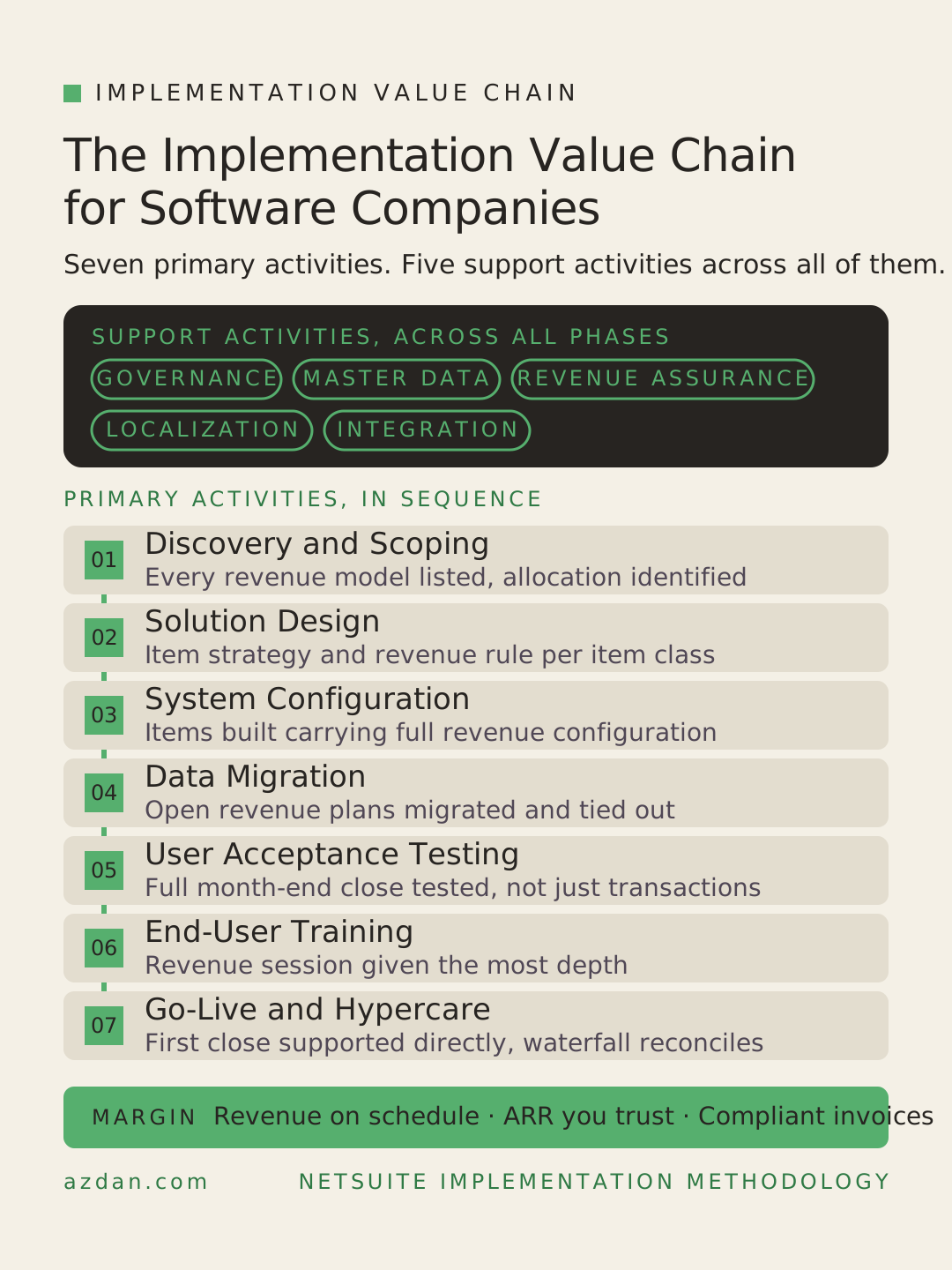
The Implementation Value Chain for Software Companies
A Gantt chart shows when work happens. A value chain shows where value is created and which supporting disciplines have to run continuously for the primary activities to hold together. For an ERP implementation, the second view is more useful, because the failures rarely come from a phase running late. They come from a support activity that was treated as a phase and then stopped.
Primary activities, in sequence:
Support activities, running across every phase:
- Program governance and change control
- Master data management
- Revenue assurance under ASC 606 and IFRS 15
- Localization and regional compliance
- Integration and platform architecture
The margin: revenue recognized on schedule, ARR that finance and the board both trust, and compliant invoices in every market the company sells into.
Each of the five support activities is a discipline, not a milestone. Revenue assurance in particular is often scheduled as a configuration task in Phase 3 and then closed. In practice it starts in discovery, when the revenue policy per item class is documented, and it does not finish until the deferred revenue waterfall reconciles to the balance sheet after go-live.
The Seven Steps
Step 1: Discovery and Scoping
The objective is a documented revenue policy, an entity map, and a defensible scope boundary. Poor scoping is where most NetSuite projects fail, and in software companies the specific failure is scoping the ERP without first resolving how revenue is earned.
Work through:
- Legal entity structure. How many subsidiaries, in which countries, in which functional currencies, and whether consolidated reporting is required. This determines whether the project is NetSuite or NetSuite OneWorld, and it is not a decision to defer.
- Revenue model inventory. List every way the company earns money: term subscriptions, perpetual licenses, usage and overage charges, implementation and onboarding fees, support and maintenance, training, and time-and-materials consulting. Each becomes an item class with its own recognition treatment.
- Multiple element arrangements. Determine what proportion of contracts bundle more than one performance obligation, and whether allocation between elements is required. This is the single biggest driver of whether standard revenue management is sufficient or whether fair value allocation is needed, and it materially changes both license and effort.
- Billing patterns. Annual upfront, monthly in arrears, milestone-based, 50/50 splits, and multi-year with escalation. Confirm how many distinct billing schedules exist. Recommendation: if the answer is more than five, treat schedule rationalization as a workstream in its own right rather than replicating every historical variant.
- Systems in scope. The CRM, the product's own provisioning or entitlement database, the payment gateway, and the support desk. Decide which is the system of record for the customer and which for the subscription. Two systems both claiming to own the subscription is the most common integration defect in this vertical.
- Compliance obligations by market. E-invoicing, VAT, corporate tax, and payroll for each country of operation.
Exit gate: a signed scope document listing every item class with its intended revenue treatment, the entity structure, the integration inventory, and an explicit out-of-scope list.
Step 2: Solution Design
This is where the software-specific work concentrates. The output is a design document that a configurator can build from without making accounting decisions.
Chart of accounts and segmentation. Consolidate accounts as far as possible and carry reporting dimensions on segments rather than in account numbers. Software companies typically need department, class, and location, with class or a custom segment carrying the product line so that gross margin by product is reportable without a rebuild. Deferred revenue needs current and non-current treatment.
Item strategy. Define every item class and, for each one, the deferred revenue account, income account, revenue recognition rule, forecast rule, plan creation trigger, and item revenue category. The objective is that revenue fields default correctly from the item so that revenue elements require no manual editing in normal operation. Manual editing of revenue elements at month-end is the symptom that item strategy was not designed.
Revenue rules per item class. This table is the core artifact of a software implementation. It reflects NetSuite's leading-practice configuration patterns for software revenue treatment:
Two design notes that follow from the table. First, ratable subscription recognition is driven by line-level start and end dates, so those dates must be populated on the sales order line before the revenue arrangement is created. Changing them afterwards requires a manual edit to the revenue element. Second, fixed-fee project recognition requires the Projects feature and an item of type Service, which means a professional services arm changes the module scope, not just the item list.
Billing schedule design. Map each contract shape to a billing schedule and confirm whether schedules apply at the order level or the line level. Where the product has usage-based charges, define where usage is metered, how it is transferred into NetSuite, and on what cadence overages are billed.
Renewal and change design. Decide how upsells, downgrades, mid-term changes, and co-termination are handled. Quantity-based pricing does not automatically recalculate on an upsell order until the contract co-terms at renewal, which is a behavior finance should understand at design time rather than discover at renewal.
Reporting design. Specify the recurring revenue metrics the business will run on, typically ARR, MRR, gross and net revenue retention, churn, and customer acquisition cost. NetSuite provides subscription metrics dashboards and prebuilt analytics for recurring revenue, but which entities, currencies, and product lines they report on is a design decision. For multi-currency groups, decide whether constant currency reporting is required.
Exit gate: a functional design document with the item and revenue rule matrix signed off by the controller or revenue manager, not only by the project sponsor.
Step 3: System Configuration
Build against the design. The sequence that works:
- Company setup, subsidiaries, currencies, consolidated exchange rate tables, and accounting periods
- Chart of accounts and segments
- Roles and permissions, using bundled role definitions as the starting point and restricting from there
- Item records carrying the full revenue configuration from the design matrix
- Customer and vendor records, credit limits, and terms
- Transaction forms, approval routing, and billing schedules
- Revenue recognition rules, revenue arrangement approval, and the reclassification process
- Tax configuration and e-invoicing templates per country
- Bank payment formats and electronic payment setup
- Saved searches, KPIs, dashboards, and the recurring revenue analytics package
Configure integrations in parallel rather than at the end. Use a dedicated integration role restricted to web services access, which prevents an integration credential from also functioning as a user login.
Recommendation: freeze configuration before UAT begins. Configuration changes made during testing invalidate test results, and the resulting confusion about which defects are real is a common cause of go-live slippage.
Step 4: Data Migration
Software companies carry a migration profile that trips teams expecting a standard finance migration.
Open revenue plans deserve their own workstream. Every live contract at cutover has revenue already recognized, revenue still deferred, and a schedule for releasing the remainder. Migrating that state accurately, then proving that the migrated deferred revenue balance ties to the legacy balance sheet, is the migration's acceptance test. Recommendation: run this reconciliation at least twice before cutover, once in a full dress rehearsal and once with final data, because a break discovered during go-live week has no good resolution.
Step 5: User Acceptance Testing
Test scripts should be written from the revenue design, not from a generic ERP script library. For a software company, the tests that matter are:
- A new subscription contract from quote through to the first recognized revenue journal
- A multiple element arrangement covering license, implementation, and support, with allocation verified against the design
- A mid-term upsell and a downgrade, checking the effect on both billing and the revenue element
- A renewal, including co-termination behavior
- A cancellation and refund routed through a return authorization merged into the revenue arrangement, rather than a standalone credit memo
- A usage overage cycle from meter to invoice
- A full month-end close: revenue recognition journals, deferred revenue reclassification, and the deferred revenue waterfall reconciled to the general ledger
- An e-invoice cleared or reported successfully in every country in scope
That final close test is the one most often skipped for time. It should be treated as the gate, because month-end is where a software implementation either works or does not.
Exit gate: documented sign-off from the finance owner, with every high-severity defect closed and retested rather than deferred to hypercare.
Step 6: End-User Training
Train by role against real scenarios, not by module against menus. A software company typically needs distinct sessions for revenue and finance, billing operations, sales and customer success, and system administration. The revenue session is the one that requires the most depth, because the concepts (revenue arrangement, revenue element, revenue plan, reclassification) are unfamiliar even to experienced accountants arriving from a system that only had deferred revenue schedules.
Recommendation: schedule training close enough to go-live that it is still fresh, but far enough ahead that the questions raised in training can still be actioned. Training frequently surfaces process gaps that testing missed, because it is the first time the people who will actually operate the system see the whole flow.
Step 7: Go-Live and Hypercare
Cut over in a low-activity window, ideally aligned to a period boundary so that opening balances are clean. Rehearse the cutover with a defined rollback decision point and a named person authorized to call it.
The first close after go-live is the real go-live. Plan for the revenue team to be supported through it directly: running recognition journals, executing deferred revenue reclassification, reconciling the waterfall, and producing the first ARR and MRR reporting from the new system. Recommendation: keep the legacy system readable, not writable, for at least one full quarter so that comparatives can be reconstructed if a question arises.
GCC Localization for Software Companies
Software companies in the region routinely sell across borders from a single entity, which makes compliance more complicated than headcount suggests. Localization is not a switch. It is tax determination, document layout, bank file formats, statutory reporting, and language, each configured separately.
Two regimes drive most of the work. Verify both against the regulator before committing to a project timeline, because thresholds and dates move.
Saudi Arabia. ZATCA operates a centralized clearance model through the Fatoora platform. Phase 2, the Integration Phase, requires UBL 2.1 XML invoices, cryptographic stamping, a UUID and QR code per invoice, and a direct API connection, with real-time clearance for standard B2B invoices and reporting within 24 hours for simplified B2C invoices. On 24 July 2026, ZATCA published the criteria for Wave 25, covering taxpayers whose VAT-subject revenue exceeded SAR 187,500 in 2022, 2023, 2024, or 2025, with an integration deadline of 1 February 2027. That threshold is half the Wave 24 level and brings most regional software companies into scope. Onboarding runs through the portal: enroll, generate a certificate signing request, obtain a compliance CSID and then a production CSID, configure templates per document type, and go live. Checked August 2026.
United Arab Emirates. The UAE uses a decentralized Peppol five-corner model rather than direct clearance, with invoices in the PINT AE format (UBL 2.1 XML) exchanged through an Accredited Service Provider appointed by the business. A voluntary pilot opened on 1 July 2026. Businesses with revenue of AED 50 million or more must appoint an ASP by 30 October 2026, extended from the original July date, and comply from 1 January 2027. Businesses below that threshold appoint by 31 March 2027 and comply from 1 July 2027. PDFs and scanned invoices do not qualify. Checked August 2026.
Egypt and Jordan. Egypt's ETA regime requires signed submission of invoices and was an early regional mover. Jordan operates JoFotara. Both need their own document configuration and their own testing cycle.
Practical implications for a software implementation: bilingual Arabic and English document templates are a baseline requirement rather than an enhancement, cross-border digital services need a documented place-of-supply position before tax configuration begins, and e-invoicing testing belongs in UAT for every country in scope rather than being handled as a post-go-live task.
What Breaks: Seven Recurring Risks
These are patterns that recur across software and SaaS implementations. They are drawn from delivery experience and are offered as recommendations rather than as measured findings.
- Item strategy treated as data entry. The most expensive mistake in the vertical. Every downstream revenue error traces back here, and correcting it after go-live means reworking live revenue arrangements.
- Multiple element arrangements discovered late. Allocation requirements found during UAT instead of discovery change both the license position and the effort estimate, mid-project.
- Two systems claiming the subscription. When the CRM and the ERP both hold subscription state with no defined master, the reconciliation burden is permanent.
- Open revenue plans under-scoped. Migration effort is estimated on customer and invoice counts, and the in-flight contract state, which is the genuinely difficult part, is not costed.
- Line-level dates left empty. Ratable recognition depends on start and end dates present on the order line before the revenue arrangement is created. Empty dates produce plans that have to be corrected by hand.
- The first close left unrehearsed. UAT covers transactions but not the close. The reclassification and waterfall steps get exercised for the first time in production.
- E-invoicing deferred to a later phase. In Saudi Arabia and, from 2027, the UAE, an ERP that cannot produce a compliant invoice cannot be used to invoice. There is no interim manual workaround at volume.
The AI Skill
The steps above are also published below as a skill file: a markdown document with structured instructions that an AI assistant can load and follow. It encodes the same seven phases, the same revenue rule matrix, and the same exit gates, so an assistant can help draft a scope document, review a design against the gates, or generate role-based UAT scripts without the consultant restating the method each time.
Copy the block below and save it as SKILL.md inside a folder named netsuite-software-implementation.
How to Use It
Save the block as SKILL.md in a folder named netsuite-software-implementation, then place that folder wherever your assistant loads skills from. Load it at the start of a NetSuite software project and it will hold the same gates a consultant would. It is a starting position, not a substitute for a qualified consultant reviewing the revenue design.
Recommendation
If you are scoping a NetSuite implementation for a software company, resolve two questions before anything else is estimated. First, list every item class and the recognition treatment it needs. Second, determine whether contracts bundle multiple performance obligations that require allocation. Those two answers determine the license position, the effort, and the timeline more than the user count does, and both are cheap to answer in week one and expensive to answer in month four.
For teams operating across the GCC, add a third: which e-invoicing regimes apply, and what the current deadline is for each. That answer has a shelf life, so check it at the point you need it rather than relying on a number in a document.
Sources
- ZATCA, Wave 25 selection criteria for the Integration Phase of e-invoicing, published 24 July 2026
- ZATCA, e-invoicing roll-out phases
- UAE Ministry of Finance, eInvoicing programme
- UAE Ministry of Finance, targeted amendments to the eInvoicing system decisions, announced 10 May 2026
- Oracle NetSuite, revenue recognition and revenue management
- Oracle NetSuite Applications Suite documentation, Saudi Arabia E-Invoicing SuiteApp
- IFRS Foundation, IFRS 15 Revenue from Contracts with Customers
Regulatory details were verified in August 2026. Thresholds and deadlines change, so confirm against the regulator before acting on them.
Related Azdan Resources
- NetSuite ERP for Software Companies
- Oracle NetSuite Implementation
- NetSuite Integration Services
- 15 Accounting Systems Approved by ZATCA in Saudi Arabia
- Top 20 UAE E-Invoicing Accredited Service Providers
- NetSuite Pricing Guide: What Oracle NetSuite Costs in 2026
Published by Azdan, an Oracle NetSuite Solution Provider operating across the UAE, Saudi Arabia, and Egypt. Guidance in this article reflects Azdan's NetSuite implementation methodology applied to the software and SaaS process model. Regulatory content checked August 2026.