.svg)


End-to-End Business Process for Nonprofits
In a business, a dollar is a dollar. It arrives, it is revenue, and management decides what to do with it. In a nonprofit, a dollar arrives with conditions attached, and those conditions outlive the transaction that carried them. It may only be spent on one program, in one region, in one financial year, and the organization has to be able to prove it. That single difference means the unit of account is not the transaction. It is the promise the transaction carries. This guide maps the nonprofit value chain end to end.
The Short Answer
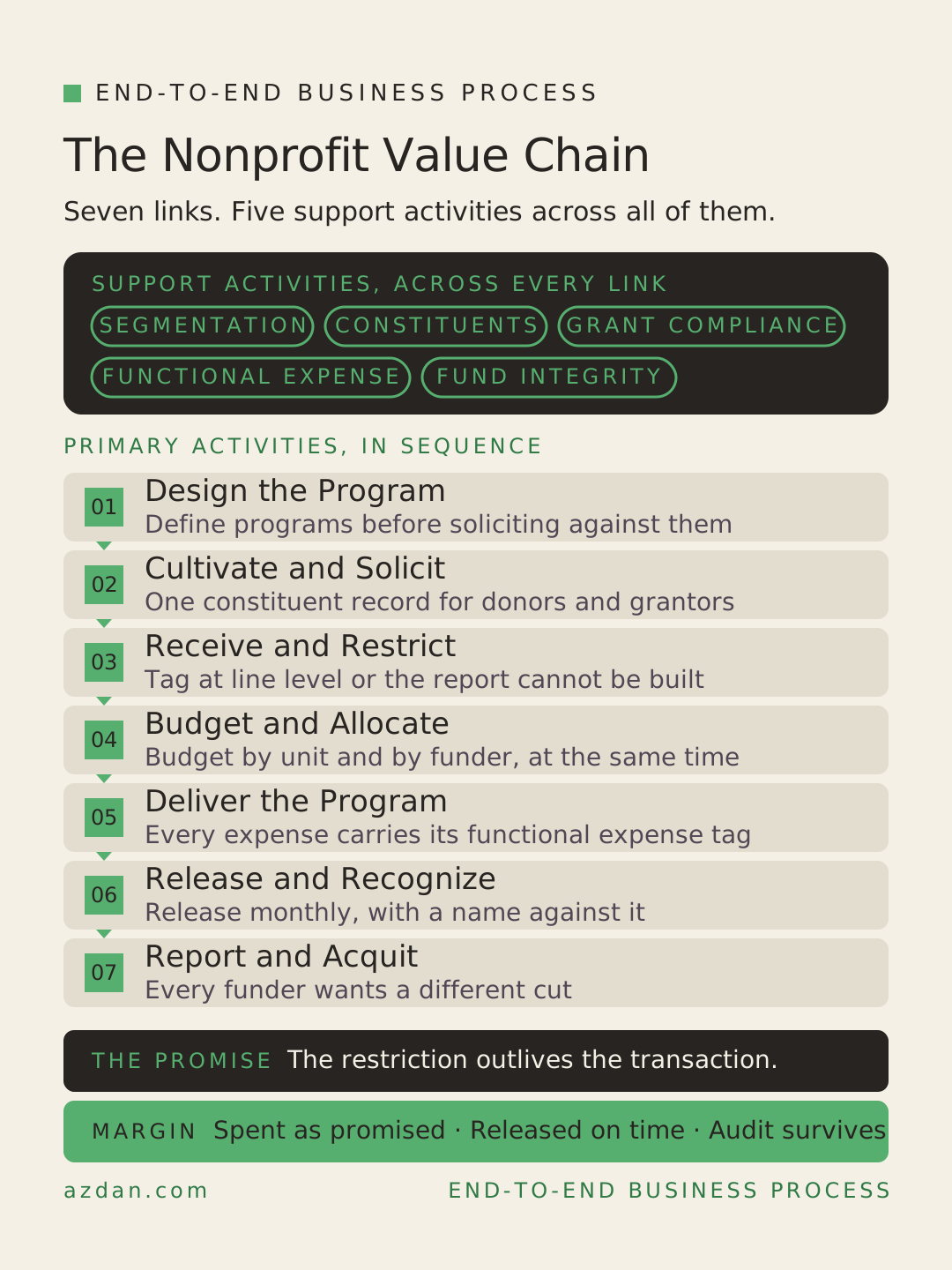
The nonprofit value chain runs in seven links:
Design the Program → Cultivate and Solicit → Receive and Restrict → Budget and Allocate → Deliver the Program → Release and Recognize → Report and Acquit
Three things make it unlike any other chain in this series. Revenue carries restrictions that persist for years, so "how much do we have" is always the wrong first question and "what may we spend it on" is the right one. The person who pays receives nothing material in return, and is not the person served, which means the organization runs a fundraising chain and a delivery chain that meet only at the fund. And the cost classification is published, because splitting expense between program, fundraising and administration produces a ratio that funders read and judge.
Methodology note. This maps the end-to-end process using the value chain model, applied to the nonprofit and social impact process design Azdan works with across its NetSuite delivery in the UAE, Saudi Arabia, and Egypt. Where a point reflects delivery experience rather than measured data, it is labeled as a recommendation.
The Restriction Outlives the Transaction
Start here, because it reorganizes the entire ledger.
Social impact organizations take significant revenue from contributions and grants alongside any fee-earning activity, and consequently need far more segmentation and reporting depth than a commercial business, because they answer to donors, grantors, boards, auditors and government, each asking a different question of the same money.
The way this is solved is not a longer chart of accounts. It is dimensional. Each transaction is tagged at line level, and the tags carry the promise. The prebuilt structure runs to eight segments:
Two rules in that table are easy to miss and expensive to get wrong.
Restriction is a revenue-side concept only. Contributed revenue is tagged with the donor's restriction. Everything else, meaning all expenses and all non-contributed revenue, is tagged without donor restrictions. Teams new to fund accounting frequently try to tag expenses as restricted, which breaks the release mechanism described below.
The Functional Expense segment is not optional if you publish a Statement of Functional Expenses. That report cannot be generated without it. Recommendation: decide the functional expense policy during design, because it is the one number in this sector that outsiders use to judge the organization, and reclassifying a year of expense afterwards is both painful and awkward to explain.
A modeling point that catches people: Grant, Program and Region are many-to-many in every direction. One grant may fund several programs, one program may draw on several grants, one program may serve several regions, and one region may host several programs. The reporting requirements for those relationships have to be defined before the segments are built, not after.
Release Is a Monthly Routine, Not an Automatic Posting
The second structural fact, and the one most likely to be assumed away in scoping.
Restricted net assets do not release themselves when the money is spent. In leading practice, restricted net assets are released to unrestricted net assets using a transaction saved search, either on the release from restriction transaction type or on the time restriction segment. The recommendation is to run it monthly.
That is a designed manual control, not an automated posting, and it has consequences worth planning for. Someone owns it. It has a cadence. If it is skipped, the statement of financial position overstates restricted net assets and understates what the organization can actually spend, which is precisely the number the board is trying to read.
Recommendation: name the owner and put the release in the month-end close checklist alongside the reconciliations. It is not a reporting nicety, it is the mechanism by which restricted money legitimately becomes spendable money.
The Nonprofit Value Chain
Primary activities, in sequence:
Support activities, running across every link:
- Segmentation and the nonprofit data model
- Constituent and grantor relationships
- Grant compliance and pledge tracking
- Functional expense discipline
- Fund integrity and release control
The margin: every restricted dollar spent as promised, released on schedule, and a functional expense split that survives both an audit and a funder.
Segmentation heads that list because unlike every other chain in this series, here the data model is the control. A commercial business can correct a mis-coded transaction and lose nothing but time. A nonprofit that mis-codes a restriction has, on paper, spent someone's donation on something they did not agree to.
The Seven Links
1. Design the Program
Programs are defined, and with them the structure everything downstream reports against.
The program record holds what the organization delivers over time, and it relates to both grants and regions. Program managers work with financial planning, risk, revenue stream distribution, beneficiary tracking, and cost per outcome. That last measure is the sector's equivalent of unit margin, and it only exists if the segmentation supports it.
Recommendation: define programs before soliciting against them. A donation restricted to a program that does not yet exist as a record has to be reclassified later, and reclassifying restricted revenue is a conversation with an auditor.
2. Cultivate and Solicit
Constituents, campaigns, proposals, and the pre-award pipeline.
In this model the customer record is a constituent, which covers donors, grantors, members and beneficiaries in one master record type. Pre-award grant tracking uses the native opportunity record, which links to the grantor constituent for forecasting and proposals, can invoice the grantor directly on award, and can link to a project record where task, time and expense tracking are needed.
Recommendation: use the project record only where the grant genuinely requires task-level reporting, employee timesheets against tasks, or billable expense tracking against the grant. Not every grant needs one, and creating projects reflexively adds administration that program staff will not maintain.
3. Receive and Restrict
Money arrives and the promise attached to it is recorded.
This is the link where the chain is won or lost, because the tags applied here determine what every later report can say. Entering the segment values at line level on the transaction is what automatically populates the saved searches, scorecards and dashboards that come with the edition. Nothing downstream can recover a tag that was not applied here.
Revenue items are the mechanism: create at least one revenue item for each income account you will use, with non-inventory for sale as the preferred type, covering contributions, membership dues, grant income, pledges and other sources.
Recommendation: consider segment codes, which store prebuilt combinations of segment values and populate them together on a transaction. With eight segments, unassisted data entry is where accuracy goes to die.
4. Budget and Allocate
Funds are committed to programs, and the budget becomes the control against which spending is judged.
The distinctive complication is that a nonprofit budgets in two directions at once: by organizational unit like any business, and by fund or grant, where the funder's budget is a commitment the organization made in a proposal and may be held to.
5. Deliver the Program
Spending happens, tagged to the program, grant, region and functional expense category it belongs to.
The discipline is unglamorous and absolute: every expense carries its segments. Where the grant requires it, employee time and expense are tracked against the project so that staff cost lands on the grant rather than in general administration.
Recommendation: make the functional expense tag mandatory on expense entry rather than a reporting-time allocation. Retrospective allocation is a spreadsheet, and a spreadsheet is what the segmentation exists to eliminate.
6. Release and Recognize
The monthly routine described above, plus the revenue recognition treatment that grants require.
Grant revenue is often required to be recognized at award, which leaves the grant amount sitting as a contra-asset or liability on the statement of financial position. As expenses are entered against the grant they are billed to the grantor and adjusted by the controller, and over time the billed expenses bring the grant balance to zero.
Recommendation: settle the grant revenue treatment early in the implementation, because it differs by award terms and it determines how the balance sheet behaves for the life of every multi-year grant.
7. Report and Acquit
The closing link, and the one with the most audiences.
The same ledger has to produce a statement of financial position and a statement of activities for the board and the auditor, a statement of functional expenses for anyone assessing overhead, per-grant acquittal reporting for each funder against their own budget, and statutory returns where they apply.
Transaction-level tagging by fund, program, grant and donor restriction with detailed audit trails is what makes those views possible from one set of books, supporting FASB, IRS Form 990 and other reporting standards depending on jurisdiction.
Recommendation: build the funder report formats during implementation, not after go-live. Every grantor wants a slightly different cut, and the segment structure either supports them or it does not.
What Breaks: Seven Recurring Failures
These are patterns that recur in nonprofit and social impact organizations. They are drawn from delivery experience and offered as recommendations rather than measured findings.
- Expenses tagged as restricted. Restriction belongs on contributed revenue. Everything else is without donor restrictions, and mixing that up breaks the release mechanism.
- Release from restriction not scheduled. It is a monthly saved search with a named owner, or it is a growing misstatement of what the organization can spend.
- Functional expense treated as a reporting-time allocation. The segment has to be on the transaction, or the statement of functional expenses cannot be produced.
- Segment values not defined before go-live. All eight have to be pre-defined, because line-level entry is what drives every prebuilt dashboard.
- Grant, program and region relationships not mapped. They are many-to-many in every direction and the reporting has to be designed for it.
- Programs created after the donations arrive. Reclassifying restricted revenue is an auditor conversation.
- Funder report formats left to after go-live. Each grantor wants a different cut and the segments either support it or they do not.
Reading Your Own Chain: Four Questions
- How much of your net assets is restricted, and by what? Purpose, time, region. If the answer takes more than a day to produce, the segmentation is not carrying it.
- When was release from restriction last run? Not the policy. The date.
- Can you produce a statement of functional expenses without a spreadsheet? That answer tells you whether the functional expense tag is really on transactions.
- How long does it take to produce an acquittal report for your largest funder? It is the clearest measure of whether the grant segment is doing its job.
Where This Sits Alongside Azdan's Practices
Nonprofit shares most of its non-contributed mechanics with practices Azdan maintains, and a social impact organization modernizing its back office will recognize its own chain in them.
- Project and grant delivery. Where grant work is tracked with tasks, timesheets and billable expense, the mechanics are those of a project-based business. See NetSuite ERP for Professional Services.
- Multi-entity and consolidation. Federated organizations, chapters and affiliates consolidating into one set of books, which is the same capability behind link seven.
- Implementation method. The seven-phase approach and the design decisions that bind it. See Oracle NetSuite Implementation.
One thing worth knowing regardless of partner: Oracle runs a Suite Donation program under NetSuite Social Impact, offering qualifying nonprofits a base software donation with no-cost activation, alongside discounted pricing on additional modules. It is worth checking eligibility before budgeting a license cost.
Recommendation
If you are mapping a nonprofit end to end, produce one thing before anything else is designed: the list of segment values you will actually use, for all eight segments, agreed with whoever signs the funder reports.
Every other decision in this chain follows from that list. It determines what the dashboards can show, what a funder acquittal can be built from, and whether the statement of functional expenses can be produced at all. It is a day of work with the right people in the room, and it is the difference between a system that reports on restrictions and a spreadsheet that tries to.
Then put release from restriction in the month-end checklist with a name against it. It is the single most commonly skipped control in this sector, and skipping it misstates the only number the board really wants.
Sources
- Oracle NetSuite, Nonprofit ERP, for fund accounting, donor and grant restriction reporting, and customizable segmentation
- Oracle NetSuite, Nonprofit Accounting Software, for transaction tagging by fund, program, grant and donor restriction, and the note that some described capabilities require partner integrations
- Oracle NetSuite, Social Impact, for the Suite Donation program
- Oracle NetSuite, What Is Value Chain? An Expert Guide, for the value chain model
- Michael E. Porter, Competitive Advantage: Creating and Sustaining Superior Performance, 1985, for the original value chain framework
Reporting obligations for nonprofits vary substantially by country and by funder. Confirm requirements against the relevant authority before acting on anything here. Checked August 2026.
Related Azdan Resources
- End-to-End Business Process for Services
- End-to-End Business Process for Healthcare
- How to Implement NetSuite ERP
Published by Azdan, an Oracle NetSuite Solution Provider operating across the UAE, Saudi Arabia, and Egypt. Content checked August 2026.