.svg)


End-to-End Business Process for Health and Beauty
A beauty brand often owns none of the physical chain. The formula is made by a contract manufacturer who also warehouses and ships it. A large share of finished stock sits on a counter inside someone else's department store, still owned by the brand. And a significant proportion of everything that moves is never sold at all, because it is a tester, a sample, or a gift with purchase. The defining problem is not making the product. It is knowing what you own, where it physically sits, and whether it will ever produce revenue. This guide maps the health and beauty value chain end to end.
The Short Answer
The health and beauty value chain runs in seven links:
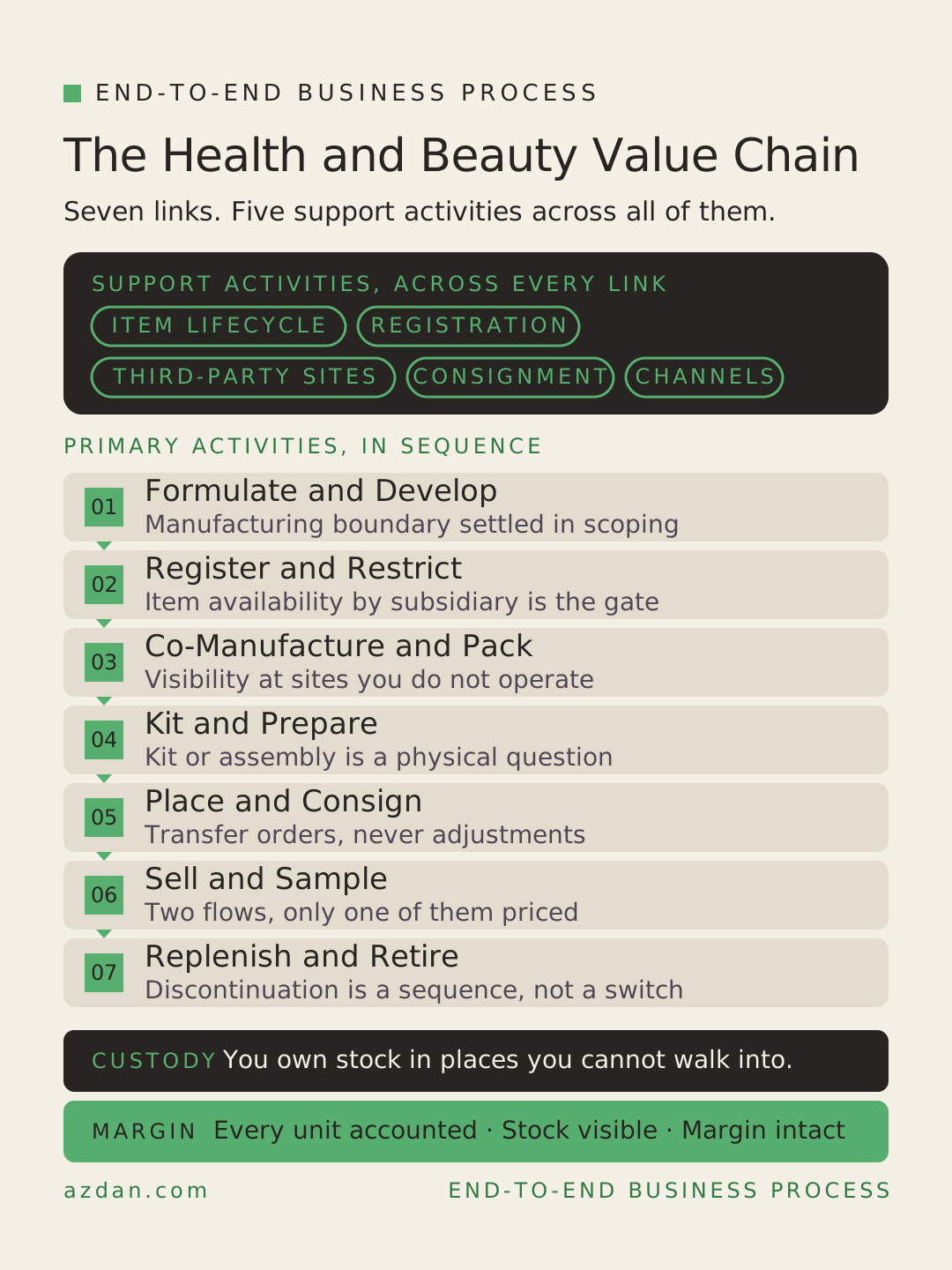
Formulate and Develop → Register and Restrict → Co-Manufacture and Pack → Kit and Prepare → Place and Consign → Sell and Sample → Replenish and Retire
Three things make it unlike a general consumer goods chain. Custody and ownership come apart, because stock sits at contract manufacturers and on consignment at retail counters while remaining on the brand's balance sheet. A material share of volume never generates revenue, and it has to post somewhere other than cost of goods sold. And market access is a gate rather than a preference, because an item that is not registered for a market cannot be sold into it regardless of how much stock exists.
Methodology note. This maps the end-to-end process using the value chain model, applied to the health and beauty process design Azdan works with across its NetSuite delivery in the UAE, Saudi Arabia, and Egypt. Where a point reflects delivery experience rather than measured data, it is labeled as a recommendation.
Custody Without Control
Start with the ownership question, because it reorganizes everything downstream.
The typical branded manufacturer in this sector does not manufacture. Contract manufacturers handle production, and frequently the warehousing and distribution of finished goods as well. The brand's system is therefore not recording what happens inside its own four walls. It is a coordination layer over physical operations someone else runs.
At the other end of the chain the same thing happens in reverse. Consignment and concession stock sits at the customer's location, in a department store or a beauty hall, and the brand still owns it. The mechanism is a transfer order to a consignment location, which moves the stock physically without selling it, and a transfer order back for anything returned.
So a beauty brand's inventory exists in at least three custody states at once: at a contract manufacturer, in its own or a third-party warehouse, and on a retailer's counter. All three are assets. Only one of them is somewhere the brand can walk into.
Recommendation: build the location structure around custody, not geography. A location that represents a contract manufacturer's warehouse and a location that represents a concession counter are different kinds of thing from a distribution center, and treating all three as generic warehouses is how stock goes missing on paper long before it goes missing physically.
Not Everything That Moves Is Sold
The second structural fact, and the one that quietly distorts margin.
Testers on a counter, samples in an order, sachets in a magazine, gift with purchase during a campaign. All of it is real inventory consuming real cost, and none of it produces a revenue line. In most industries this is a rounding error. In beauty it is a deliberate and substantial part of how the product is marketed.
The accounting requirement is that this volume posts to accounts other than cost of goods sold, so that gross margin reflects what was actually sold rather than what was given away alongside it.
Here the leading practice is unusually candid about a gap. There is no native tester item type in NetSuite. The recommended approach is to create a separate child item under the parent product line, named accordingly, so the business can track its own accounts and inventory levels on that item record, and then to designate it using the Item Lifecycle Status field, which represents the stage of an item as tester, sample, discontinued, or active.
Recommendation: decide the tester and sample structure before the item master is built, not after. It is a duplication of part of the catalog, and retrofitting it means splitting history across old and new item records for every product with a tester.
The Kit or Assembly Decision
Gift sets, bundles, and value packs are central to beauty selling, and they force a choice between two item types that behave very differently. The choice is easy to make casually and expensive to reverse.
Read the second and third rows together. A kit cannot be bought and cannot be counted, which is fine for a bundle assembled at the moment of picking and unworkable for a boxed set that physically exists on a pallet. If the set is a physical object sitting in a warehouse, it is an assembly. If it is a convenience for the order taker, it is a kit.
Recommendation: audit every existing bundle against that single question before migrating it. Most brands have both kinds and have called them all the same thing.
The Health and Beauty Value Chain
Primary activities, in sequence:
Support activities, running across every link:
- Item lifecycle and merchandise hierarchy
- Registration and market restriction
- Contract manufacturer and third-party site visibility
- Consignment and concession stock control
- Channel and retail partner management
The margin: every unit accounted for whether it was sold or given, stock visible wherever it sits and whoever holds it, and a gross margin that survives the sampling program.
Item lifecycle heads the support list because in this sector the item master carries states that other industries do not need. Active, tester, sample, and discontinued are not reporting conveniences. They determine which accounts a movement posts to and whether the unit was ever supposed to generate revenue.
The Seven Links
1. Formulate and Develop
Formula development, packaging design, and the decision about what will actually be made in house.
The scoping question that matters most is settled here, and the leading practice is direct about it. NetSuite's manufacturing capability is best used for final packaging of finished goods, or for managing inventory levels at contract manufacturing locations. It is explicitly noted that the native manufacturing functionality often falls short of branded manufacturers' expectations for contract manufacturing and high-volume in-house processes, and that such requirements typically create exceptions or point toward a partner product or an integration to dedicated manufacturing software.
Recommendation: resolve this in scoping rather than during testing. A brand that expects full formulation and batch manufacturing inside NetSuite has a different project, and probably a different system boundary, than one using it for final pack and contract manufacturer visibility.
2. Register and Restrict
Market access. An item that is not registered for a market cannot be sold there, whatever the stock position says.
The mechanism inside the system is item availability by subsidiary. Leading practice is to make items available to the parent and the appropriate child subsidiaries to support growth, unless there are specific regulatory requirements where items need to be restricted by subsidiary. That exception is doing a lot of work in this sector, because ingredient rules, labeling requirements, and product registration all vary by market.
Recommendation: treat the subsidiary restriction list as a controlled register with an owner, reviewed when registrations are granted or lapse. The failure mode is not a blocked sale. It is an unblocked one.
3. Co-Manufacture and Pack
Components go to the contract manufacturer, finished goods come back, or never physically come back at all because the same site ships to customers.
Where NetSuite runs the build, assemblies are constructed through a work order that consumes component inventory and increases finished goods, and can be reversed through an unbuild. Where the contract manufacturer runs it, the system's job is inventory visibility at a location the brand does not operate.
Units of measure deserve attention here. Assembly components are commonly tracked in different units from the finished item, with bulk purchased in liters and filled in milliliters, so the conversion has to be right at the item level before the first build.
4. Kit and Prepare
Sets, bundles, testers, samples, and gift with purchase all get prepared here, and the kit or assembly decision above determines how each behaves.
This is also where the sampling program becomes a supply chain activity rather than a marketing one. A campaign that gives away a sachet with every order has a component requirement, a lead time, and a stock position, exactly like a saleable product.
Recommendation: plan sample and tester demand alongside saleable demand in the same replenishment cycle. Treating it as a marketing budget line rather than a stock line is how campaigns run out of samples halfway through.
5. Place and Consign
Stock moves to where it will be sold, and in this sector that frequently means moving it without selling it.
Transfer orders are the mechanism for all of it, between warehouses, to store locations, and to consignment or concession locations at a customer's site. The transaction facilitates a formal fulfillment at the source and a receipt at the destination, so the movement is recorded at both ends rather than assumed. By default the item cost is used as the transfer cost, and that should only be changed for intercompany transfers.
Recommendation: use transfer orders rather than inventory adjustments for every physical movement, including consignment placements. An adjustment records that the number changed. A transfer order records that goods moved from somewhere to somewhere, which is the question asked during a stock investigation.
6. Sell and Sample
Retail partners, concessions, direct to consumer, and marketplaces, with the two flows running side by side.
The sold flow is conventional. The given flow is the one that needs designing: tester items consumed at counters, samples attached to orders, gift with purchase triggered by campaign rules. Each has to reduce inventory and post to the correct account, and each has to be visible as a cost of doing business rather than disappearing into cost of goods sold.
Recommendation: report sampling cost as its own line, monthly, against the revenue of the products it supported. It is one of the few marketing investments in any industry with a precise unit cost and a precise unit count, and most brands do not use that.
7. Replenish and Retire
Reorder points, preferred stock levels, lead times, and safety stock drive replenishment through purchase orders and transfer orders. The supply chain control tower gives a running balance per item across sales orders, purchase orders, and intercompany transfer orders, provided the relevant locations are enabled for inclusion.
Retirement is the other half and gets less attention. Discontinued is an item lifecycle status, and a discontinued item with stock at three custody locations and a tester variant still on counters is not a single decision. It is a sequence: stop replenishment, sell through, recall consignment stock, retire the tester, then close the item.
Recommendation: write the discontinuation sequence down once and reuse it. Beauty ranges turn over constantly, and an undocumented retirement process leaves orphan stock at third-party sites that nobody is looking for.
What Breaks: Seven Recurring Failures
These are patterns that recur in health and beauty businesses. They are drawn from delivery experience and offered as recommendations rather than measured findings.
- Testers modeled as ordinary items. There is no native tester type, so without a deliberate structure the giveaway volume lands in cost of goods sold and gross margin is understated everywhere.
- Full manufacturing assumed to be in scope. The leading practice warns that native functionality often falls short for contract manufacturing, and that a partner product or integration is frequently needed.
- Kits used where assemblies were needed. A kit cannot be purchased and its quantity on hand cannot be seen, which is discovered when someone tries to count the boxed sets.
- Consignment stock treated as sold. It has moved and it is not on site, but it is still owned, and it still has to be counted and valued.
- Item availability by subsidiary left open. Regulatory restriction is an exception that has to be applied deliberately, and the failure is a sale that should not have happened.
- Sample demand planned outside the replenishment cycle. Campaigns run out because the sachets were a marketing line rather than a stock line.
- No discontinuation sequence. Ranges turn over fast and orphan stock accumulates at sites the brand does not visit.
Reading Your Own Chain: Four Questions
- What proportion of units shipped last quarter generated no revenue? If nobody can answer, the sold and given flows are not separated and margin is approximate.
- How much inventory do you own at locations you do not operate? Contract manufacturers plus consignment counters, at cost.
- Which items are restricted by subsidiary, and when was that list last reviewed against current registrations?
- How many discontinued items still have stock somewhere? The number is usually higher than expected and always older.
Which Health and Beauty Business Are You
The chain is common to the sector, but its center of gravity shifts by model, and Azdan maintains separate industry practices for each.
- Branded manufacturer selling through retail partners. The chain is heaviest at co-manufacture, place, and consign, with transfer orders and third-party site visibility carrying the weight. See NetSuite ERP for Wholesale Distribution.
- Owned retail and concessions. Store and counter inventory, promotions, loyalty, and returns processed back into stock. See NetSuite ERP for Retail.
- Direct to consumer and marketplace. Order volume, sampling attached to orders, subscription and replenishment models, and a return rate that behaves like apparel. See NetSuite ERP for E-Commerce.
- In-house production. Where formulation and filling genuinely happen internally rather than at a contract manufacturer. See NetSuite ERP for Manufacturing.
Most beauty brands of any scale run three of these at once, from one inventory pool, which is the real complication.

Recommendation
If you are mapping a health and beauty business end to end, produce two numbers before anything else is designed.
First, the value of inventory you own at locations you do not operate. Contract manufacturers plus consignment counters. It is usually a larger number than expected and it is the part of the balance sheet nobody can walk into.
Second, the proportion of units shipped that generated no revenue. Testers, samples, and gift with purchase. That number tells you how much of the chain is running a second, unpriced flow, and whether your gross margin is measuring the business you think it is.
Then settle the manufacturing boundary in scoping rather than in testing. It is the single scope question in this sector most likely to be answered optimistically and corrected expensively.
Sources
- Oracle NetSuite, Health and Beauty ERP Software
- Oracle NetSuite, Health and Beauty Industry Insights
- Oracle NetSuite, What Is Value Chain? An Expert Guide, for the value chain model
- Michael E. Porter, Competitive Advantage: Creating and Sustaining Superior Performance, 1985, for the original value chain framework
Process content reflects health and beauty leading practice as applied by Azdan, checked August 2026. Product registration and ingredient rules vary by market, so confirm against the relevant authority before acting on them.
Related Azdan Resources
- End-to-End Business Process for Food and Beverage
- End-to-End Business Process for Apparel, Footwear, and Accessories
- End-to-End Business Process for Advertising
- Oracle NetSuite Implementation
Published by Azdan, an Oracle NetSuite Solution Provider operating across the UAE, Saudi Arabia, and Egypt. Guidance in this article reflects Azdan's process design work with health and beauty businesses. Content checked August 2026.