.svg)


End-to-End Business Process for Hospitality: Restaurants and Hotels
A restaurant sells forty burgers. Nothing in that transaction touches a single bun. The point of sale records revenue; the buns were bought weeks ago on an invoice that named a case of bread, not a burger. What was sold and what was used are recorded by two systems that never speak to each other directly, and the only bridge between them is a recipe living somewhere else again. That gap is where hospitality margin is won and lost. This guide maps the hospitality value chain end to end.
The Short Answer
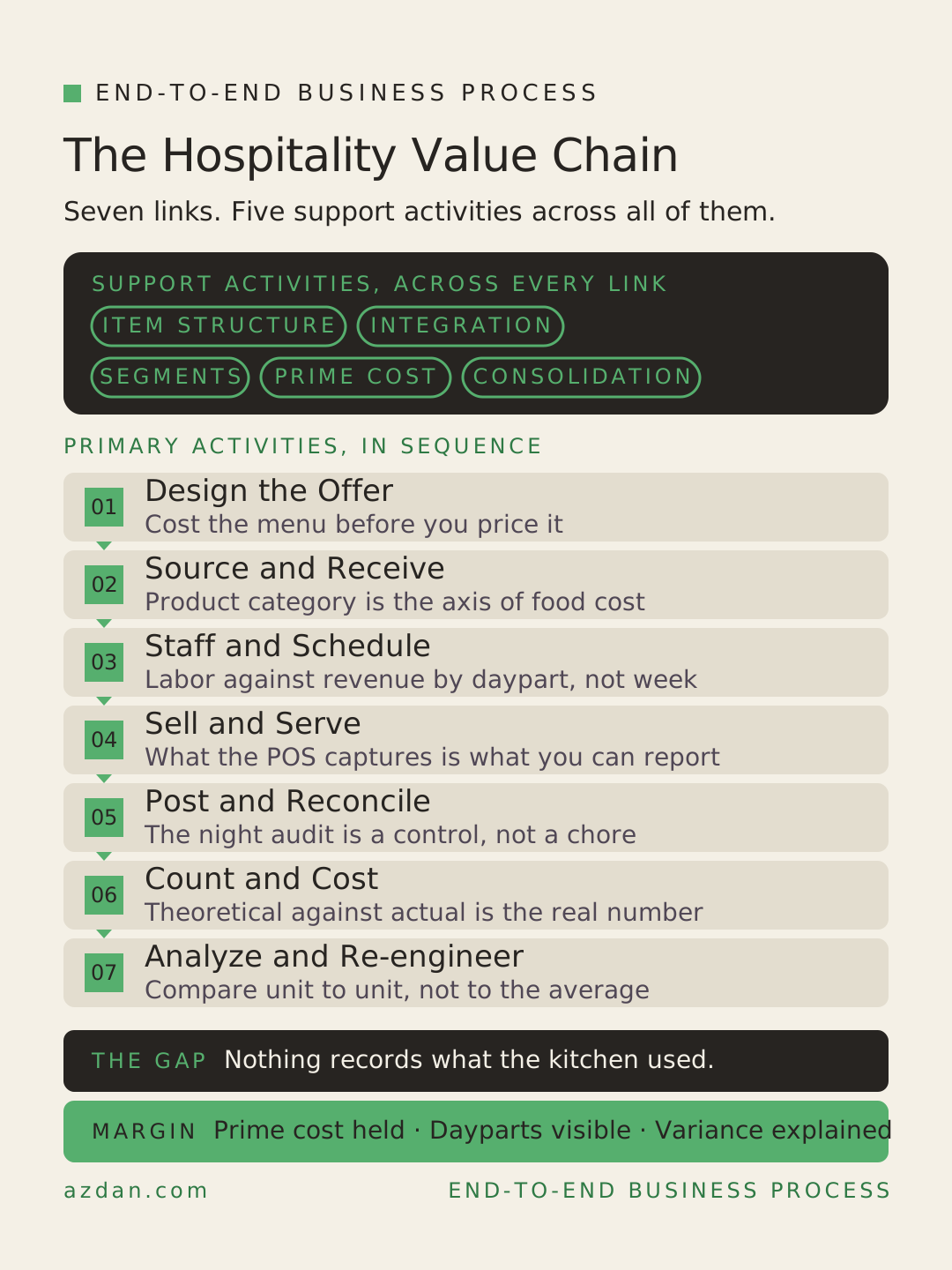
The hospitality value chain runs in seven links:
Design the Offer → Source and Receive → Staff and Schedule → Sell and Serve → Post and Reconcile → Count and Cost → Analyze and Re-engineer
Three things make it unlike the other chains in this series. The transaction system is not the finance system, so the ERP learns what was sold from a nightly feed rather than from its own records. Consumption is never documented, because food leaves the kitchen on a plate rather than on a fulfillment, which makes a physical count the only hard number in the chain. And the business runs two kinds of perishability at once, since a hotel room expires nightly at zero value while the food in its kitchen expires on a shelf life clock.
Methodology note. This maps the end-to-end process using the value chain model, applied to the hospitality process design Azdan works with across its NetSuite delivery in the UAE, Saudi Arabia, and Egypt. Where a point reflects delivery experience rather than measured data, it is labeled as a recommendation.
What the System Knows, and What It Does Not
Start here, because the whole chain is shaped by a boundary most people assume is not there.
The hospitality edition of NetSuite presupposes that ingredient and menu-level inventory management is maintained in a third-party solution. Menu items sold through the point of sale arrive in the ERP as non-inventory items, created with a name and a general ledger account so the incoming POS transaction has somewhere to post. Selling a menu item records revenue. It does not deplete stock, because in the ERP the menu item is not stock.
That is a deliberate design, not a shortcoming, and it produces a very specific division of knowledge:
Read the third and fourth rows together. Consumption in hospitality is never recorded as a transaction. It is inferred, and then checked against a count. The difference between theoretical usage and actual usage is the operating control of the entire industry, and no single system produces it on its own.
Recommendation: establish where the recipe lives before the ERP scope is agreed. If the answer is a spreadsheet, the theoretical side of the variance does not exist and the count is being compared against nothing.
The Dimensions That Matter, and One Limit on Them
Hospitality does not report by customer. It reports by where, when, and how.
The segmentation is built from a product category on the item record, tracked automatically in the general ledger, plus three custom segments assigned to incoming point of sale transactions:
- Product category carries the major groups: food, beer, wine, liquor, and retail for menu items; meat, seafood, produce, dairy, and grocery for ingredients; and a separate set for assets such as small wares, china, glass, and silverware.
- Daypart separates breakfast, lunch, dinner, and happy hour, and is assigned automatically to integrated POS transactions rather than keyed by anyone.
- Order type separates dine-in, take-out, catering, and delivery, which have entirely different margin profiles once delivery commission is accounted for.
- Revenue center divides a location into its functions. In a quick-service restaurant each register and the drive-thru is a revenue center. In a full-service restaurant it is the bar and the dining room. In a hotel it is the restaurant, the bar, and the gift shop within one property.
That structure is what makes hospitality reporting work: a location is a place, and revenue centers are the businesses inside it.
One documented limitation is worth knowing before design, not after. Custom segments cannot be used for budget segmentation, and they do not always maintain hierarchical presentation in dropdowns and group reporting. So you can report actuals by daypart and by revenue center, and you cannot budget in the same dimensions using that structure.
Recommendation: raise this with the finance team during design. Operators who plan by daypart and revenue center will assume the budget follows the same shape, and discovering otherwise during the first planning cycle is an unpleasant surprise that has a workaround only if it is anticipated.
The Hospitality Value Chain
Primary activities, in sequence:
Support activities, running across every link:
- Item and product category structure
- Point of sale and property system integration
- Segment reporting by daypart, order type, and revenue center
- Prime cost control
- Multi-property consolidation
The margin: prime cost under control, every daypart and revenue center visible, and a count that explains the gap rather than just reporting it.
Integration heads that list for a reason peculiar to this sector. In most industries the ERP is where transactions happen. Here it is where they arrive, nightly, from somewhere else, and the integrity of every downstream number depends on a feed that runs while everyone is asleep.
The Seven Links
1. Design the Offer
Menu engineering for restaurants, room product and rate structure for hotels.
The commercial decision here sets the ceiling on everything downstream. A menu item's contribution is fixed the moment its recipe and price are set, and no amount of operational discipline recovers a badly costed dish. For rooms, the equivalent is a rate structure that has to hold against a perishable inventory, which behaves much more like media than like food.
Recommendation: cost the menu before pricing it, and recost when ingredient prices move materially. Most independent operators price against the market and discover the cost afterwards.
2. Source and Receive
Food, beverage, and supplies, purchased against vendor bills that categorize spend by ingredient group.
This is the only link where consumption-related cost enters the ERP with any precision, which is why the product category structure on the item record does so much work. Meat, seafood, produce, dairy and grocery are not arbitrary labels. They are the axis along which food cost gets analyzed.
3. Staff and Schedule
Labor, the other half of prime cost and usually the larger half.
Hospitality lives or dies on prime cost, meaning food and beverage cost plus labor cost as a proportion of revenue. Labor is also the more controllable of the two in the short run, because a schedule can be changed this week while a supply contract cannot.
Recommendation: report labor against revenue by daypart, not by week. A restaurant that is efficient at dinner and overstaffed at lunch shows a healthy weekly number and is losing money for four hours a day.
4. Sell and Serve
The guest transaction, captured in the point of sale or the property management system.
This link happens entirely outside the ERP, and that is correct. What matters for the chain is what gets captured for later: the menu item, the daypart, the order type, and the revenue center. Anything not captured at the point of sale cannot be reported afterwards, and the point of sale configuration is usually owned by operations rather than by finance.
Recommendation: have finance review the point of sale item and category configuration before go-live. The reporting the CFO wants is determined by choices made in a system the CFO does not own.
5. Post and Reconcile
The nightly feed, and the most overlooked link in hospitality finance.
Nightly revenue summaries, guest charges, and settlements import from the property management and point of sale systems, posting against the item and segment structure. In a hotel this is the night audit, and it carries room revenue, tips, departmental expenses, and intercompany charges through to the general ledger.
There is a second integration underneath it that only hotels have. A point of sale connected to the property management system lets a charge in the hotel's restaurant post automatically to the guest's room bill, which means an outlet transaction can settle in two entirely different ways depending on how the guest chose to pay.
Then the reconciliation: what the POS says was taken, what the bank says was deposited, what the card processor settled, what posted to guest folios, and what the cash count found. Numbers that should agree and frequently do not.
Recommendation: treat the daily reconciliation as a controlled process with an owner and an exception report, not as something a location manager does when there is time. At multi-unit scale it is the primary control against loss, and it degrades quietly.
6. Count and Cost
The physical count, and the moment theory meets reality.
Opening stock, plus purchases, minus closing stock, gives actual usage. Recipes multiplied by items sold give theoretical usage. The difference is the number that matters, and it is the only view of waste, over-portioning, and shrinkage the business will ever get.
Recommendation: count the high-value and high-variance categories weekly and everything else monthly. A full count of every line every week is not sustainable and does not survive contact with a busy kitchen, so it stops happening entirely. A targeted count that actually gets done beats a comprehensive one that does not.
7. Analyze and Re-engineer
The closing link, feeding back into link one.
Menu mix analysis against contribution, daypart performance, revenue center profitability, and prime cost by location. In a multi-unit business the useful comparison is unit against unit on the same measures, because the outlier is usually more informative than the average.
What Breaks: Seven Recurring Failures
These are patterns that recur in hospitality businesses. They are drawn from delivery experience and offered as recommendations rather than measured findings.
- The recipe layer assumed to be in the ERP. Ingredient-level inventory is presupposed to live in a third-party system, and a scope that does not name that system has a hole in it.
- Budgeting expected in the same dimensions as reporting. Custom segments cannot be used for budget segmentation, and operators plan by daypart.
- Point of sale configuration owned only by operations. The reporting available to finance is decided by item and category setup in a system finance does not control.
- Daily reconciliation left to location managers. It is the primary loss control at multi-unit scale and the first thing to lapse under pressure.
- Labor reported weekly rather than by daypart. A good week hides a bad shift, every day.
- Counting everything, and therefore counting nothing. Comprehensive counts stop happening. Targeted counts survive.
- Menu priced before it is costed. The contribution of a dish is set when the recipe and price are fixed, and operations cannot recover it later.
Reading Your Own Chain: Four Questions
- Where does the recipe live, and who maintains it? If the answer is a spreadsheet on someone's laptop, theoretical food cost does not exist.
- What is the gap between theoretical and actual usage, by category? One number for the whole kitchen is not actionable. By category it points at a problem.
- What is prime cost by daypart and revenue center? Weekly and site-level numbers conceal the shifts and outlets that are losing money.
- How often does the daily reconciliation fail to balance, and who sees it? If nobody can answer, the control is not running.
Which Hospitality Business Are You
The chain is common to the sector, but its weight shifts by model.
- Multi-unit restaurants. The chain is heaviest at post, reconcile, and count, with point of sale integration carrying every downstream number. Azdan works on POS to ERP integration across the region, including the platforms most widely deployed in UAE and Saudi F&B. See Top 20 POS Software Providers in the UAE and Top 20 POS Software Providers in Saudi Arabia.
- Hotels and multi-outlet properties. A property is a location and its restaurant, bar, and gift shop are revenue centers, each with its own margin profile inside one set of accounts.
- Beverage-led operations. Where the supply chain behaves like distribution and the outlet behaves like hospitality. See NetSuite ERP for Beverages Distribution.
- Retail attached to hospitality. Gift shops, retail counters, and packaged goods sold alongside service. See NetSuite ERP for Retail.
The upstream supply chain that feeds all of them is covered separately in End-to-End Business Process for Food and Beverage, which maps the chain from supplier certification through to delivery.
Recommendation
If you are mapping a hospitality business end to end, answer one question before anything else is scoped: where does the recipe live, and does it produce a theoretical usage figure the finance team can get at?
That single answer determines whether food cost control is a real process or an after-the-fact observation. With it, the physical count becomes a variance you can act on. Without it, the count is just a number that moves.
Then check the second boundary: what the point of sale captures. Daypart, order type, and revenue center are assigned to transactions as they arrive, and anything not captured there cannot be reported later, no matter how the ERP is configured.
Sources
- Oracle NetSuite, Restaurant ERP
- Oracle NetSuite, Hospitality ERP, for nightly import of revenue summaries, guest charges, and settlements from property management and point of sale systems
- Oracle NetSuite, Hospitality Accounting Software, for night audit revenue, tips, departmental expenses, and intercompany charges posting to the general ledger
- Oracle NetSuite, 6 Business Benefits of System Integration in Hospitality, for point of sale to property management posting of outlet charges to a guest folio
- Oracle NetSuite, What Is Value Chain? An Expert Guide, for the value chain model
- Michael E. Porter, Competitive Advantage: Creating and Sustaining Superior Performance, 1985, for the original value chain framework
Process content reflects hospitality leading practice as applied by Azdan, checked August 2026.
Related Azdan Resources
Published by Azdan, an Oracle NetSuite Solution Provider operating across the UAE, Saudi Arabia, and Egypt. Guidance in this article reflects Azdan's process design work with hospitality businesses. Content checked August 2026.