.svg)


End-to-End Business Process for Food and Beverage
Every other industry in this series races a clock the business itself sets. A season, a term, a contract. Food and beverage races a clock printed on the product, started by someone else, usually before the goods were owned. That single difference reorganizes the whole chain: procurement becomes a race, inventory policy stops being first in first out, delivery frequency becomes a margin lever, and the lot number becomes the unit that the business is actually accountable for. This guide maps the food and beverage value chain end to end.
The Short Answer
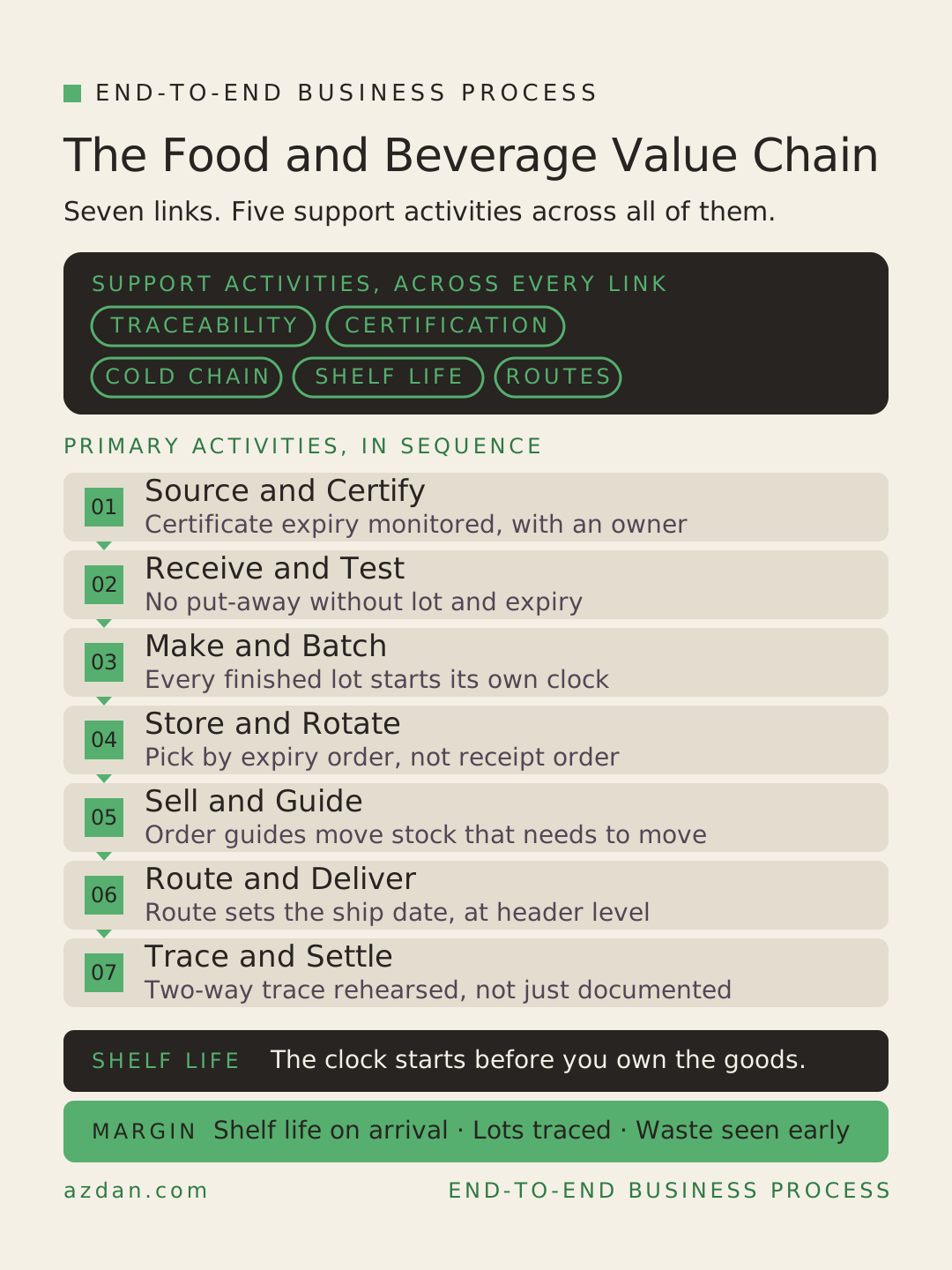
The food and beverage value chain runs in seven links:
Source and Certify → Receive and Test → Make and Batch → Store and Rotate → Sell and Guide → Route and Deliver → Trace and Settle
Three things make it unlike a general distribution chain. Remaining shelf life is the real currency, and every link either preserves it or burns it. The lot, not the item, is the unit of accountability, because a recall is addressed to a lot and answered against a clock. And the truck is part of inventory policy, because a product that needs refrigeration cannot travel on a vehicle that does not have it.
Methodology note. This maps the end-to-end process using the value chain model, applied to the food and beverage process design Azdan works with across its NetSuite delivery in the UAE, Saudi Arabia, and Egypt. Where a point reflects delivery experience rather than measured data, it is labeled as a recommendation.
Remaining Shelf Life Is the Currency
Start here, because it explains most of what follows.
A carton of yogurt with ninety days of shelf life is not worth the same on day one and day sixty. It is not simply worth less, either. Past a threshold, a retailer will refuse the delivery outright, which converts a sale into a return, a disposal cost, and a credit note. The value does not decline smoothly toward zero. It falls off a cliff that the buyer, not the seller, decides where to place.
So the operative number in a food business is not stock on hand. It is stock on hand with enough life left to sell, and that number is consumed by everything: supplier lead time, customs clearance, time on the dock, time in the warehouse, and the gap between delivery runs to a given customer.
The chain consequences are direct:
- Inventory policy is first expired, first out, not first in, first out. The two diverge whenever receipts arrive out of date order, which happens constantly with mixed suppliers and mixed lead times.
- Backorders are usually the wrong answer. In durable goods a backorder preserves the sale. In food it often produces a short-dated delivery later, which is worse than no delivery. This is why fill or kill exists: backordered order lines close automatically at invoicing unless the item sits on a per-customer exception list.
- Route frequency is an inventory decision. A customer served twice a week can hold less and take fresher product than one served fortnightly. The delivery schedule is not just a logistics cost, it is a determinant of how much shelf life reaches the shelf.
Recommendation: report inventory by days of remaining shelf life, not just by quantity and value. A business that cannot age its stock forward is discovering its write-offs rather than managing them.
The Lot Is the Unit of Accountability
The second structural fact, and the one that carries the tail risk.
Nothing in a food business is recalled at item level. A recall names a lot. So the chain has to be able to answer two questions quickly, and they are different questions requiring different data:
Both directions have to work from the same data, captured as a by-product of ordinary transactions rather than assembled during the emergency. That is the whole design goal of lot handling.
NetSuite supports this with lot-numbered items carrying expiration dates, and with lot auto numbering: a defined lot number format assigned to items, so that entering inventory detail assigns the number automatically rather than relying on someone typing it. The lot record can carry the supplier's own lot number and the manufactured date, and additional lot fields can be created and made mandatory per item.
Recommendation: make supplier lot number and manufactured date mandatory fields on receipt for any item that carries an expiry. They cost seconds at the goods-in door and they are the difference between a two-hour trace and a two-day one.
The Food and Beverage Value Chain
Primary activities, in sequence:
Support activities, running across every link:
- Lot traceability and recall readiness
- Certification and compliance management
- Cold chain integrity
- Shelf life and waste control
- Route and fleet management
The margin: product delivered with usable life left, every lot traceable in both directions, and waste that appears as a number before it appears as a write-off.
Lot traceability heads the support list because it is the only one where failure is existential rather than expensive. A business can survive poor margin visibility. It does not reliably survive a recall it cannot execute.
The Seven Links
1. Source and Certify
Supplier selection in food carries an obligation that most industries do not have: the supplier's paperwork is part of the product.
Approvals, food safety certifications, and in this region halal certification, all have issuing bodies, scopes, and expiry dates of their own. A certificate that lapses does not stop the goods arriving. It stops them being legally sellable, which is discovered later and worse.
NetSuite handles this through vendor certification tracking, holding certification type and description on the vendor record with visibility of certifications approaching expiration.
Recommendation: treat certificate expiry as a monitored date with an owner and a lead time, the same way a contract renewal is monitored. The failure mode is not that nobody knows the certificate expires. It is that nobody is told until after it has.
2. Receive and Test
Goods arrive, and three things must be captured before they move anywhere: the lot, the expiry, and the result of whatever inspection applies.
This link is where most traceability programs are won or lost, because it is the only moment when supplier lot data is easy to capture. Once the pallet is put away, the link between the physical goods and the supplier's paperwork is a manual reconstruction.
Failed inspection follows the same pattern used elsewhere in NetSuite: transfer the failed quantity to a quarantine sublocation, make it unavailable for commitment, then decide between return to vendor, rework, or disposal.
Recommendation: do not allow put-away without lot and expiry. A configuration that permits blank expiry dates will accumulate untraceable stock, and nobody notices until the day it matters.
3. Make and Batch
For manufacturers, the recipe is a bill of materials and the formula is a revision of it, with component yield defined at the revision component level so that planning, work order creation, and inventory commitment all account for loss automatically rather than by manual inflation.
Two things distinguish food production from discrete manufacturing. Yield is variable rather than fixed, because agricultural inputs vary. And the output inherits a new expiry date derived from the production date and the shelf life of the formula, which means every finished lot starts its own clock.
Allergen handling sits here too. Allergen types are maintained centrally, and allergen statements are created per product and made available from the item master for customers who require them, covering the allergens identified by law including wheat and gluten, milk, eggs, peanuts, tree nuts, fish, shellfish, and soy.
4. Store and Rotate
The warehouse link, where remaining shelf life is either protected or quietly spent.
Bins identify where stock sits, and a preferred or primary pick bin per item speeds put-away and picking. But the rotation rule is what matters: picking must follow expiry order, not receipt order, and the two are only the same when deliveries arrive in date sequence.
Temperature zones make this a physical problem as well as a data one. Ambient, chilled, and frozen are separate inventories with separate handling, and stock that crosses zones incorrectly is not merely misplaced, it is compromised.
Recommendation: measure and review stock aged by remaining shelf life weekly, at item and lot level. Monthly is too slow for anything with a ninety-day life.
5. Sell and Guide
Food selling is unusual in that the order is often composed before the customer places it.
Order guides are predefined lists of items customers order regularly, and they come in four useful forms. A historical guide is built from invoiced customer history. A default guide is the one that loads for that customer automatically. A customer guide can be sequenced to that customer's own layout, so a restaurant sees products in the order they walk their store room. And a template guide is built independently and pushed to many customers at once, which is how promotions, weekly flyers, holiday pushes, and chain-restricted item lists are distributed.
That last one is worth noticing. A template order guide is a merchandising instrument, not an administrative convenience. It is how a distributor moves stock that needs to move, to the customers who can absorb it, before its shelf life runs out.
Fill or kill belongs here as well: backordered lines close at invoicing unless the item is on the customer's exception list, maintained per subsidiary from the customer record.
6. Route and Deliver
The link that most general distribution chains do not have in this form.
Delivery runs on routes with stops, delivery days, and delivery time windows, maintained per shipping location and assigned by customer delivery address. A customer may have several delivery addresses, each with multiple route options. The ship date on an order is then derived from the route's delivery days and the shipping location's order cut-off times, rather than promised freely.
The fleet is part of this. The truck list carries payload weight and capacity alongside ambient, refrigerated, and frozen capability, which makes vehicle capability an inventory constraint and not just a transport one.
Two configuration details worth knowing before design starts. Route, stop, ship date, and delivery address are held at the sales order header level, not the line level, so an order cannot split across routes without splitting the order. And route-based pick tickets require the multiple shipping routes feature to be enabled, so route picking is a scoping decision rather than a later switch.
Recommendation: if no route exists for a customer delivery address, the order cannot be assigned a ship date or fulfilled. Build route setup into customer onboarding rather than discovering it at the first order.
7. Trace and Settle
The closing link, and the one that proves whether the previous six worked.
Settlement in food carries deductions that other industries meet less often: short-dated refusals, quality claims, promotional allowances, and returns of product that cannot be resold. Each needs a disposition, and each affects both margin and inventory value.
Trace is the other half. The two directions described earlier are exercised here, either in a real event or in a drill.
Recommendation: run a traceability drill on a schedule, pick a lot at random, and time the answer in both directions. A recall procedure that has never been timed is a document, not a capability.
What Breaks: Seven Recurring Failures
These are patterns that recur in food and beverage businesses. They are drawn from delivery experience and offered as recommendations rather than measured findings.
- Expiry capture optional at receipt. Untraceable stock accumulates silently, and the gap is discovered during the event that needed it.
- Picking by FIFO rather than FEFO. The two only agree when receipts arrive in date order, which is rarely.
- Certificate expiry unmonitored. Goods keep arriving after a certification lapses, and the problem surfaces at an audit or a border.
- Inventory reported without shelf life. Quantity and value say nothing about whether stock is sellable, so write-offs arrive as surprises.
- Route data treated as a shipping detail. It determines the ship date and lives at order header level, so it constrains order structure, not just logistics.
- Backorders left on for perishables. A late short-dated delivery is worse than no delivery, which is what fill or kill exists to prevent.
- Recall never rehearsed. The procedure exists, has an owner, and has never been timed against a randomly chosen lot.
Reading Your Own Chain: Four Questions
- What percentage of stock has less than a third of its shelf life left? If this cannot be produced today, the chain is not managing its main currency.
- How long does a two-way trace take on a lot chosen at random? Not the documented target. The measured time.
- What did short-dated returns and quality claims cost last quarter? Usually larger than expected and rarely reported as one number.
- Which customers are served least often, and what does that cost them in shelf life? Route frequency and product freshness are the same question.
Which Food and Beverage Business Are You
The chain is common to the sector, but its center of gravity shifts by model, and Azdan maintains separate industry practices for each.
- Food manufacturing and processing. The chain is heaviest at make and batch, with recipes, variable yield, allergen statements, and lot genealogy through production. See NetSuite ERP for Manufacturing.
- Foodservice and wholesale distribution. The chain is heaviest at sell, route, and deliver, with order guides, fill or kill, and route delivery management carrying the volume. See NetSuite ERP for Wholesale Distribution.
- Beverages. A distinct pattern again, with high volume, dense route networks, and returnable assets in some categories. See NetSuite ERP for Beverages.
- Retail and outlet operations. Where the chain terminates at a point of sale rather than a delivery, with store-level stock and waste. See NetSuite ERP for Retail.
Most food businesses of any scale run at least two of these at once, which is the real complication. The same stock supports a distribution customer, a retail outlet, and sometimes a manufacturing input.
Recommendation
If you are mapping a food and beverage business end to end, produce two numbers before anything else is designed.
First, stock aged by remaining shelf life rather than by receipt date. It reframes the inventory conversation from how much is there to how much is still sellable, and those are different businesses.
Second, the measured time to complete a two-way trace on a randomly chosen lot. Not the target in the quality manual. The time it actually takes today. That number tells you whether the traceability design is real or aspirational, and it is the one number in this industry where being wrong is not merely expensive.
Sources
- Oracle NetSuite, Food and Beverage ERP Software, for lot-level inventory, product freshness, traceability, and variable weight pricing
- Oracle NetSuite, Food and Beverage Manufacturing ERP
- Oracle NetSuite, What Is Value Chain? An Expert Guide, for the value chain model
- Michael E. Porter, Competitive Advantage: Creating and Sustaining Superior Performance, 1985, for the original value chain framework
Process content reflects food and beverage leading practice as applied by Azdan, checked August 2026. Food safety and certification requirements vary by country and by product category, so confirm against the relevant authority before acting on them.
Related Azdan Resources
- End-to-End Business Process for Apparel, Footwear, and Accessories
- End-to-End Business Process for Advertising
- How to Implement NetSuite for Manufacturing
- Oracle NetSuite Implementation
Published by Azdan, an Oracle NetSuite Solution Provider operating across the UAE, Saudi Arabia, and Egypt. Guidance in this article reflects Azdan's process design work with food and beverage businesses. Content checked August 2026.