.svg)


End-to-End Business Process for Services
A manufacturer builds something and then sells it. A retailer buys something and then sells it. A services firm sells something and only then finds out whether it can build it, with people who may not be free, at a price fixed before anyone understood the work. Every other chain in this series moves value forward through a product. This one commits to an outcome first and assembles the capability afterwards. This guide maps the services value chain end to end.
The Short Answer
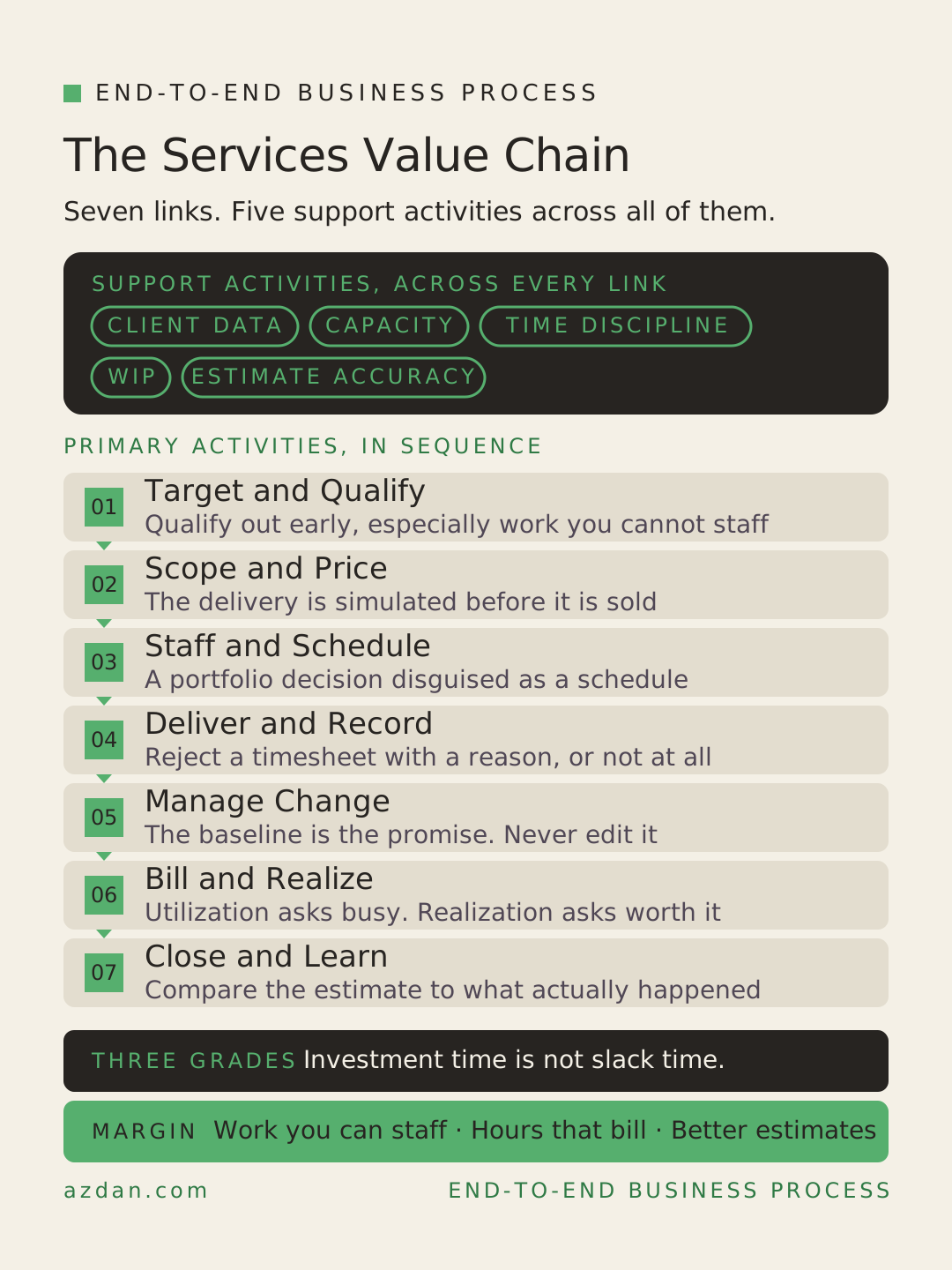
The services value chain runs in seven links:
Target and Qualify → Scope and Price → Staff and Schedule → Deliver and Record → Manage Change → Bill and Realize → Close and Learn
Three things make it unlike the other chains in this series. The promise precedes the capability, so the price is set on a simulation of work that has not happened. Capacity is perishable and cannot be stockpiled, because an hour not sold today does not carry forward. And the firm's headline metric, utilization, can be at target while the business loses money, because being busy and being worth it are different questions.
Methodology note. This maps the end-to-end process using the value chain model, applied to the professional services process design Azdan works with across its NetSuite delivery in the UAE, Saudi Arabia, and Egypt. Where a point reflects delivery experience rather than measured data, it is labeled as a recommendation.
A companion piece covers the same vertical from the implementation side. How to Implement NetSuite for Services Companies covers the seven-phase method and the rate architecture that governs it.
The Delivery Is Simulated Before It Is Sold
Start here, because it inverts the sequence every product chain follows.
When an opportunity needs proper scoping before a quote goes out, the leading practice is to create the project first. Not after the win. Before the quote. The project is built out with a work breakdown structure, resource task assignments made against generic resources rather than named people, and project billing rules applied, in order to establish the three things a price depends on: how many hours the work needs, how long it will take, and what it will cost to deliver.
Once that simulation exists, the forecast charges it generates are pulled back into the opportunity and the estimate, so the number quoted is derived from a modeled delivery rather than from judgment.
That is a genuinely unusual arrangement. The firm constructs a hypothetical delivery, staffed by placeholder people, and prices from it. Which means:
- The estimate is a forecast of a project that does not exist yet, and its accuracy is a measurable thing rather than a matter of opinion.
- Generic resources are the right tool at this stage, because naming individuals before a win creates commitments nobody has made.
- The scoping effort is itself a cost, incurred on work that may never be won, and it needs somewhere to be recorded.
Recommendation: build the scoping project for anything above a value threshold the firm sets, and keep it after the bid whether won or lost. A library of scoping projects with their outcomes is the only reliable way a firm learns whether it estimates well.
Three Grades of Time, Not Two
The second structural fact, and the one most firms get wrong in configuration.
Most services businesses think in two categories: billable and non-billable. The system distinguishes three, using two independent flags on a project, and the distinction matters more than it looks.
The leading practice is explicit: projects covering pre-sales and training should be classified as productive, while administrative work and bench time should carry neither classification.
The consequence is worth stating plainly. Lumping the middle row in with the bottom row is how a firm concludes that training is waste. Pre-sales and professional development are how the next engagement gets won and how the team becomes able to deliver it. Recorded as generic non-billable time alongside admin and bench, they look like the same problem, and they get cut in the same budget round.
Recommendation: set up the internal project structure with these three grades before the first timesheet is submitted, and report them separately every month. The split between investment and slack is the most useful non-billable number a services firm has, and it does not exist unless it was configured for.
The Services Value Chain
Primary activities, in sequence:
Support activities, running across every link:
- Client and engagement master data
- Capacity and resource management
- Time and expense discipline
- Revenue recognition and work in progress
- Estimate accuracy and knowledge reuse
The margin: work won that the firm can actually staff, hours that reach an invoice, and estimates that get better rather than merely repeat.
Capacity management heads that list because it is the constraint the whole chain runs into. A product business short of stock can buy more. A services firm short of the right people in the right week has to decline the work, delay it, or staff it wrongly, and all three are expensive in different ways.
The Seven Links
1. Target and Qualify
Leads, prospects, and the decision about which work to chase.
Leading practice is one opportunity per prospect or customer, with each opportunity able to spawn multiple quotes so pricing variations do not fragment the pipeline. Probabilities are maintained deliberately, because the pipeline report is the forward-looking health of the firm and it is only as honest as its weightings.
Recommendation: qualify out loudly and early. In a capacity-constrained business, pursuing work the firm cannot staff is worse than pursuing work it will lose, because winning it is the bad outcome.
2. Scope and Price
The simulated delivery described above, converted into a quote.
Once a quote is accepted, generate the sales order directly from the estimate so the audit trail from promise to commitment stays intact.
The design detail worth knowing: project department, class, and location set at project creation default onto downstream transactions, including purchase orders, expense reports, vendor bills, sales orders, estimates, and invoices, when classification defaulting is enabled. Recommendation: populate them at creation. Retrofitting segmentation across an engagement's transactions is manual and nobody enjoys it.
3. Staff and Schedule
Generic resources become named people, and the engagement joins the queue for the firm's capacity.
This is the link where the chain meets its constraint. Every engagement competes for the same people, and the resourcing decision is a portfolio decision disguised as a scheduling one. Staffing a junior onto a demanding engagement protects utilization and damages realization. Staffing a senior onto simple work does the reverse.
4. Deliver and Record
The work happens, and the record of it is made by people who did not join the firm to fill in timesheets.
Time approval carries a mechanic worth using: approvers can reject with a note, and the reason travels with the rejection email back to the person who submitted it. Recommendation: require a reason on every rejection. Silent rejections teach people that the system is arbitrary, and the next timesheet is later and less accurate.
5. Manage Change
The link that decides profitability, and the one most often handled by conversation rather than process.
A project budget can be set as a baseline, freezing what was agreed, with past versions retained. Estimate to complete columns can then be populated from items or project resources to keep the forward view honest as the work progresses.
The baseline is the record of the promise. The estimate to complete is the current truth. The gap between them is scope change, and whether it was agreed with the client or absorbed by the firm is the difference between a variation and a loss.
Recommendation: set the baseline at the point of sale and never edit it. A baseline that moves whenever reality does is not a baseline, and the firm loses its only measure of how far the work drifted from what was sold.
6. Bill and Realize
Invoicing, and the moment the firm discovers what its hours were actually worth.
This is where utilization and realization separate. Utilization asks whether people were busy. Realization asks what proportion of the standard value of their hours actually reached an invoice, after discounts, write-offs, and hours absorbed because the engagement overran.
A firm can run at target utilization and still lose money, if the hours are being written off at billing. The two numbers have to be read together, and most firms report only the first because it is the easier one to produce.
Recommendation: report realization by engagement and by engagement leader, not just at firm level. Write-offs concentrate, and the firm-level average conceals which engagements and which leaders are absorbing them.
7. Close and Learn
The closing link, and the one that feeds link two.
Closing an engagement means final billing, releasing the team, and recognizing the remaining revenue. Learning from it means comparing the estimate built during scoping against what actually happened, at task level where possible.
That comparison is the only mechanism by which a services firm improves at the thing it does before every sale. Recommendation: hold a short estimate review on every engagement above a threshold, and feed the result back into the scoping templates. Firms that skip this re-estimate from memory forever.
What Breaks: Seven Recurring Failures
These are patterns that recur in professional services businesses. They are drawn from delivery experience and offered as recommendations rather than measured findings.
- Investment time recorded as non-billable slack. Pre-sales and training belong in their own grade, or the firm cuts the two things that generate future work.
- Utilization reported without realization. Fully busy and unprofitable is a real and common combination.
- The baseline budget edited to match reality. It stops being a baseline and the firm loses its measure of drift.
- Scoping projects discarded after the bid. The estimate library is how a firm learns to estimate, and it is thrown away every time.
- Named resources committed before the win. It creates expectations the resourcing plan never agreed to.
- Segmentation set after project creation. Department, class, and location default onto downstream transactions only if they were there first.
- Timesheets rejected without a reason. The next one is later and less accurate.
Reading Your Own Chain: Four Questions
- What is your realization rate, by engagement leader? The firm-level number hides where write-offs actually concentrate.
- How much non-billable time is investment and how much is slack? If they are one number, the firm cannot manage either.
- How accurate was the estimate on your last ten engagements? Not whether they were profitable. How close the hours were to the scope.
- How often does the baseline budget get edited mid-engagement? Every edit erases evidence of scope drift.
Which Services Business Are You
The chain is common to the sector, but its weight shifts by model, and Azdan maintains separate industry practices for each.
- Management and business consulting. The chain is heaviest at scope, staff, and realize, with estimate accuracy and rate discipline carrying profitability. See NetSuite ERP for Management Consulting.
- Engineering and technical consulting. Longer engagements, deliverable-based milestones, and subcontracted specialist input that has to reach the project margin. See NetSuite ERP for Engineering Consulting.
- IT services and managed services. Where recurring contracted service sits alongside project work, and two different revenue models run through one resource pool. See NetSuite ERP for IT Services.
- Professional services generally. See NetSuite ERP for Professional Services.
One adjacent chain in this series covers a services model with a mechanic of its own. Advertising maps the agency chain, where large pass-through costs sit between the client and the firm and have to be held out of cost of sales.
Recommendation
If you are mapping a services business end to end, produce two numbers before anything else.
First, realization alongside utilization, for the same period and the same teams. Utilization on its own has told firms they were healthy right up to the point they were not. The pair tells you whether busy was worth it.
Second, the split of non-billable time between investment and slack. Pre-sales and training on one side, administration and bench on the other. Most firms report a single non-billable figure and then wonder why cutting it damages next year's pipeline.
Then check one habit rather than one number: whether the baseline budget on live engagements has been edited since the sale. If it has, the firm has no measure of how far its delivery drifted from its promise, which is the central question this whole chain exists to answer.
Sources
- Oracle NetSuite, Professional Services Automation
- Oracle NetSuite, What Is Value Chain? An Expert Guide, for the value chain model
- Michael E. Porter, Competitive Advantage: Creating and Sustaining Superior Performance, 1985, for the original value chain framework
Process content reflects professional services leading practice as applied by Azdan, checked August 2026.
Related Azdan Resources
Published by Azdan, an Oracle NetSuite Solution Provider operating across the UAE, Saudi Arabia, and Egypt. Guidance in this article reflects Azdan's process design work with professional services businesses. Content checked August 2026.