.svg)


How to Implement NetSuite for Manufacturing Companies: Steps and AI Skill
Most ERP decisions can be revisited. In a manufacturing implementation, one cannot. Once an item record is created with a costing method, NetSuite will not let you change it, and that single constraint reaches forward into inventory valuation, margin reporting, variance analysis, and which manufacturing features you are allowed to switch on at all. This guide sets out the consultant-level steps, the decisions that have to be made before the first item exists, and a machine-readable skill file you can hand to an AI assistant to run the same method.
The Short Answer
Short answer: Implement NetSuite for a manufacturing company in seven phases:
Discovery and Scoping → Solution Design → System Configuration → Data Migration → User Acceptance Testing → End-User Training → Go-Live and Hypercare
What makes the manufacturing version distinct is that the costing decision has to be resolved in Phase 2 and cannot be corrected later. It also interacts with feature scope, because neither Work in Process nor Advanced Manufacturing supports FIFO or LIFO costing. So the costing method and the manufacturing feature set are not two decisions taken in sequence. They are one decision, and it is taken before any item record is built.
The process areas a manufacturing implementation genuinely turns on are Design to Build, Item Management, and Ship Central, sitting on top of Master Data Management, with Financial Management carrying the cost accounting. Revenue recognition, which dominates a software implementation, is close to trivial here.
Methodology note. The sequence below follows the seven-phase implementation methodology Azdan applies across its NetSuite delivery work in the UAE, Saudi Arabia, and Egypt, adapted here to the discrete manufacturing process model. Where a point reflects delivery experience rather than measured data, it is labeled as a recommendation.
What Makes a Manufacturing Implementation Different
In a software business the economic unit is a contract term. In a services business it is a delivered hour. In manufacturing it is a physical unit of inventory whose cost is assembled from several sources: material consumed, labor and machine time applied, overhead absorbed, and freight and duty paid to get the raw material through the door.
That assembly is the whole problem. A manufacturer does not record cost once. It records material issue, production time, and overhead absorption as separate events, then compares the total against what the item was expected to cost. The difference is a variance, and variance analysis is the entire management reporting story in this vertical. A system that produces variances nobody can explain has failed, even if every number in it is arithmetically correct.
This produces a scoping profile that looks very different from the other verticals in this series:
Manufacturing is the widest footprint of the three verticals in this series. It is also the one where the decisions cluster earliest, which is why the discovery and design phases carry disproportionate weight.
The Costing Method Is the Decision You Cannot Undo
This is the single most consequential thing to resolve before configuration begins, and it is where the manufacturing model diverges most sharply from the software one, where the item record governs revenue, and the services one, where the employee record governs cost.
In NetSuite, the costing method is set on the item record, and once the item is set up it cannot be changed. The practical implication is that costing has to be planned before item creation, not discovered during it.
Two constraints narrow the choice more than most teams expect, and they compound:
- Neither Work in Process nor Advanced Manufacturing supports FIFO or LIFO costing. If the business needs WIP tracking or the Advanced Manufacturing module, FIFO and LIFO are off the table before the conversation starts.
- LIFO is not permitted under IFRS. IAS 2 requires inventory cost to be assigned using first-in first-out or weighted average cost, and the LIFO option was eliminated when the standard was revised. Entities in the GCC reporting under IFRS therefore cannot use it regardless of what the system supports.
Put those together and a useful deduction falls out. For a GCC manufacturer reporting under IFRS that wants WIP or Advanced Manufacturing, the costing choice collapses to standard or average. That is worth establishing in week one, because it removes two options from a debate that otherwise consumes weeks of design time.
Between the two survivors:
Recommendation: choose standard costing only if the business will commit to maintaining it. Leading practice is to update standards and revalue inventory twice a year, plus whenever new items are created or a known major cost change occurs. A manufacturer that will not do that is better served by average costing, because a stale standard is worse than no standard.
The BOM Revision Is the Second Control Point
The bill of materials carries the recipe, but the revision carries the effectivity, and NetSuite enforces a strict model that surprises teams migrating from spreadsheets.
Only one revision can be active at a time. Revision start and end dates cannot overlap, though gaps between them are allowed. When a component changes, the production manager creates a new revision with a new effective date rather than editing the existing one, which is what preserves visibility into historical component changes.
Some naming and structure conventions that pay for themselves:
- Name the bill of materials the same as the assembly item. Where the BOM differs by plant, name it as the assembly item plus the manufacturing location.
- Every assembly must have exactly one BOM marked as master default. Alternates can be added and pinned to a specific location.
- Component yield can be set at the revision component level once the component yield preference is enabled at the BOM level. It then feeds planning, work order creation, and inventory commitment automatically rather than being applied by hand.
- Other Charge items are how labor and overhead cost enter a revision.
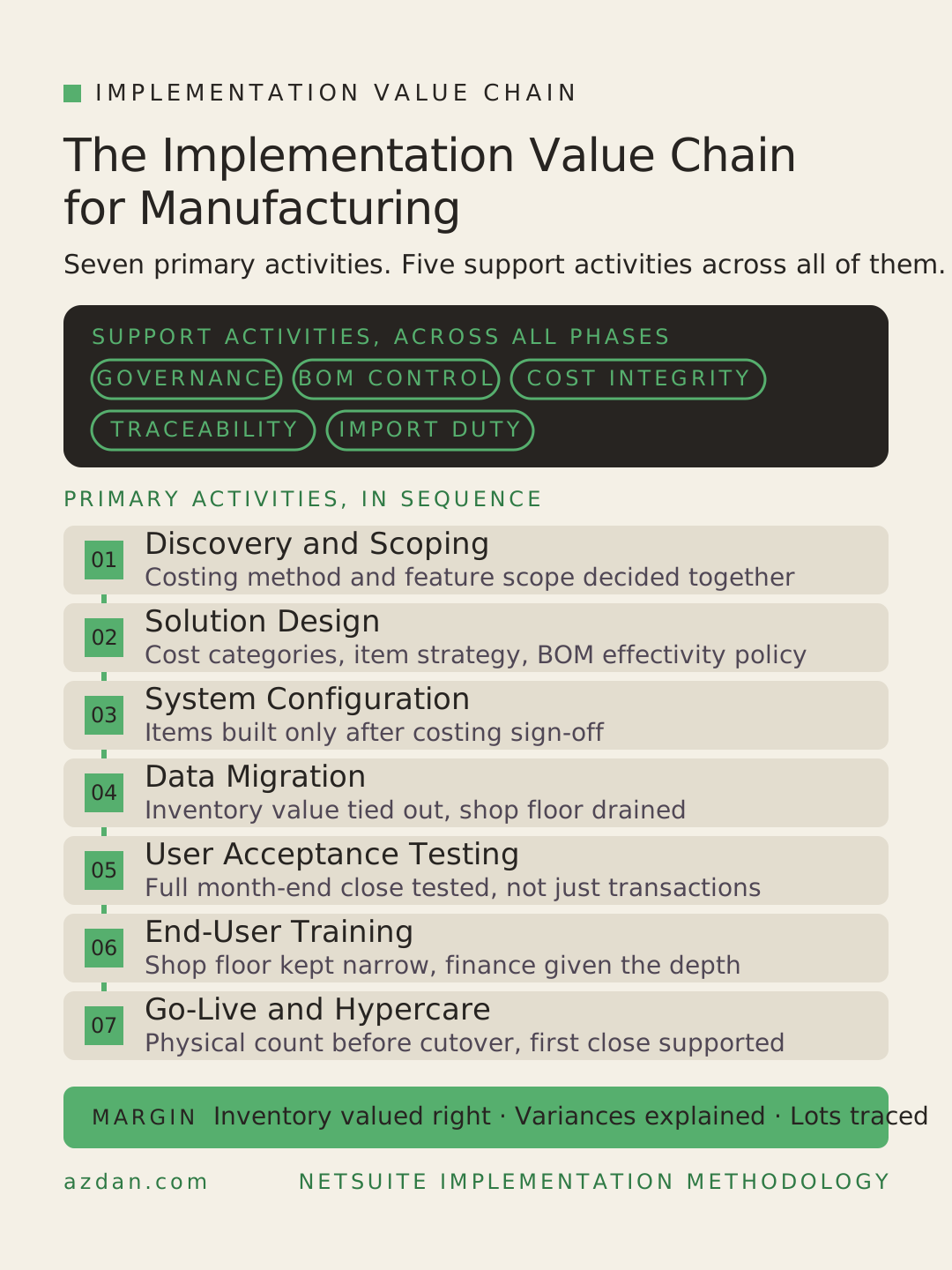
The Implementation Value Chain for Manufacturing Companies
A Gantt chart shows when work happens. A value chain shows where value is created and which supporting disciplines have to run continuously for the primary activities to hold together. For an ERP implementation the second view is more useful, because failures rarely come from a phase running late. They come from a support activity that was treated as a phase and then stopped.
Primary activities, in sequence:
Support activities, running across every phase:
- Program governance and change control
- Item and BOM master data control
- Cost integrity and variance analysis
- Inventory accuracy and traceability
- Localization, import duty, and compliance
The margin: inventory valued correctly, variances a production manager can explain, and every batch traceable in both directions.
Cost integrity earns its place on that list because it is the discipline most often mistaken for a configuration task. Standards get loaded once during build and then never touched, and eighteen months later the variance report is noise. It starts when the costing method is chosen and it does not finish, because standards need maintaining for as long as the system is live.
The Seven Steps
Step 1: Discovery and Scoping
The objective is a costing decision, a product structure inventory, and a defensible scope boundary.
Work through:
- Manufacturing model. Make to stock, make to order, engineer to order, or a mix. Discrete or process. Whether any production is outsourced, and if so whether it is turnkey, where the contract manufacturer sources everything and charges one inclusive fee, or tolling, where they charge for labor only and you supply the components.
- Costing method and feature scope together. As set out above, these are one decision. Establish whether WIP tracking is required, whether Advanced Manufacturing is in scope, and what the group's reporting framework permits.
- Product structure depth. How many levels of assembly, whether sub-assemblies are stocked or phantom, and how often BOMs change. A business that revises BOMs weekly needs a different change control conversation than one that revises them annually.
- Traceability requirement. Lot, serial, or neither, and whether it is driven by regulation, by customer contract, or by recall exposure. This is expensive to add later and cheap to design in.
- Import profile. What proportion of raw material is imported, and which cost elements need to land in inventory value. In the GCC this is usually the difference between a margin report that is right and one that is optimistic.
- Plant and warehouse structure. Locations, bins, quarantine areas, and whether BOMs or costs differ by site.
- Planning approach. Whether supply is driven by reorder point, demand planning, or manual scheduling, and how much transaction history exists to calibrate it.
Exit gate: a signed scope document naming the costing method with its feature implications, the manufacturing model, the traceability requirement, the plant structure, and an explicit out-of-scope list.
Step 2: Solution Design
The output is a design a configurator can build from without making accounting decisions.
Chart of accounts and segmentation. Carry reporting dimensions on segments rather than in account numbers. Manufacturers typically need location for plant, department for cost center, and class or a custom segment for product line. Variance accounts need to exist per variance type, not as a single catch-all, or the variance report cannot be read.
Cost categories and the cost template. Cost categories classify the types of cost attached to items and become active once standard costing, landed cost, or WIP is enabled. An inventory item carries one material cost category and a service item carries one service cost category, but an assembly can carry several, because its categories are inherited from its component members through the cost rollup.
Recommendation: keep the cost template to setup cost and run cost. Teams that split labor into six categories in the belief that granularity aids analysis produce variance reports nobody reads. Granularity should match the decisions the business actually makes.
The standard cost cycle, if standard costing is chosen. Design the whole loop, not just the initial load: cost categories, then item records with the cost rollup category set, then cost versions to label a point in time, then planned standard cost records as the draft of expected cost, then the planned standard cost rollup to calculate assembly costs from component costs and operation setup and run times, then the update and revaluation that sets the new standard and revalues inventory on hand.
Item strategy. Every item needs its costing method, cost category, units of measure, and where applicable its lot or serial setting decided before load. Analyze the planning unit of measure first and build unit types with the base unit set to it, because retrofitting units of measure across a live item master is painful.
BOM and routing design. Revision naming, effectivity policy, master default per assembly, alternates by location, component yield policy, and how labor and overhead enter the structure.
Work order flow. Whether work orders are generated from reorder point planning, demand planning, or special orders. How scheduling is sequenced. Which components backflush and which require explicit issue. NetSuite backflushes non-lot and non-serial components by default from the BOM and the work order quantity, and differences are corrected at completion, so the decision is really about which components are worth counting.
Quality and rework. Where failed inspection quantity goes, and how it is made unavailable for commitment. The workable pattern is a quarantine sublocation, with rework handled by an assembly unbuild against that sublocation to recover reusable components, an item transfer of replacement components, and a fresh work order raised against quarantine before good stock is transferred back.
Planning parameters. Reorder point, safety stock level, preferred stock level, and lead time per item and location. Where less than six months of transaction history exists, set these statically. Beyond six months, auto-calculation can derive them from actual demand.
Exit gate: a functional design with the costing decision, cost category structure, and item strategy signed off by the controller, not only by the project sponsor or the production manager.
Step 3: System Configuration
Build against the design, in this order:
- Company setup, subsidiaries, currencies, consolidated exchange rates, and accounting periods
- Chart of accounts, segments, and variance accounts
- Roles and permissions, starting from bundled role definitions and restricting from there
- Units of measure and unit types, with the base unit set to the planning unit
- Cost categories and landed cost categories with their general ledger accounts
- Item records carrying the correct costing method, cost category, and traceability setting
- Bills of materials, revisions, and effectivity dates
- Locations, bins, quarantine sublocations, and reorder policy
- Work order preferences, backflush settings, and scheduling attributes
- Standard cost versions and the initial rollup, if standard costing is in scope
- Tax configuration, e-invoicing templates, and bank payment formats per country
- Saved searches, KPIs, dashboards, and the Costed BOM and variance reporting
Step 6 is the point of no return. Items created with the wrong costing method cannot be corrected, only replaced, and replacing an item that already has transaction history is not a clean operation. Recommendation: gate item creation behind written sign-off of the costing decision, and load a small pilot batch first to confirm the configuration behaves as designed before the full item master goes in.
Recommendation: freeze configuration before UAT opens. Configuration changes during testing invalidate test results.
Step 4: Data Migration
Manufacturers carry a migration profile that trips teams expecting a standard finance migration.
Open work orders deserve their own workstream. Production in flight at cutover has some material issued, some labor applied, and some quantity completed, and that partial state has to arrive in the new system with its cost intact. Recommendation: where the business can tolerate it, drain the shop floor before cutover and complete or close open work orders in the legacy system. Migrating a partially built work order is possible but it is the most error-prone thing in a manufacturing cutover, and avoiding it is usually cheaper than doing it well.
The migration's acceptance test is that migrated inventory value ties to the legacy balance sheet, by location and by item class. Run that reconciliation twice, once in a dress rehearsal and once with final data.
Step 5: User Acceptance Testing
Write test scripts from the manufacturing model, not from a generic ERP script library. For a manufacturer, the tests that matter are:
- A full make-to-stock cycle from demand signal through planned work order, firming, release, component issue, completion, and finished goods receipt
- A multi-level assembly where a sub-assembly is built and consumed, proving the cost rolls up correctly
- A BOM revision taking effect part way through, with work orders on both sides of the effective date
- A completion where actual component consumption differs from the backflushed quantity
- A failed inspection routed to quarantine, then reworked through an assembly unbuild and a fresh work order
- Lot or serial traceability queried in both directions, from raw material to finished goods and back
- An import receipt with landed cost allocated across multiple lines, then the effect on item cost verified
- A standard cost rollup and inventory revaluation, if standard costing is in scope
- A full month-end close: WIP reconciliation, variance analysis by category, and inventory valuation tied to the general ledger
- A contract manufacturing cycle, turnkey or tolling, where outsourced production is in scope
That close test is the one most often skipped for time. It should be the gate, because month-end is where a manufacturing implementation either works or does not.
Exit gate: documented sign-off from the controller and the production manager, with every high-severity defect closed and retested rather than deferred to hypercare.
Step 6: End-User Training
Manufacturing spans the widest range of user sophistication of any vertical in this series. The same system is operated by a controller running cost rollups and by a machine operator recording a completion between shifts, and those two need entirely different sessions.
Train by role: production operators on work order completion, lot and serial entry, and scrap recording, production managers on scheduling, release, and rework, warehouse staff on receipt, put-away, picking, and transfers, purchasing on landed cost entry at receipt, and finance on cost rollups, revaluation, WIP, and variance analysis.
Recommendation: give the shop floor sessions the shortest possible scope. An operator needs three transactions done correctly every time, not a tour of the module. Depth belongs in the finance and production management sessions.
Step 7: Go-Live and Hypercare
Cut over in a low-activity window aligned to a period boundary, and where possible during a production shutdown, which is the one advantage manufacturing has over the other verticals. A planned maintenance week or a seasonal shutdown makes for a far cleaner inventory count and a far cleaner cutover.
Take a physical inventory count immediately before cutover and load balances from the count rather than from the legacy system's perpetual records. If those two disagree, and they usually do, it is better to discover it before go-live than to inherit the discrepancy.
The first close after go-live is the real go-live. Support the finance team through it directly: WIP reconciliation, variance review by cost category, inventory valuation tied to the general ledger, and the first Costed BOM review against actuals. The Costed BOM report is the tool for this, giving the cost breakdown of an assembly across its bill of materials, operations, and cost types for a selected revision.
Recommendation: keep the legacy system readable, not writable, for at least one full quarter.
Landed Cost and the GCC Importer Problem
This is where regional manufacturers most often carry an error that survives review, because the item cost in the system is populated and looks reasonable.
Most manufacturers in the GCC import a substantial share of their raw material. Freight, insurance, customs duty, and clearing charges are real costs of bringing that material to a usable condition, and IAS 2 is explicit that the cost of inventories includes costs of purchase and the costs of bringing them to their present location and condition. If those costs are expensed to the profit and loss account instead of landing in item cost, then gross margin is overstated on every product built from imported input, and the error is proportional and consistent enough that it is very hard to spot by comparison.
NetSuite handles this through estimated landed cost applied at receipt. The design work is:
- Set up landed cost categories such as freight, duty, and insurance, each pointing at the correct general ledger account.
- Assign default landed cost categories to items so allocation happens automatically rather than by memory.
- Build landed cost templates so estimated costs populate on purchase receipts without manual entry.
- Confirm the allocation basis, since spreading duty by value and freight by weight are different answers and the difference is material on mixed shipments.
One trap worth knowing before it costs a week: a landed cost template cannot be associated with an inbound shipment record. Where inbound shipments are used to manage in-transit stock, landed cost components have to be entered manually on the shipment. Teams that build their whole landed cost design around templates discover this during UAT and have to add a manual step and a control to catch what gets missed.
Two further regional points. Customs duty treatment differs between free zone and mainland entities, and a group operating both needs the difference reflected in configuration rather than in a spreadsheet. And e-invoicing under ZATCA and the UAE Federal Tax Authority applies to manufacturers exactly as it does to everyone else, but because the requirements are regime-level rather than industry-level, they are covered in the companion posts linked at the end rather than repeated here.
What Breaks: Seven Recurring Risks
These are patterns that recur across manufacturing implementations. They are drawn from delivery experience and offered as recommendations rather than as measured findings.
- The costing method chosen without checking feature compatibility. The defining failure of this vertical, because it is the one that cannot be corrected. A team picks FIFO on general principle, then discovers WIP is in scope and the two are incompatible after items are already built.
- Items loaded before the costing decision is signed off. The same failure arriving through the back door, usually because item load looked like a data task that could start early.
- Landed cost left out of item cost. Every product built from imported material carries an overstated margin, consistently enough to look normal.
- Standards loaded once and never maintained. Variances grow until the report is noise, and the business quietly goes back to managing cost in spreadsheets.
- Cost categories too granular. Splitting cost into a dozen categories produces a variance report with a dozen columns and no insight.
- BOM effectivity treated as documentation. Overlapping or ignored revision dates produce work orders built to the wrong recipe, and the cost is wrong in a way that is hard to trace back.
- Open work orders migrated rather than drained. Partial production state is the most error-prone element of a manufacturing cutover, and it is often avoidable.
The AI Skill
The steps above are also published below as a skill file: a markdown document with structured instructions an AI assistant can load and follow. It encodes the same seven phases, the same costing decision tree, and the same exit gates, so an assistant can help draft a scope document, review a design against the gates, or generate role-based UAT scripts without the consultant restating the method each time.
Copy the block below and save it as SKILL.md inside a folder named netsuite-manufacturing-implementation.
How to Use It
Save the block as SKILL.md in a folder named netsuite-manufacturing-implementation, then place that folder wherever your assistant loads skills from. Load it at the start of a manufacturing project and it will hold the same gates a consultant would. It is a starting position, not a substitute for a qualified consultant reviewing the costing design.
Recommendation
If you are scoping a NetSuite implementation for a manufacturer, resolve one question before anything else is estimated: which costing method, decided together with whether WIP or Advanced Manufacturing is in scope, and signed off by the controller in writing. Everything else in the project can be adjusted later. This cannot.
For manufacturers importing raw material, add a second: which cost elements will land in inventory value, and on what allocation basis. That answer is the difference between a margin report the business can act on and one that is quietly wrong in the same direction every month.
Sources
- Oracle NetSuite, Manufacturing ERP
- Oracle NetSuite, Manufacturing Execution System and Advanced Manufacturing
- IFRS Foundation, IAS 2 Inventories
Accounting standard references were checked in August 2026. Customs and duty treatment varies by jurisdiction and by free zone status, so confirm against the relevant authority before acting on it.
Related Azdan Resources
- How to Implement NetSuite for Software Companies
- How to Implement NetSuite for Services Companies
- NetSuite ERP for Manufacturing
- NetSuite ERP for Process Manufacturing
- Oracle NetSuite Implementation
- Top ERP Companies in Saudi Arabia
Published by Azdan, an Oracle NetSuite Solution Provider operating across the UAE, Saudi Arabia, and Egypt. Guidance in this article reflects Azdan's NetSuite implementation methodology applied to the discrete manufacturing process model. Accounting standard content checked August 2026.