.svg)


Oracle NetSuite for Automotive Dealerships: A Native CRM for Sales, Service and After-Sales
Franchise dealer groups run on relationships that outlast any single transaction. A customer who buys a vehicle today may trade it in for a different model in three years, service both under the same roof, and expect the showroom, the call centre, and the workshop to already know who they are. Most CRM platforms were not built for that. They were built for a single sales cycle, then bolted onto whatever ERP happens to run the back office.
For a multi-brand, multi-branch dealer group already running Oracle NetSuite, that split shows up everywhere. The CRM knows a lead came in asking about a new SUV; NetSuite knows the same customer already drives a five-year-old model that is due for a 40,000 km service. Nobody sees both without switching screens, and by the time someone does, the moment to cross-sell or retain has usually passed.
Azdan's Vehicle CRM was built specifically for this industry — franchise sales, trade-ins, warranty, recalls, service lanes, and multi-brand portfolios — natively inside NetSuite rather than integrated to it. One customer record, one vehicle record, across every brand and branch in the network. This article walks through the CRM module by module, and explains why native beats integrated for a dealership.
Lead CRM: built for how customers actually enquire
Buyers rarely enquire through a single channel. One household might message a showroom on WhatsApp, call the group's call centre about a fleet deal, and walk into a different branch the same week. Lead CRM treats that as one job: catch it, check it, route it — fast, and without creating three separate customer records for the same person.
Platform features
- Unified intake across website, walk-in, call centre, WhatsApp, social, referral, and fleet RFQ
- SLA-timed buffer so no enquiry sits unqualified for days, visible per branch and per brand
- Automatic duplicate detection across channels, with merge or not-a-duplicate resolution before acceptance
- Guided accept, assign, qualify, or reject workflow
- Lead scoring and temperature (hot, warm, cold) tuned to model and trim-level interest
- Capture of trade-in vehicle, finance preference (cash, finance, leasing), and campaign origin
- Searchable, filterable lead workspace by brand, source, stage, owner, and branch
Sales CRM: one buying journey, even across a multi-brand portfolio
A customer weighing two models from different brands at the same group is not two opportunities. They are one buyer making one decision. Sales CRM is built to reflect that, so forecasts stay honest instead of inflating every showroom visit or trim-level change into a new pipeline entry.
Platform features
- Eight-stage pipeline: New Lead, Qualified, Prospect, Test Drive Scheduled, Quotation Sent, Negotiation, Won, Lost
- One opportunity can carry interest across multiple models or brands without duplicating pipeline value
- Stage value, temperature, and days-in-stage visible on every card
- Full opportunity history per customer across multiple purchases and years, useful for repeat and fleet buyers
- Live showroom floor board: waiting list, rep assignment, test drive, quotation, wrap-up
- Rule-based assignment across branches and available consultants
- Deposit, quotation-taken, and follow-up status tracked at check-out
Customer CRM: a Customer 360 across the whole ownership lifecycle
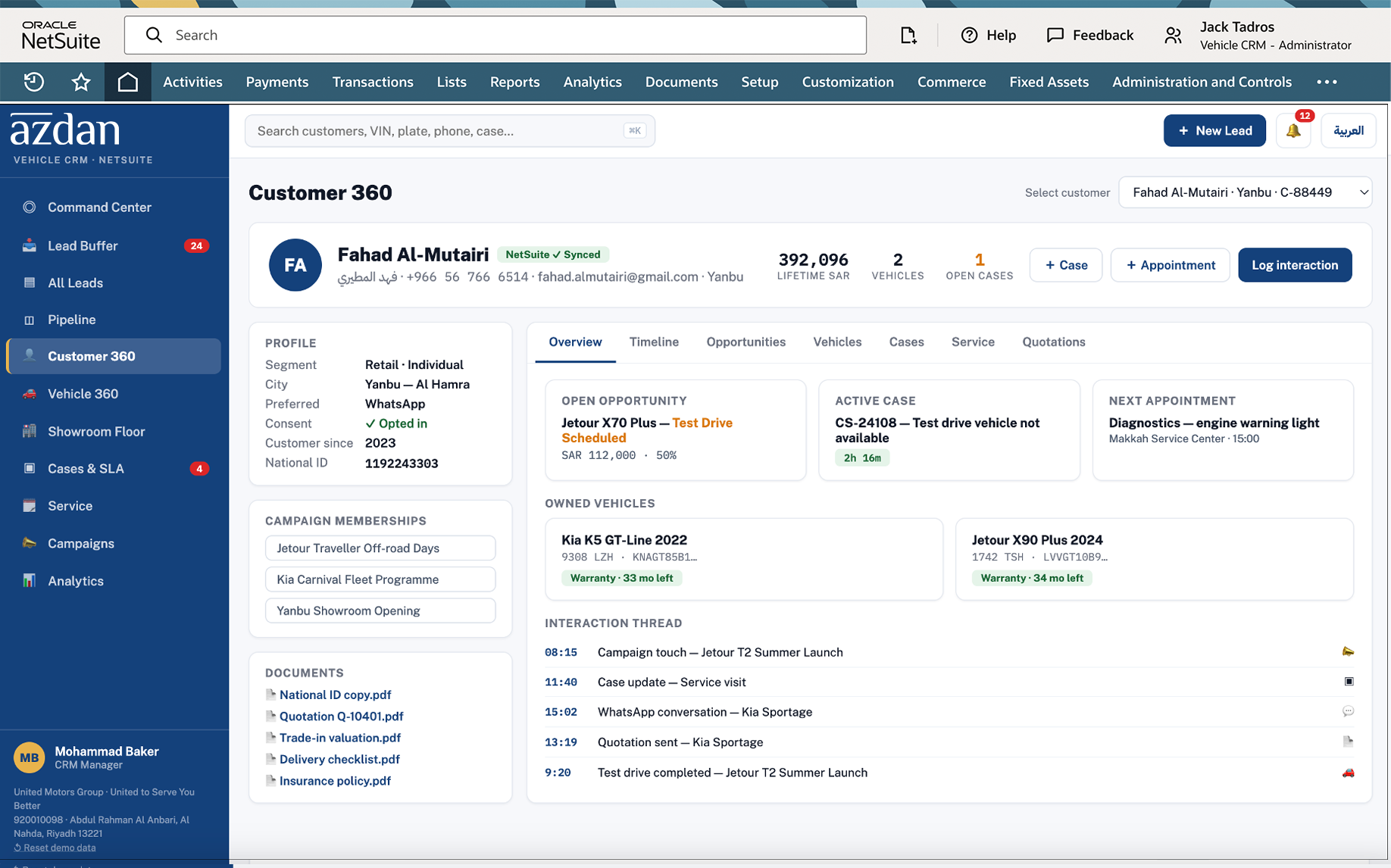
In this industry, the sale is the start of the relationship, not the end of it. A customer's value to the group is measured across every vehicle they have owned, every service visit, and every campaign they have responded to, often over a decade or more. Customer 360 is built to carry that whole history, not just the most recent enquiry.
Platform features
- Profile: segment (retail, fleet, trader), city, preferred contact channel, consent status, customer-since date
- Lifetime value and total vehicle count surfaced at the top of the record
- Open opportunities, active cases, and next service appointment shown up front
- All owned vehicles with live warranty status, across brands
- Campaign membership and touch history: trade-in offers, seasonal service campaigns, launch events
- Document store: ID, quotations, trade-in valuations, delivery checklist, insurance policy
- Single interaction timeline spanning campaigns, cases, WhatsApp, quotations, and test drives
- Real-time NetSuite sync status on every record
Service CRM: Vehicle 360, warranty, and case management
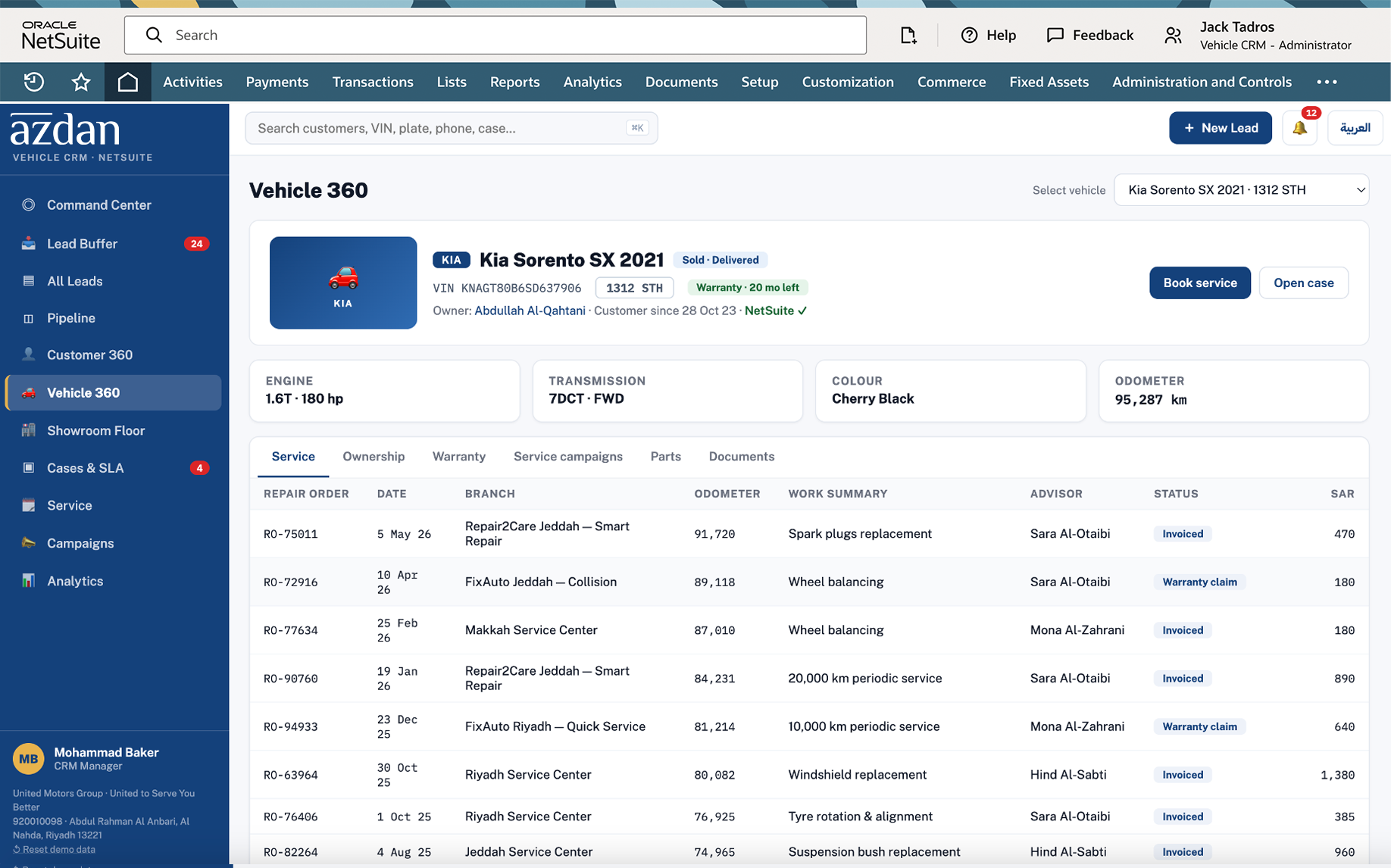
After-sales is where dealer groups make and keep customers, and where CSAT is won or lost. Service CRM connects the vehicle's full service and warranty history to the same case management and appointment booking used across the network, whether the work happens at an in-house service centre or a partner workshop.
Platform features
- Vehicle 360: VIN, plate, ownership, and live warranty status
- Full repair-order history per vehicle: branch, odometer, work summary, advisor, status, value
- Warranty claims tracked distinctly from standard invoiced work
- Service campaigns and recall visibility at the vehicle level
- Case management with priority, status, owner, and branch: delivery delays, warranty disputes, parts availability, roadside assistance, paint and body issues
- SLA countdown, at-risk flagging, breach tracking, and escalation
- Major-customer-issue flagging for cases that need leadership visibility
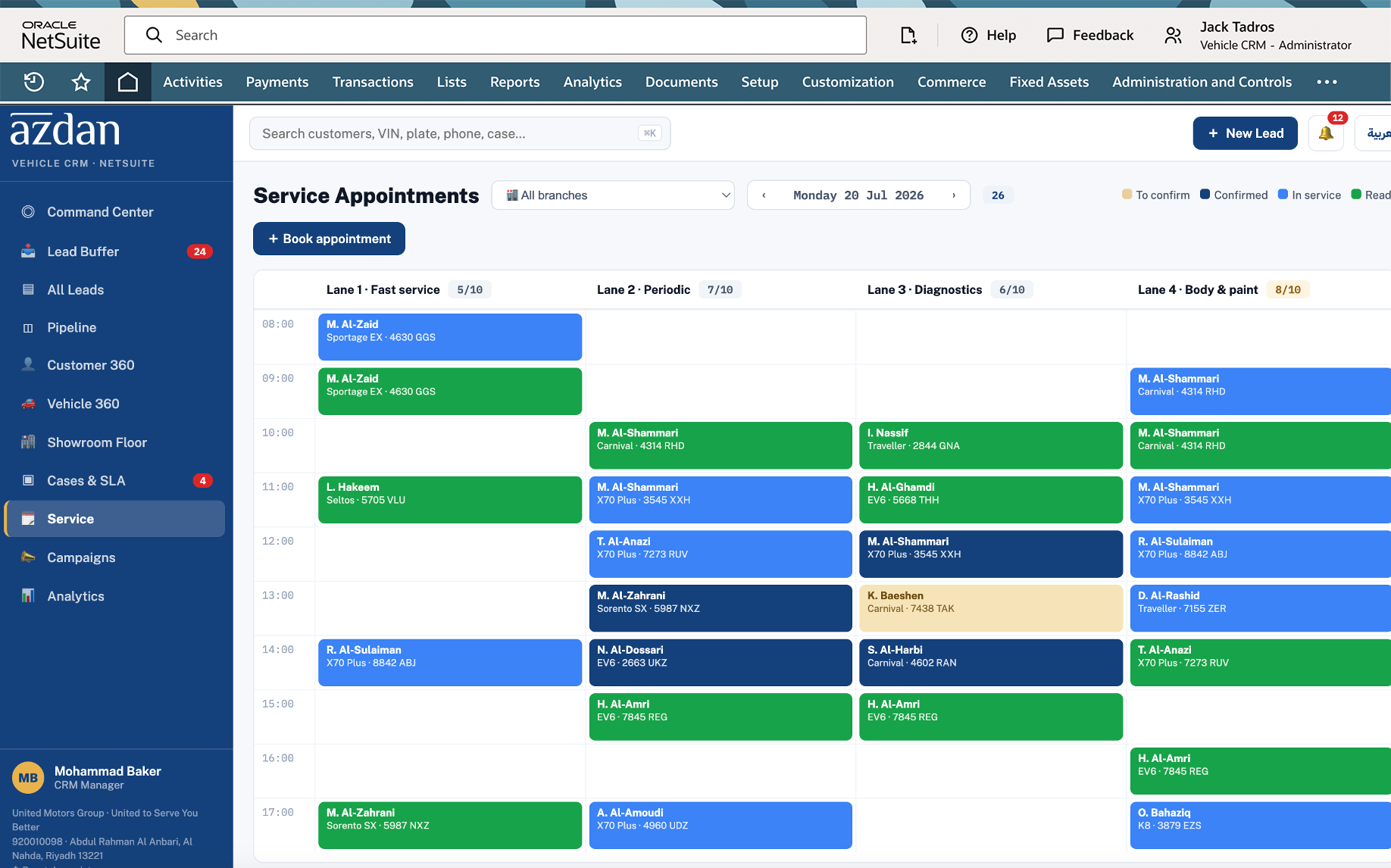
- Capacity-aware appointment booking by service lane (fast service, periodic, diagnostics, body and paint), branch, date, and time, with conflict prevention
Marketing CRM: campaigns measured against real sales, not clicks
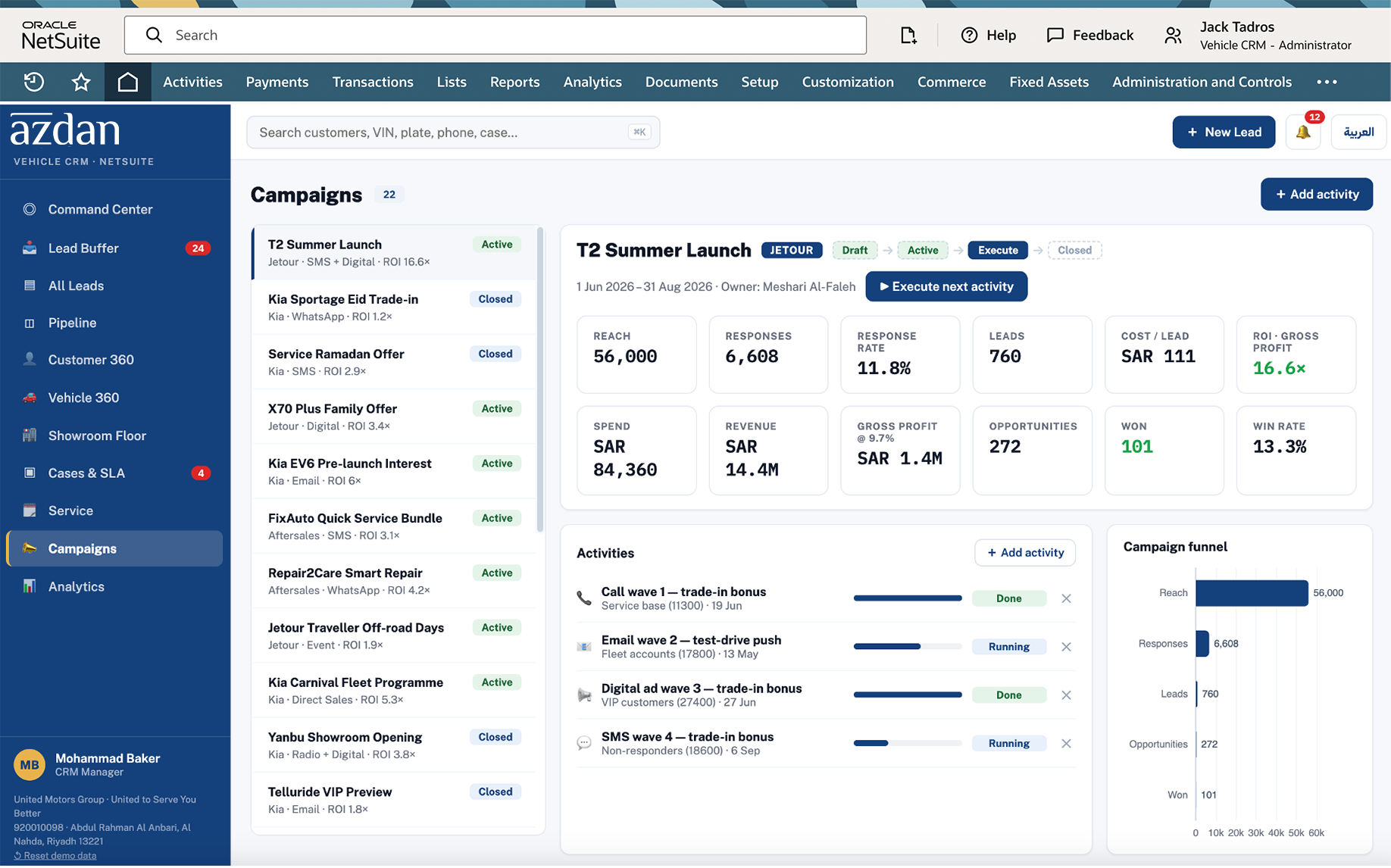
Seasonal and model-launch campaigns drive a disproportionate share of dealership activity: trade-in promotions, service offers, new-model launches, fleet programmes. Marketing CRM ties every one of them back to what NetSuite actually recorded as sold or serviced, so ROI is a real number, not a marketing platform's self-reported estimate.
Platform features
- Full campaign lifecycle: Draft, Active, Execute, Closed, by brand
- Reach, responses, response rate, leads generated, and cost per lead
- Revenue, gross profit, opportunities, wins, and win rate tied to real transactions
- ROI multiple calculated against actual sales and service revenue
- Multi-wave activity tracking across SMS, WhatsApp, email, and digital, with status per wave
- Campaign funnel from reach through to won business
- Every lead traceable back to its originating campaign, end to end, including trade-in and fleet-specific offers
CRM analytics: visibility across brands, branches, and the network
A dealer group is not one showroom. It is a network of brands and branches that need to be compared on the same terms. CRM analytics gives operational teams and leadership the same numbers, filtered by branch, brand, and consultant.
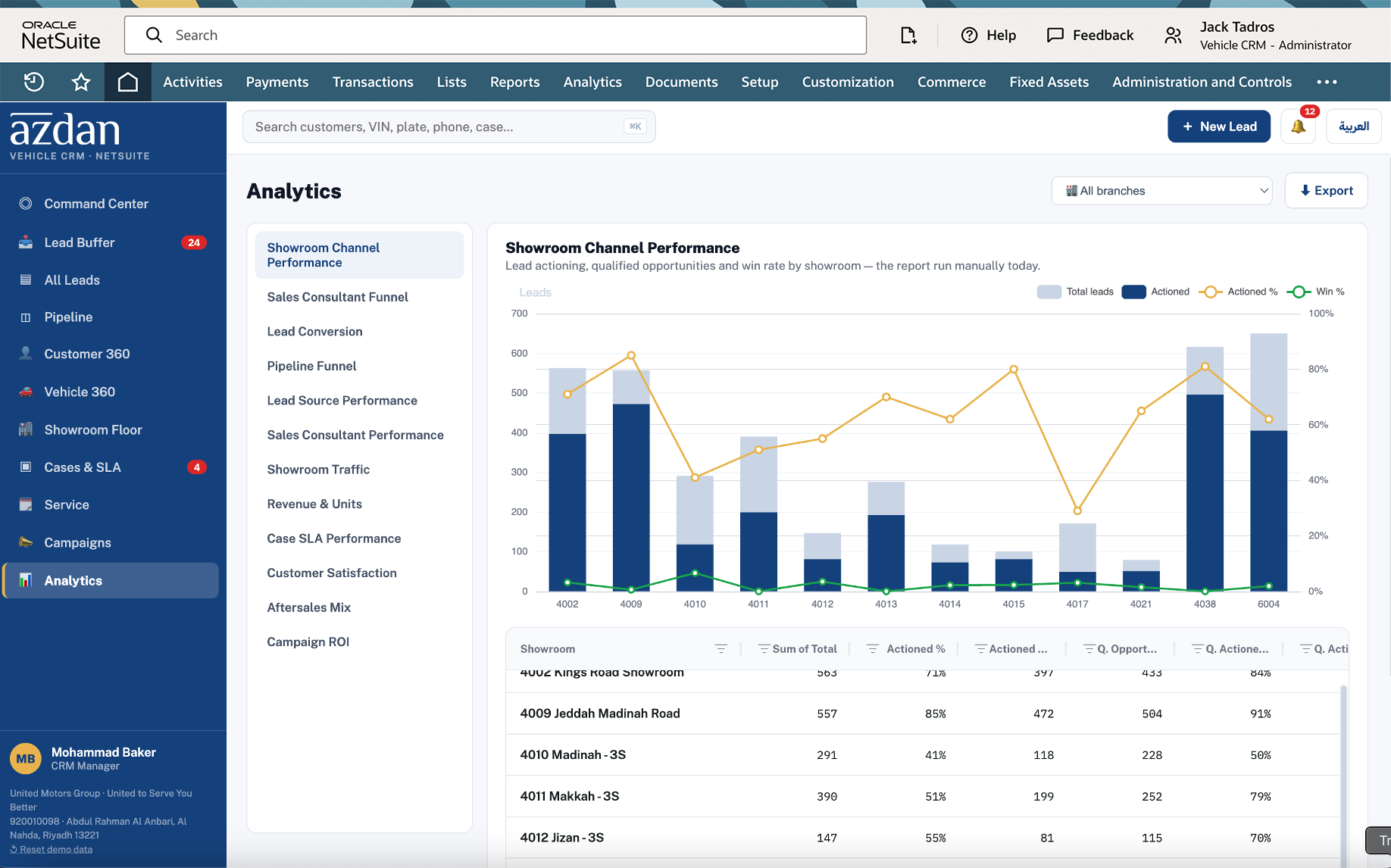
- Lead Conversion — monthly lead-to-won trend across the network
- Pipeline Funnel — stage-by-stage conversion and leakage
- Lead Source Performance — volume and conversion by acquisition channel
- Sales Consultant Performance — units, conversion, revenue, CSAT, cycle time
- Branch Performance — visits, test drives, sales, revenue, CSAT by showroom
- Case SLA Performance — compliance by case type
- Customer Satisfaction — CSAT trend across sales and after-sales
- Aftersales Mix — job volume and value by service line
- Campaign ROI — return multiple per campaign, ranked
- Executive Command Center — revenue, units, margin, market share, and aftersales revenue on one screen
Native vs integrated: why it matters for a dealership
There is a real difference between a CRM that is connected to NetSuite and one that is built in it. The table below sets out what changes for a dealer group in practice.
Where this CRM goes next
The roadmap moves the CRM from insight to proactive, governed action: sense overdue follow-ups, warranty expirations, and service due-dates; recommend the next best action, offer, or upsell; assist consultants with context and drafted customer messaging; and, within approved controls, act, triggering reminders, campaigns, or appointments automatically. A customer-facing mobile app and web portal, with multi-language support, sit alongside this.
For dealer groups weighing whether their CRM should sit beside NetSuite or inside it, the answer usually comes down to the same thing: a customer relationship split across brands, branches, and systems is not really one relationship at all.
Related Azdan resources
Published by Azdan, an Oracle NetSuite Solution Provider. Guidance in this article reflects Azdan's CRM design work with automotive dealership groups. Content checked August 2026.