.svg)


End-to-End Business Process for Campus Stores
A campus store looks like a bookstore and is priced like one in the public imagination. It is not. Its anchor category has been losing revenue per unit for twenty years, most of what remains goes to the publisher, and the profit increasingly comes from sweatshirts. That inversion is the structural fact of collegiate retail, and it means the value chain has two economically opposite businesses running through one store, one inventory system, and one three-week rush. This guide maps that chain end to end.
The Short Answer
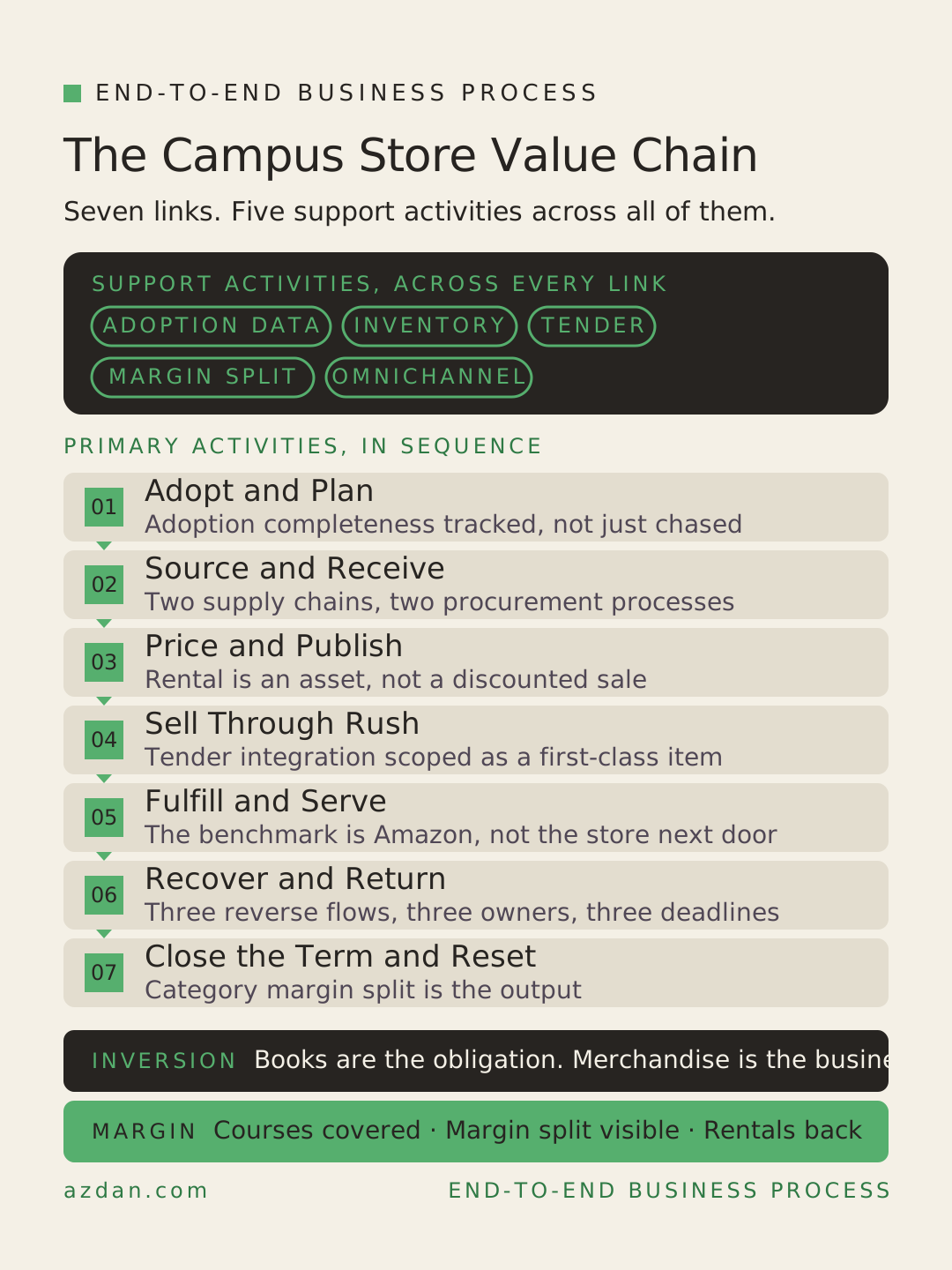
The campus store value chain runs in seven links:
Adopt and Plan → Source and Receive → Price and Publish → Sell Through Rush → Fulfill and Serve → Recover and Return → Close the Term and Reset
Three things make it unlike any other retail chain. The demand signal is generated outside the business, by faculty who do not work for the store and have no commercial stake in its accuracy. The same title lives four commercial lives at once, as new, used, rental, and digital access, one of which is an asset that has to come back. And the customer frequently does not pay, because the transaction settles against a campus card, a student account, or a departmental chargeback.
Methodology note. This maps the end-to-end process using the value chain model. The process detail and the figures are grounded in Oracle NetSuite's published campus stores material and its reporting on collegiate retail, all sourced at the end. Where a point is inference from the structure of the business rather than a sourced fact, it is labeled as a recommendation.
The Inversion: Books Do Not Pay for the Store
Start with the economics, because they drive everything downstream.
Collegiate retailers already faced low margins on course materials before digital, because most of the revenue from a book goes to the publisher. Then the unit economics compressed twice over. At Cal State Fullerton's Titan Shops, one of the first colleges to offer textbook rental back in 2005, a textbook that would once have sold for one hundred dollars rents for forty, and a digital copy sells for less than that. The same student, the same course, a fraction of the revenue.
What filled the gap was merchandise, which carries much higher margins. The proportions at named institutions are striking:
The University of Washington's University Book Store puts it plainly through its CIO: the operation is more like a Macy's or Nordstrom than a Barnes and Noble, because it runs so many different departments.
So the honest description of a modern campus store is a specialty retailer with a compulsory low-margin category attached. Course materials are an obligation to the institution and its students. Merchandise is the business.
That is the reporting requirement that falls out of it. If the chain cannot show course materials margin and merchandise margin separately, by category and by term, then the store cannot tell whether the profitable half is subsidizing the unprofitable half by a little or a lot. Recommendation: treat category-level margin separation as a design requirement of the chain, not a report to add later. It is the single number the institution will eventually ask for.
The Campus Store Value Chain
Primary activities, in sequence:
Support activities, running across every link:
- Adoption data and course materials compliance
- Inventory accuracy across formats
- Campus card, chargeback, and tender integration
- Category margin visibility
- Omnichannel student experience
The margin: every course covered, merchandise margin visible on its own, and rentals that actually come back.
Adoption data heads the support list because it is the input the store cannot generate and cannot operate without. Everything downstream in the course materials half of the chain inherits its timeliness and its accuracy.
The Seven Links
1. Adopt and Plan
Faculty select course materials, the institution publishes enrollment, and the store turns those two signals into a buy.
This is the link that has no equivalent in ordinary retail. A normal retailer forecasts from its own sales history and controls its own assortment. A campus store receives its assortment from academics, per course, per section, on an academic calendar, and it cannot proceed without them. Adoptions arrive late as a matter of routine, not exception.
The practical consequences are worth stating plainly. Late adoption means a compressed buying window, which means paying more, ordering less confidently, or both. And a store that cannot show adoption completeness by department, live, has no way to escalate before the window closes.
Recommendation: instrument the adoption pipeline as a tracked process with a completion percentage by department and a deadline, rather than treating it as correspondence. The store cannot make faculty submit on time, but it can make lateness visible to the people who can.
2. Source and Receive
Publishers, wholesalers, the used market, and the store's own rental fleet, plus an entirely separate merchandise supply chain.
Two supply chains converge here with almost nothing in common. Course materials sourcing is title-driven, publisher-dominated, and returnable under publisher terms. Merchandise sourcing is a normal buy, with seasons, sizes, and licensing on branded apparel.
Recommendation: resist the temptation to force both through one procurement process because they land in one warehouse. The vendor terms, the return rights, and the planning horizon are different enough that a shared process serves neither well.
3. Price and Publish
The same title is offered simultaneously as new, used, rental, and digital access, at four price points, with four different cost structures and four different downstream obligations.
This is the link where campus retail diverges most sharply from the apparel or general retail chains covered elsewhere in this series. In apparel, a style has many SKUs but they are all the same kind of thing. Here, one title has formats that are not commercially equivalent at all. A rental is not a sale with a discount. It is a temporary transfer of an asset the store still owns and expects back, recognized differently and carrying a recovery obligation.
Recommendation: model rental as an asset with a return obligation from the outset, not as a discounted sale with a note attached. Retrofitting that distinction after a term of transactions is the kind of correction that requires reconstructing history.
4. Sell Through Rush
Most of the term's course materials revenue moves in a window of days.
Rush is a capacity problem disguised as a sales period. Queue length, checkout speed, stock accuracy, and the ability to answer "which edition does my course need" all get tested at once, by an audience that grew up with Amazon and judges the experience accordingly.
The tender mix is the part that surprises teams from ordinary retail. NetSuite's campus store capability explicitly covers campus cards and chargebacks alongside conventional payment, because a significant share of transactions settle against a student account, a financial aid disbursement, or a departmental budget rather than a card. Each is a different posting, a different reconciliation, and a different conversation with the institution's finance office.
Recommendation: treat tender integration as a first-class scope item. A store that reconciles campus card settlements by hand will spend more time on it than on any other close activity.
5. Fulfill and Serve
In store, online, ship to home, pick up on campus, and increasingly a hybrid of all four during the same week.
The competitive bar here is not other campus stores. It is the general online market, which is why omnichannel capability keeps appearing in this sector's technology decisions. The store's structural advantage is that it knows what the course requires. Its structural disadvantage is everything else about convenience and price, which means the advantage has to be made visible at the point of decision.
6. Recover and Return
The link that does not exist in most retail chains, and the one where a campus store's working capital lives.
Three separate reverse flows run through it. Rentals must come back, on a deadline, in resaleable condition, or convert to a charge. Buyback purchases inventory from students at the end of term, turning the store into a buyer from its own customers. And publisher returns send unsold stock back under terms that vary by supplier and expire.
All three are time-boxed to the term boundary, and all three affect inventory value. Recommendation: give each of the three its own owner and its own deadline calendar. They are usually treated as one seasonal scramble, and the rental recovery rate in particular is a number that should be tracked continuously rather than discovered at the end.
7. Close the Term and Reset
The academic equivalent of a season close, and the moment the chain either produces usable information or does not.
Closing the term means valuing what came back, writing down editions that will not be adopted again, settling campus card and chargeback balances with the institution, and producing the split the institution actually wants: what course materials cost to provide, and what merchandise earned.
Recommendation: run the term close as a defined sequence with the category split as its output, and reconcile it to the fiscal period rather than the other way around. Terms do not align to quarters, and the store reports into an institution that thinks in fiscal years.
What Breaks: Seven Recurring Failures
These are patterns that follow from the structure of the business described above. They are offered as recommendations rather than as measured findings.
- Course materials and merchandise margin reported together. The single most consequential reporting failure. It hides whether the profitable half is carrying the other half sustainably.
- Adoption completeness not tracked. The store's most important input arrives late and nobody can say how late until the buying window has closed.
- Rental modeled as a discounted sale. It is an asset with a return obligation. Treating it as revenue with a footnote breaks both inventory value and recovery.
- Campus card and chargeback reconciliation left manual. It scales with volume and lands entirely inside the close.
- One procurement process for two supply chains. Publisher terms and merchandise buying have different horizons, different return rights, and different risks.
- Buyback treated as a customer service gesture. It is inventory purchasing from an unusual supplier, and it needs a price policy and a margin expectation.
- The term close mapped onto the fiscal close. Terms and quarters do not align, and forcing them produces reports the merchandising team ignores.
Reading Your Own Chain: Four Questions
- What percentage of gross margin comes from merchandise? If the answer is not known immediately, the chain is not separating the two halves.
- What proportion of adoptions arrive after the buying deadline? This prices the cost of the store's dependency on an input it does not control.
- What is the rental recovery rate, and when do you learn it? Discovering it at term close is too late to act on.
- How long does campus card reconciliation take each period? It is usually the largest manual task in the close and the easiest to eliminate.
Where This Sits Alongside Azdan's Practices
Campus retail shares most of its mechanics with two industry practices Azdan does maintain, and a store modernizing its operation will recognize its own chain in both.
- Multi-store retail. Point of sale posting to finance, real-time inventory across locations, promotions, loyalty, and returns processed and restocked without manual steps. This is links four through six of the chain above. See NetSuite ERP for Retail.
- Ecommerce and omnichannel. Order routing, click and collect, marketplace and storefront integration, and returns connected to finance. This is the capability gap most campus stores are actually trying to close. See NetSuite ERP for E-Commerce.
What campus retail adds on top of both is the course materials half: adoptions, the four formats, rentals as recoverable assets, buyback, and institutional tender. Those are the links to scope carefully, because they have no equivalent in general retail.
Recommendation
If you are mapping a campus store end to end, produce one number before anything else: gross margin split between course materials and merchandise, for the last four terms. It will tell you which business you are actually running, and it usually surprises the people who have been running it.
Then look at two dates. When adoptions were due, and when they actually arrived. The gap between those is the cost of the store's dependency on an input it does not control, and closing it is worth more than most system improvements downstream.
Sources
- Oracle NetSuite, Bookstore Management System Software for Campus Stores, for course materials management scope including adoptions, buybacks, rentals, campus cards and chargebacks
- Oracle NetSuite, How 100-Year-Old Campus Bookstores Are Reacting to Gen Z, for the revenue mix figures at The Duck Store, The Cornell Store and University Co-op
- Oracle NetSuite, After Fine-Tuning Its Online Shop, a Campus Bookstore Stays Strong, for the Titan Shops rental economics
- Oracle NetSuite, University Book Store Upgrades Ecommerce, POS and Back-Office
- Oracle NetSuite, What Is Value Chain? An Expert Guide, for the value chain model
- Michael E. Porter, Competitive Advantage: Creating and Sustaining Superior Performance, 1985, for the original value chain framework
Revenue mix figures are as reported by Oracle NetSuite and reflect the institutions named at the time of publication. Checked August 2026.
Related Azdan Resources
- End-to-End Business Process for Apparel, Footwear, and Accessories
- End-to-End Business Process for Advertising
- How to Implement NetSuite ERP
- Oracle NetSuite Implementation
Published by Azdan, an Oracle NetSuite Solution Provider operating across the UAE, Saudi Arabia, and Egypt. Content checked August 2026.