.svg)


How to Implement NetSuite ERP: Steps and AI Skill
Every NetSuite implementation follows the same seven phases. What changes between one project and the next is not the sequence, it is which decision inside that sequence you cannot walk back. A software company and a manufacturer run identical phase plans and fail in completely different places. This guide sets out the method that holds across every project, the way to identify the decision that binds yours, and a machine-readable skill file you can hand to an AI assistant to run the same process.
The Short Answer
Short answer: Implement NetSuite in seven phases:
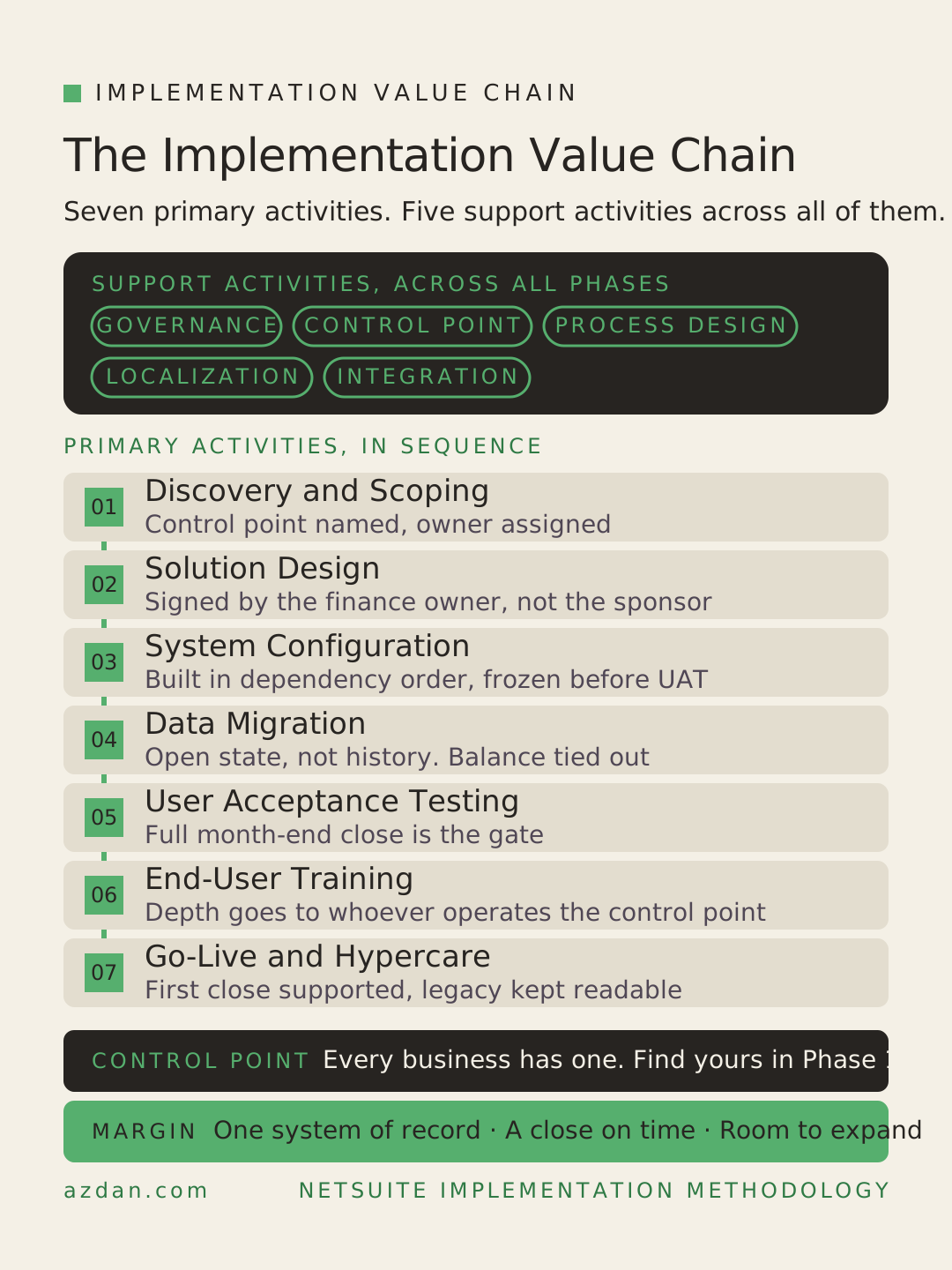
Discovery and Scoping → Solution Design → System Configuration → Data Migration → User Acceptance Testing → End-User Training → Go-Live and Hypercare
Azdan's published range is 6 to 12 weeks for a focused single-entity deployment, longer for multi-entity or multi-module projects.
The phases are universal. The hard part is not running them, it is knowing which one carries your project's irreversible decision, because that decision is almost always made two phases before anyone notices it matters. Finding it is the first job of discovery, and the rest of this guide is about how.
Methodology note. This is the seven-phase methodology Azdan applies across more than 200 NetSuite implementations delivered in the UAE, Saudi Arabia, Egypt, and beyond. Where a point reflects delivery experience rather than measured data, it is labeled as a recommendation.
First, Find Your Control Point
Every business type has one master record that governs its economics. It is set before transactions start flowing, it defaults its attributes onto every downstream document, and correcting it after go-live ranges from expensive to impossible. Call it the control point.
The control point is not the same record in every business, and that is precisely why generic implementation checklists fail. They tell you to configure master data in Phase 3 without telling you which piece of master data will decide whether your margin reporting is right for the next five years.
Three worked examples, drawn from the vertical guides in this series:
Read the pattern rather than the rows. In each case the control point is set during master data configuration, its effect only becomes visible at the first month-end close, and by then the transactions carrying the error already exist.
How to find yours in discovery. Ask three questions:
- Which record, if populated wrongly, would make our margin or revenue reporting wrong without producing an error message?
- Which of our configuration choices does NetSuite prevent us from changing later?
- Which number will the board look at first, and what chain of records produces it?
The answers converge on one or two records. Those are your control points. Name them in the scope document, assign an owner, and gate their creation behind written sign-off. Recommendation: make this an explicit deliverable of Phase 1 rather than something that emerges during configuration, because the whole point is that it is invisible until it is expensive.
The Implementation Value Chain
A Gantt chart shows when work happens. A value chain shows where value is created and which supporting disciplines have to run continuously for the primary activities to hold together. For an ERP implementation the second view is more useful, because failures rarely come from a phase running late. They come from a support activity that was treated as a phase and then stopped.
Primary activities, in sequence:
Support activities, running across every phase:
- Program governance and change control
- Master data and control point integrity
- Process design and validation
- Localization and compliance
- Integration and platform architecture
The margin: one system of record, a close that lands on time, and a platform that expands without a rebuild.
Control point integrity is the discipline most often mistaken for a configuration task. It is set in design, built in configuration, loaded in migration, proven in testing, and reconciled after go-live. A team that treats it as a Phase 3 activity has already lost the thread.
The Seven Steps
These are the universal versions. Each vertical loads them differently, and the guides linked at the end carry the specifics.
Step 1: Discovery and Scoping
Poor scoping is where most NetSuite projects fail, which makes this the phase with the worst effort-to-attention ratio in the whole method.
Establish: the legal entity structure with countries and functional currencies, which decides whether the project is NetSuite or NetSuite OneWorld; every process area genuinely in scope and an explicit list of what is not; the system inventory with a named system of record per object; compliance obligations per country; and the control point, per the section above.
Exit gate: a signed scope document with the entity structure, in-scope and out-of-scope process areas, the integration inventory, the control point with a named owner, and acceptance criteria.
Step 2: Solution Design
The output is a document a configurator can build from without making accounting or commercial decisions on the client's behalf.
Cover the chart of accounts and segmentation, which is where most reporting regret originates. Carry reporting dimensions on segments rather than encoding them in account numbers, because segments are reportable and account number conventions are not. Then the control point design in full, the transaction flows per process area, approval routing, and the reporting the business will actually run on.
Exit gate: design signed by the finance owner, not only the project sponsor. The sponsor owns the budget. The finance owner owns the consequences.
Step 3: System Configuration
Build against the design in dependency order: company and subsidiaries, currencies, consolidated exchange rates, and periods; chart of accounts and segments; roles and permissions starting from bundled definitions and restricting from there; master data including the control point; transaction forms and approval routing; tax, e-invoicing, and bank payment formats per country; then searches, KPIs, and dashboards.
Configure integrations in parallel rather than at the end, and give each one a role restricted to web services access so an integration credential cannot also function as a user login.
Recommendation: freeze configuration before UAT opens. Changes made during testing invalidate test results, and the resulting argument about which defects are real is a common cause of go-live slippage.
Step 4: Data Migration
Migrate structure and open state, not history. The recurring mistake is treating migration as a volume problem when it is a state problem: open transactions, in-flight commitments, and partially complete work are what make it hard, not record counts.
Every project needs the same acceptance test in some form: the migrated balance ties to the legacy balance sheet. What that balance is differs by vertical, deferred revenue for software, work in progress for services, inventory value for manufacturing, but the test is structurally identical. Run it twice, once in a dress rehearsal and once with final data.
Step 5: User Acceptance Testing
Write scripts from the design, not from a generic ERP script library, and include a full month-end close as a mandatory scenario.
The close test is the one most often cut for time and the one that matters most, because month-end is where an implementation either works or does not. Transactions passing individually tells you very little about whether the period will close.
Exit gate: finance owner sign-off with every high-severity defect closed and retested, not deferred to hypercare.
Step 6: End-User Training
Train by role against real scenarios, not by module against menus. Scope each session to what that role does daily, and give the most depth to whoever operates the control point.
Recommendation: schedule training close enough to go-live that it is still fresh, but far enough ahead that questions raised in training can still be actioned. Training is frequently the first time anyone sees the whole flow end to end, and it surfaces process gaps that testing missed.
Step 7: Go-Live and Hypercare
Cut over in a low-activity window aligned to a period boundary, with a rehearsed cutover, a defined rollback decision point, and a named person authorized to call it.
The first close after go-live is the real go-live. Plan for direct support through it. Recommendation: keep the legacy system readable, not writable, for at least one full quarter, so comparatives can be reconstructed without reopening anything.
Sequencing: Foundation, Expand, Lead
The seven phases describe how to deliver a scope. They do not tell you what should be in the first scope. That is a separate decision, and it is where phased implementations either work or turn into a permanent project.
The pattern that holds across NetSuite's industry capability models is a three-tier sequence. A foundation tier delivers core capability, an expand tier adds operational depth, and a lead tier adds optimization and analytics. Financials appears in the foundation tier of every industry model without exception, because every other process posts into it. Customer relationship management appears in almost all of them.
What changes by industry is the second and third step, not the first:
Two practical consequences. First, a client insisting on industry-specific depth in phase one is usually describing the pain that made them buy, not the sequence that will deliver it fastest. Financials first is not consultant conservatism, it is a dependency. Second, NetSuite expands additively within one platform. Adding modules, subsidiaries, users, or integrations after go-live does not require a new system or a fresh implementation, which means deferring scope is genuinely cheap and over-scoping phase one genuinely is not.
What Actually Drives the Cost
Buyers routinely conflate two different numbers, and the confusion distorts scoping conversations. The license and the implementation are priced on different variables.
That last row is the useful one. Adding fifty read-only users changes the license and barely touches the implementation. Adding one subsidiary in a new country changes both, and adding one poorly documented legacy system to migrate from can change the implementation more than either.
The practical scoping implication: when an estimate needs to come down, the levers are entity count in phase one, integration count, and how much historical data is in scope. Cutting users saves license fee and almost no delivery time.
Requirement changes during delivery should run through formal change control, documented, assessed for timeline and budget impact, and approved before work starts. Recommendation: agree that mechanism in the statement of work rather than inventing it mid-project, when both sides are already under pressure.
What Breaks: Seven Recurring Risks
These are patterns that recur across implementations regardless of vertical. They are drawn from delivery experience and offered as recommendations rather than measured findings.
- The control point identified too late. The defining failure of ERP delivery. It is invisible until the first close, and by then the transactions carrying the error already exist.
- Scoping treated as a sales activity. Scope written to win the deal rather than to describe the work produces a project that is behind before kickoff.
- Industry depth pulled into phase one. Financials is a dependency for everything else. Skipping ahead means rebuilding.
- Data migration estimated on volume. Record counts are easy. Open state is not, and it is where the effort actually sits.
- The first close left unrehearsed. UAT covers transactions but not the period. The close steps get exercised for the first time in production.
- No named finance owner. A project sponsor who owns budget but not consequences will approve a design nobody in finance has validated.
- Change control invented mid-project. Without an agreed mechanism, every change becomes a negotiation and the timeline becomes fiction.
The AI Skill
The method above is also published below as a skill file: a markdown document with structured instructions an AI assistant can load and follow. It encodes the same seven phases, the control point discovery questions, the sequencing rule, and the exit gates, so an assistant can help draft a scope document, review a design against the gates, or generate role-based UAT scripts without the consultant restating the method each time.
Copy the block below and save it as SKILL.md inside a folder named netsuite-implementation.
How to Use It
Save the block as SKILL.md in a folder named netsuite-implementation, then place that folder wherever your assistant loads skills from. Where a vertical guide applies, load that skill instead, since it carries the specific control point and configuration matrix. This one covers what holds regardless.
Which Guide to Read Next
This is the general method. The decisions that actually bind a project are vertical-specific, and each guide below carries the configuration matrix, migration profile, and failure patterns for its business model.
- Software and SaaS. Revenue is the design problem. Recognition treatment per item class, subscription billing, and ARR reporting. How to Implement NetSuite for Software Companies
- Professional services. Cost is the design problem. Rate architecture, project revenue rules, and utilization. How to Implement NetSuite for Services Companies
- Manufacturing. Valuation is the design problem. Costing method, BOM effectivity, WIP, and landed cost. How to Implement NetSuite for Manufacturing Companies
Recommendation
If you are about to scope a NetSuite implementation, do one thing before anything else is estimated: identify the control point and put a name against it. Not the project sponsor's name, the name of the person in finance who will answer for the number it produces.
Then keep phase one to financials plus the one process area that carries the control point. Everything else can follow, and on a platform that expands additively, following is cheap. Over-scoping the first phase is the only part of this that gets more expensive with time.
Sources
- Oracle NetSuite, NetSuite ERP
- Azdan, Oracle NetSuite Implementation, for the seven-phase methodology, published timeline range, and implementation cost drivers
Implementation timelines and cost drivers reflect Azdan's published delivery model as of August 2026.
Related Azdan Resources
- How to Implement NetSuite for Software Companies
- How to Implement NetSuite for Services Companies
- How to Implement NetSuite for Manufacturing Companies
- Oracle NetSuite Implementation
- NetSuite Managed Services
- NetSuite Pricing Calculator
Published by Azdan, an Oracle NetSuite Solution Provider operating across the UAE, Saudi Arabia, and Egypt. Guidance in this article reflects Azdan's NetSuite implementation methodology across more than 200 delivered implementations. Content checked August 2026.