.svg)


End-to-End Business Process for Retail
A jacket on a shelf in a store is not one thing. It is a sale waiting for a customer to walk in, a click-and-collect order waiting to be picked, a parcel waiting to be shipped to someone three cities away, and a transfer waiting to rebalance another store that is short. Which of those it becomes is decided by a rules engine, in real time, against a stock number that a salesperson maintained between customers. That is the modern retail chain, and it is why omnichannel is an inventory accuracy problem wearing a technology costume. This guide maps it end to end.
The Short Answer
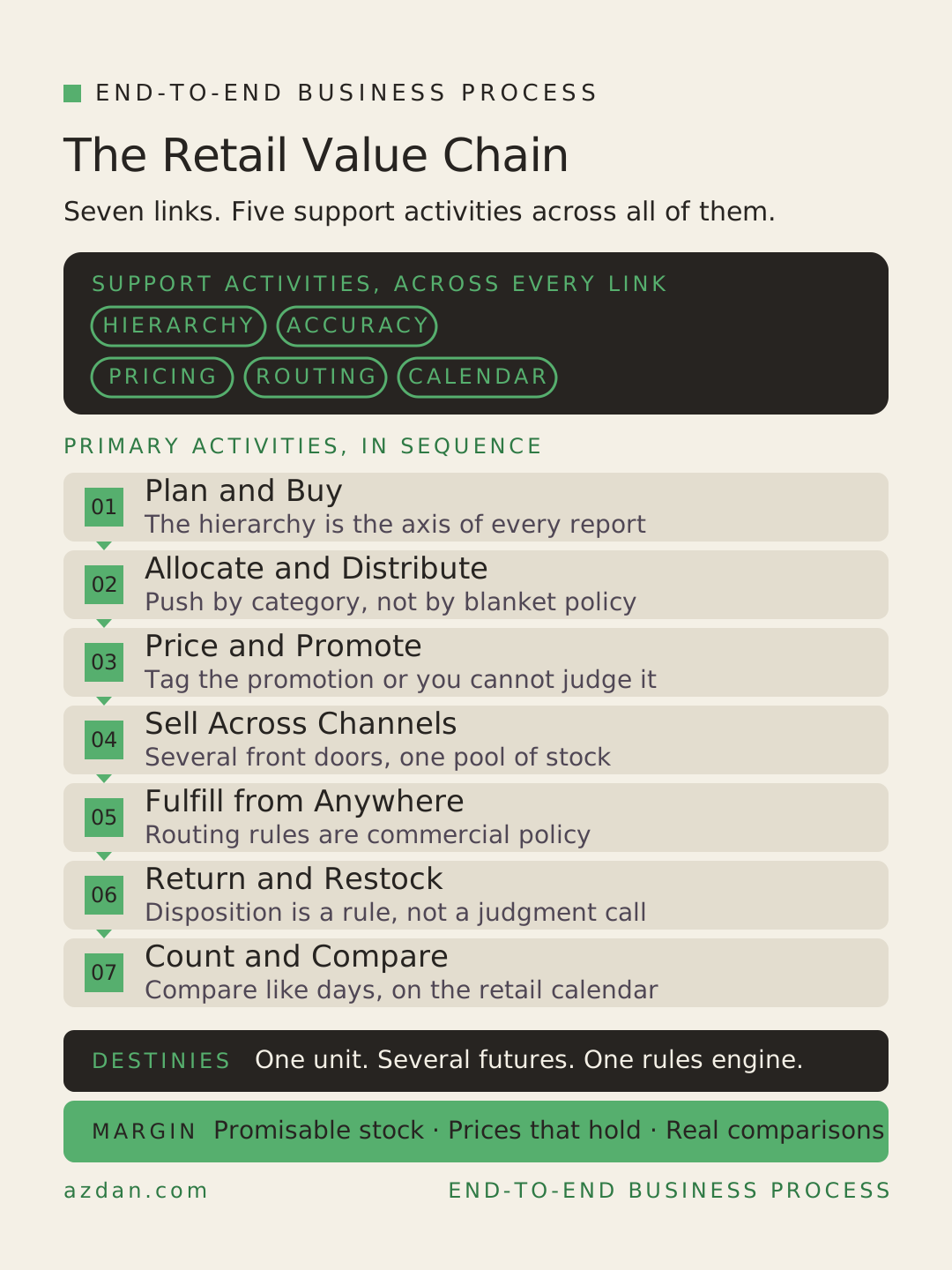
The retail value chain runs in seven links:
Plan and Buy → Allocate and Distribute → Price and Promote → Sell Across Channels → Fulfill from Anywhere → Return and Restock → Count and Compare
Three things make it unlike the other chains in this series. Every unit has several possible destinies, and an orchestration engine picks one based on availability and configurable rules rather than on where the stock happens to sit. The store is a shop, a warehouse, and a returns depot at once, operated by people hired to sell rather than to manage stock. And retail does not measure time in calendar months, because a month with five weekends is not comparable to one with four.
Methodology note. This maps the end-to-end process using the value chain model, applied to the retail process design Azdan works with across its NetSuite delivery in the UAE, Saudi Arabia, and Egypt. Where a point reflects delivery experience rather than measured data, it is labeled as a recommendation.
One Unit, Several Destinies
Start here, because it reorganizes what a stock number means.
In classic retail, stock sat in a store and was sold from that store. Availability was a shelf you could look at. In omnichannel retail, a central engine orchestrates fulfillment and returns, determining the optimal path based on inventory availability and configurable business rules, across click-and-collect, ship-from-store, and distribution center dispatch.
That turns availability from a report into an input:
Read the middle rows together. Three of the five destinies depend on a store's stock figure being right, and none of them is visible to the person maintaining that figure. A phantom unit in a store does not cause a small discrepancy at the annual count. It causes a cancelled customer order, which is a service failure attributed to the website by a customer who will never know a shelf was wrong.
Recommendation: measure order cancellation and short-pick rate by store, not just stock accuracy by store. The first is what the customer experiences and it is the number that justifies investment in the second.
The Store Is Three Businesses in One Room
The second structural fact, and the one that decides whether the first works.
A modern store simultaneously runs a shop, a fulfillment node, and a returns depot. Mobile point of sale extends this further, giving associates access to customer profiles, inventory, and endless-aisle catalogs so they can sell stock the store does not physically hold.
The people doing all of it were hired to sell. Cycle counting happens between customers. Picking an online order happens on the same shop floor a customer is browsing. Receiving a delivery competes with a queue at the till. None of that is a criticism of store teams; it is a description of the operating conditions, and it has design consequences:
- Counting has to be short and frequent rather than long and rare. A full store count is a closure, and it will be deferred. A rolling count of high-value and high-movement lines survives.
- Pick tasks compete with service. If the system routes a large online order to a store at its busiest hour, either the customer waiting at the till or the customer waiting for the parcel loses.
- Receiving discipline determines everything downstream. Stock received but not confirmed is stock the routing engine will promise and the picker cannot find.
Recommendation: give routing rules a store capacity input, not just an availability input. A store that is accurate and busy should be deprioritized over one that is accurate and quiet.
Retail Does Not Use Months
The third structural fact, and the one most likely to surprise a finance team arriving from another sector.
Retail runs on comparison. Like-for-like sales, this year against last, store against store. And comparison breaks if the periods are not comparable, because retail trade is concentrated at weekends.
Hence the 4-5-4 calendar, a retail convention that divides the year into months of four weeks, five weeks, and four weeks. The layout lines up holidays and ensures the same number of Saturdays and Sundays in comparable months, so like days are compared to like days.
The implication for the chain is that the reporting calendar is a design decision made early, and it propagates. Period close, comparatives, promotional windows, and budget phasing all sit on it.
Recommendation: settle the retail calendar before the chart of accounts is built. Converting a business from calendar months to 4-5-4 after a year of history means every comparative in the system is rebuilt.
The Retail Value Chain
Primary activities, in sequence:
Support activities, running across every link:
- Item hierarchy and matrix structure
- Store and channel inventory accuracy
- Price and promotion management
- Order routing and availability rules
- Retail calendar and comparative reporting
The margin: stock you can actually promise, prices that hold across channels, and comparisons that mean something.
Inventory accuracy heads that list because in this vertical it is not a hygiene metric. It is the input to a customer-facing decision made hundreds of times a day by a machine that cannot see the shelf.
The Seven Links
1. Plan and Buy
Assortment planning, open to buy, vendor negotiation, and the purchase commitment.
Retail buys ahead of demand, and the buy is the largest single bet in the chain. The item hierarchy set here determines what can be analyzed later: department, category, subcategory, and where variants exist, the matrix structure of a parent style against its child SKUs.
Recommendation: agree the hierarchy before the first purchase order. It is the axis of every report the business will ever run, and it cannot be restructured quietly once transactions hang off it.
2. Allocate and Distribute
Stock arrives and is pushed out to stores, or held back at a distribution center for demand-driven replenishment.
The decision between pushing early and holding centrally is a real trade-off. Push and stores have stock to sell but the wrong stores may have it. Hold and allocation improves but the shelf is empty on day one. Recommendation: set the split by category rather than by policy. Fashion and seasonal lines need early presence. Continuity lines are better held and pulled.
3. Price and Promote
Price, promotion, markdown, and the tagging that makes any of it analyzable afterwards.
Transactions can be tagged by location, product line, promotion, and other categories, which is what allows a retailer to ask afterwards whether a promotion made money. Recommendation: require a promotion identifier on every promotional transaction as a matter of configuration rather than discipline. Promotions analyzed only in aggregate get repeated whether or not they worked.
4. Sell Across Channels
The till, the website, the marketplace, the app, and the associate with a mobile device selling stock held elsewhere.
The important design point is that these are not separate businesses with separate stock. They are several front doors onto one pool, and the ERP's job is to keep that pool honest while several channels promise against it simultaneously.
5. Fulfill from Anywhere
The routing decision, and the link that distinguishes modern retail from its own recent past.
One engine manages purchasing, fulfillment, and returns for all locations, choosing the fulfillment path from availability and configured rules. The rules are where the commercial judgment lives: nearest node, cheapest node, node with excess stock, node with capacity, node that will not be left with a broken size run.
Recommendation: write the routing rules down as commercial policy, reviewed quarterly, rather than leaving them as configuration nobody revisits. They decide shipping cost, markdown exposure, and store workload simultaneously, and they are usually set once and forgotten.
6. Return and Restock
Returns arrive through any channel, including channels the order did not come from.
Buy online, return in store is now standard, which means a store receives goods it never sold, for an order it never saw, and has to decide their disposition on the spot: back to the shelf, back to a warehouse, to markdown, or to write-off. Each choice has a different margin consequence and each is made in seconds.
Recommendation: give returns disposition a rule keyed to condition and category, and put it where the associate is standing. Disposition left to judgment produces inconsistent inventory value and unsellable stock back on the shelf.
7. Count and Compare
The closing link, and the one that validates the whole chain.
Cycle counting maintains the accuracy every other link depends on. Comparison turns activity into management information: like-for-like by store, category performance against last year, sell-through against plan, all sitting on the retail calendar.
Recommendation: report accuracy and commercial performance to the same audience in the same pack. Store teams treat counting as an administrative burden until they see it next to the cancelled orders it caused.
What Breaks: Seven Recurring Failures
These are patterns that recur in retail businesses. They are drawn from delivery experience and offered as recommendations rather than measured findings.
- Store stock accuracy treated as a stocktake issue. It is a customer-facing input to an automated promise, and a phantom unit is a cancelled order.
- Routing rules set once and never reviewed. They quietly determine shipping cost, store workload, and markdown exposure.
- Routing that ignores store capacity. Accuracy is not enough if the store cannot pick during trading hours.
- The retail calendar decided late. Converting to 4-5-4 after a year of history rebuilds every comparative.
- Item hierarchy changed after transactions exist. It is the axis of all reporting, and it does not restructure quietly.
- Returns disposition left to judgment. Inconsistent value and unsellable stock returned to the shelf.
- Promotions analyzed in aggregate. Without a promotion tag on the transaction, the business cannot tell which ones worked.
Reading Your Own Chain: Four Questions
- What is your order cancellation rate by store, and why were they cancelled? It converts stock accuracy from a hygiene metric into a commercial one.
- When were the fulfillment routing rules last reviewed, and by whom? If the answer is the implementation, they are two years stale.
- Are you on a retail calendar, and does every comparative use it? Half-adopted calendars produce comparisons nobody trusts.
- What proportion of returns go back to full-price sale? It is a direct measure of whether disposition is a rule or a guess.
Which Retail Business Are You
The chain is common to the sector, but its weight shifts by model, and Azdan maintains separate industry practices for each.
- Multi-store retail. The chain is heaviest at allocate, fulfill, and count, with store stock accuracy carrying every omnichannel promise. See NetSuite ERP for Retail.
- Ecommerce and marketplace led. Where the store network is small or absent, and the chain concentrates on routing, delivery, and returns. See NetSuite ERP for E-Commerce.
- Wholesale alongside retail. Where the same stock serves trade customers and consumers, on different terms and different margins. See NetSuite ERP for Wholesale Distribution.
Two adjacent chains in this series go deeper on categories with their own rules. Apparel, footwear and accessories covers the style and SKU structure and the season clock. Food and beverage covers shelf life, lot traceability, and route delivery.
Recommendation
If you are mapping a retail business end to end, produce one number before anything else: the rate at which customer orders are cancelled or short-picked, by store, with the reason.
Most retailers measure stock accuracy as an inventory metric and report it to an inventory audience. Expressed as cancelled orders, the same problem becomes a customer experience number with a commercial owner, and it stops being negotiable.
Then read the fulfillment routing rules. They were probably written during implementation by someone optimizing for shipping cost, and they have been silently deciding store workload and markdown exposure ever since.
Sources
- Oracle NetSuite, Retail ERP, for omnichannel order orchestration, mobile point of sale, and one engine managing purchasing, fulfillment, and returns across locations
- Oracle NetSuite, Retail Accounting Software, for transaction tagging by location, product line, and promotion
- Oracle NetSuite, What Is Retail ERP?, for how retail requirements differ from traditional ERP assumptions
- Oracle NetSuite, What Is Value Chain? An Expert Guide, for the value chain model
- Michael E. Porter, Competitive Advantage: Creating and Sustaining Superior Performance, 1985, for the original value chain framework
Process content reflects retail leading practice as applied by Azdan, checked August 2026.
Related Azdan Resources
Published by Azdan, an Oracle NetSuite Solution Provider operating across the UAE, Saudi Arabia, and Egypt. Guidance in this article reflects Azdan's process design work with retail businesses. Content checked August 2026.