.svg)


End-to-End Business Process for Healthcare
Every other industry in this series runs its core activity through the ERP. Healthcare does not. The thing a hospital or clinic actually does happens in a clinical system the ERP does not own and must not contain. That makes healthcare the only vertical here where the first design question is not how to model the business but where the business system stops. This guide maps the healthcare value chain end to end, and marks the boundary.
The Short Answer
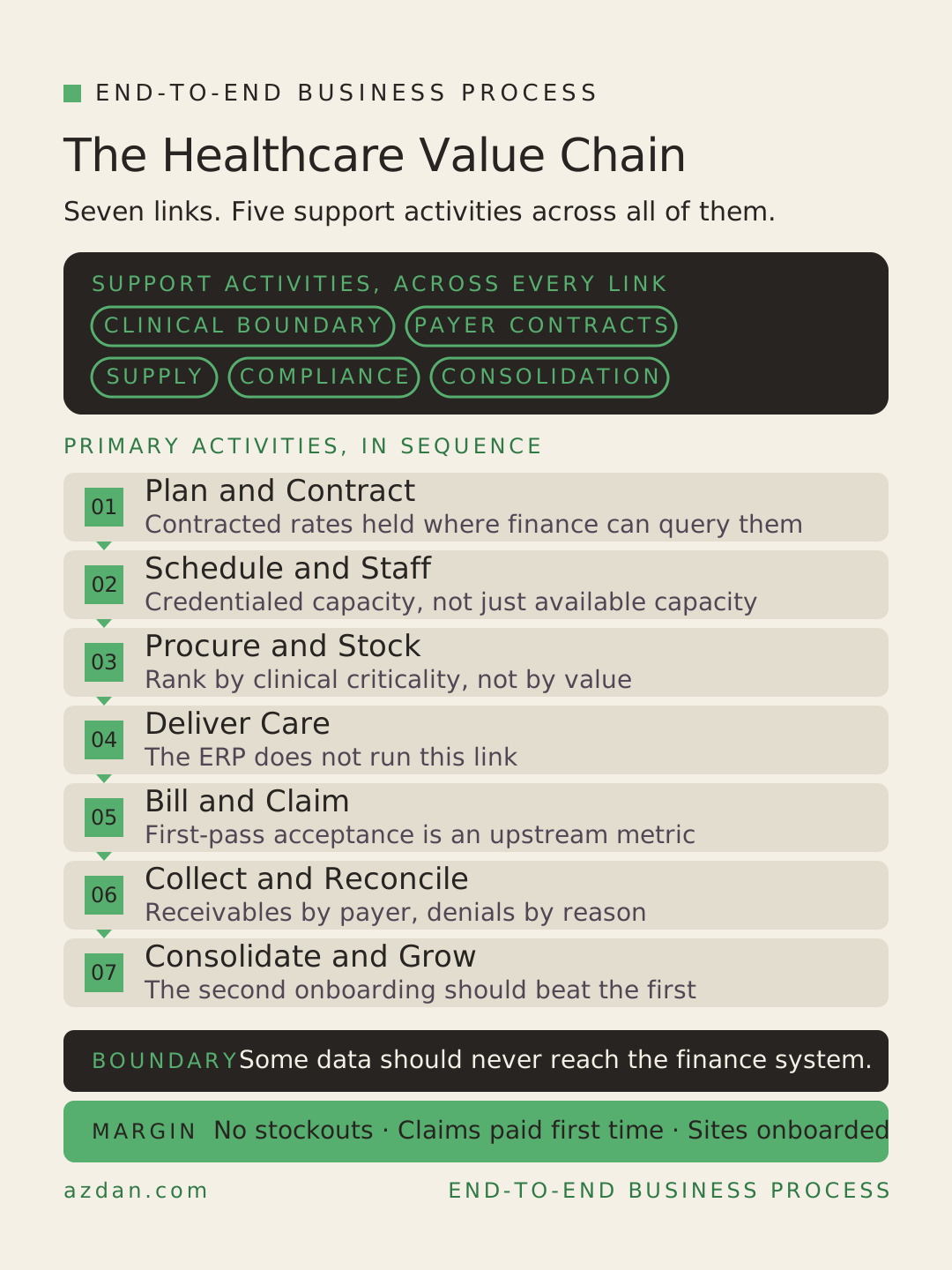
The healthcare value chain runs in seven links:
Plan and Contract → Schedule and Staff → Procure and Stock → Deliver Care → Bill and Claim → Collect and Reconcile → Consolidate and Grow
Three things make it unlike any other chain in this series. The central link, delivering care, sits outside the ERP by design and connects to it through integration rather than through configuration. The person receiving the service is usually not the person paying for it, so revenue is a claim against a contracted rate rather than an invoice against a price. And the entity structure changes often, because provider groups grow by acquiring practices rather than by opening branches.
Methodology note. This maps the end-to-end process using the value chain model. The process detail here is grounded in Oracle NetSuite's published healthcare material, sourced at the end, rather than in delivery experience specific to this sector. Where a point is inference from the structure of the business, it is labeled as a recommendation.
The Boundary Is the Design
Start here, because getting it wrong is the most expensive mistake available in a healthcare implementation.
An ERP in healthcare centralizes the business side: finance, supply procurement, workforce scheduling, and compliance. The clinical record, the orders, the imaging, and the care itself live in an electronic health record and the practice management systems around it. The ERP integrates with those tools rather than replacing them.
That split has a hard consequence that teams from other industries find counterintuitive. In manufacturing, the more the ERP knows, the better. In healthcare, there is information the ERP should deliberately not hold, and a design that quietly pulls patient detail into financial records to make a report easier has created a compliance problem in exchange for a convenience.
Recommendation: write the boundary down as a deliverable in scoping, field by field, before any integration is designed. The question to answer for each data element is not can we bring this across but does the finance process fail without it. Most of the time it does not.
The integration standards that carry the join are established rather than bespoke. Selecting an ERP for healthcare means checking it can exchange data with EHR, laboratory information, and patient management systems using the industry's interchange standards, Health Level Seven and Fast Healthcare Interoperability Resources for records, and Digital Imaging and Communications in Medicine for imaging. Recommendation: identify the specific systems the ERP must talk to during selection, not after, and confirm the interchange method for each one.
One further caution worth carrying into scoping: NetSuite's own clinic and lab material notes that some of the capabilities described require partner integrations. That is a normal and honest position for a platform at this boundary, but it means the healthcare scope conversation has to distinguish native capability from integrated capability, item by item.
The Payer Is Not the Patient
The second structural fact, and the one that reshapes the revenue links.
In every other chain in this series, whoever receives the goods or service is the one who pays for it. In healthcare the patient receives care, a co-pay is collected at the point of service, and the substantial balance is claimed from an insurer or a government scheme at a rate negotiated in advance and specific to that payer.
Healthcare providers therefore manage patient co-pays alongside the many different rates negotiated with various payers, and healthcare accounting processes differ meaningfully from those used in other industries as a result.
Three consequences for the chain:
- Price is not one number. The same procedure has a different contracted value per payer, so the rate card is a matrix and revenue depends on which payer the patient carries.
- Revenue is provisional until adjudicated. A claim submitted is not revenue collected. Denials, partial payments, and adjustments arrive weeks later, which makes accounts receivable aging a payer-level analysis rather than a customer-level one.
- The first submission matters more than the follow-up. A claim that is paid first time costs a fraction of one that is denied and reworked, which puts the quality burden upstream, on capture and coding, rather than downstream on collections.
Recommendation: report accounts receivable by payer and by age, and track first-pass claim acceptance as an operational metric rather than a finance one. It is the number that predicts cash.
The Healthcare Value Chain
Primary activities, in sequence:
Support activities, running across every link:
- The clinical system boundary and integration
- Payer contract and rate management
- Supply and pharmacy inventory control
- Compliance and data protection
- Multi-entity consolidation
The margin: care delivered without stockouts, claims paid the first time, and an acquired practice consolidated in weeks rather than quarters.
The clinical boundary heads the support list because it is the only item on it that is not a process. It is a line, and every link either respects it or erodes it. Erosion is gradual and nobody notices until an audit asks what patient information is sitting in the finance system.
The Seven Links
1. Plan and Contract
Service lines are planned, payer contracts are negotiated, and the rates that will govern revenue for the next period are set.
This link is upstream of everything and is frequently invisible to the finance system entirely, held in contract documents and spreadsheets. The practical consequence is that the rate a claim should have been paid at is not available to check the rate it was actually paid at.
Recommendation: hold contracted rates in a structured, queryable form somewhere the finance team can reach. Underpayment against contract is one of the few leakages in this sector that is both material and completely invisible without the reference data.
2. Schedule and Staff
Workforce scheduling, credentialing, and the matching of clinical capacity to expected demand.
Labor is the dominant cost in a provider organization, and unlike a services firm the constraint is not utilization alone but credential and licensing coverage. A shift is not staffed because someone is available. It is staffed because someone qualified and currently credentialed is available.
3. Procure and Stock
Medical supplies and pharmaceuticals, procured against demand and held across multiple sites.
This link behaves like distribution with an unusual failure cost. Demand-based planning keeps critical items flowing without under or overstocking, and site-specific inventory views, cycle counts, and bin tracking reduce carrying cost and misplaced items. What differs is the asymmetry: overstocking wastes money and expires, understocking cancels care.
Recommendation: classify items by clinical criticality, not just by value. An ABC analysis by cost will rank an inexpensive but non-substitutable consumable far below where its stockout consequence belongs.
4. Deliver Care
The central link, and the one the ERP does not run.
Care is delivered and recorded in the clinical system. What crosses into the ERP is the consequence: supplies consumed, procedures performed in a form that can be billed, labor hours worked, and the cost attribution that follows. What does not cross is the clinical detail itself, beyond the minimum the financial process genuinely requires.
Recommendation: define the crossing as an interface contract with a fixed field list, and review it whenever either system changes. Interfaces at this boundary tend to acquire fields over time, one reasonable request at a time, until the ERP holds more than it should.
5. Bill and Claim
Co-pays at the point of service, claims to payers, and the coding that determines whether either is correct.
NetSuite consolidates billing, accounting, and budgeting in one platform, with customizable payment rules and patient portals giving patients and providers more control over the payment relationship. But the accuracy of what is billed originates in the clinical encounter, which is on the other side of the boundary. That is why first-pass acceptance is an upstream metric.
6. Collect and Reconcile
Payments arrive partial, late, and coded, and each one has to be matched to a claim, a contract rate, and an expected value.
This is the link where the payer-level view earns its place. A single aged receivables report tells a provider nothing actionable. The same data split by payer shows which contracts are performing, which are slow, and which are systematically denying a particular claim type.
Recommendation: treat denial reasons as a categorized dataset with a trend, not as a queue to be worked. The queue is today's cash. The trend is next quarter's.
7. Consolidate and Grow
The link that surprises people arriving from other sectors.
Provider organizations frequently grow by acquisition rather than by opening new sites, operating as holding companies for a range of medical service providers in a highly acquisitive environment. That makes multi-entity consolidation a routine operational activity rather than an occasional corporate event.
The practical requirement is a repeatable onboarding pattern: a new entity with a conformed chart of accounts, mapped payer contracts, connected clinical systems, and consolidated reporting from the first close. Recommendation: build that pattern deliberately after the first acquisition and reuse it. Organizations that treat each acquisition as bespoke spend the same effort every time and never improve the timeline.
What Breaks: Seven Recurring Failures
These follow from the structure of the business described above and from the platform boundaries noted in the sources. They are offered as recommendations rather than measured findings.
- The clinical boundary never written down. It erodes gradually, and the compliance exposure is discovered by an audit rather than by a design review.
- Contracted rates held only in documents. Underpayment against contract cannot be detected without structured reference data.
- Receivables reported in aggregate. A single aging report hides which payer is the problem, which is the only actionable version of the question.
- Denials worked as a queue. Clearing today's denials without categorizing them means the same denials arrive next month.
- Native and integrated capability conflated in scope. Some healthcare capabilities require partner integrations, and a scope that does not distinguish them will misprice the project.
- Inventory ranked by value alone. A cheap, non-substitutable consumable is a higher stockout risk than an expensive one with alternatives.
- Each acquisition treated as bespoke. The second entity onboarding should be faster than the first, and it usually is not.
Reading Your Own Chain: Four Questions
- What patient information currently sits in the finance system, and which process would fail without it? The second half of that question usually shortens the answer to the first.
- What is first-pass claim acceptance, by payer? It predicts cash better than any aging report.
- Can you compare what a payer paid against what the contract says they owed? If not, underpayment is invisible rather than absent.
- How long did the last acquired entity take to reach a clean consolidated close, and how long did the one before it take? The gap between those two numbers is whether the onboarding pattern exists.
Where This Sits Alongside Azdan's Practices
Healthcare shares most of its non-clinical mechanics with practices Azdan maintains, and a provider group modernizing its back office will recognize its own chain in them.
- Healthcare organizations. Azdan publishes directly on NetSuite for healthcare providers, covering billing workflows, reimbursement, and the integration of financial and clinical data. See NetSuite for Healthcare Organizations.
- Multi-entity consolidation. Conformed charts of accounts, intercompany, and consolidated reporting across many subsidiaries is the mechanism behind links six and seven above, and it is the same capability a holding group relies on.
- Wholesale distribution. Supply and pharmacy inventory across sites, demand planning, and expiry-sensitive stock behave like distribution. See NetSuite ERP for Wholesale Distribution.
What healthcare adds on top of all three is the clinical boundary and the payer relationship. Those are the two links to scope with the most care, because neither has an equivalent in any other sector.
Recommendation
If you are mapping a healthcare organization end to end, produce the boundary document before anything else. A field-level list of what the ERP will hold and what it will not, with the finance process that justifies each inclusion. It is a day of work and it prevents the most expensive category of mistake available here.
Then measure two numbers. First-pass claim acceptance by payer, which tells you where revenue is leaking upstream. And the time to a clean consolidated close for the last two entities onboarded, which tells you whether growth is repeatable or improvised.
Sources
- Oracle NetSuite, Healthcare ERP, for the scope of billing, accounting, budgeting, and supply management in provider organizations
- Oracle NetSuite, Clinic and Lab Management ERP, for the business-side scope, EHR and practice management integration, and the note that some described capabilities require partner integrations
- Oracle NetSuite, How to Choose the Right ERP System for Healthcare, for the integration standards HL7, FHIR, and DICOM
- Oracle NetSuite, 5 Ways Integrated ERP Supports Healthcare Management Organizations, for payer rate negotiation, co-pays, and the acquisitive structure of provider groups
- Oracle NetSuite, What Is Value Chain? An Expert Guide, for the value chain model
- Michael E. Porter, Competitive Advantage: Creating and Sustaining Superior Performance, 1985, for the original value chain framework
Regulatory and data protection obligations for healthcare vary substantially by country. Confirm requirements against the relevant authority before acting on anything here. Checked August 2026.
Related Azdan Resources
- End-to-End Business Process for Health and Beauty
- End-to-End Business Process for Food and Beverage
- How to Implement NetSuite ERP
- Oracle NetSuite Implementation
Published by Azdan, an Oracle NetSuite Solution Provider operating across the UAE, Saudi Arabia, and Egypt. Content checked August 2026.