A manufacturer turns what it buys into what it sells, and almost everything difficult sits in between: what to make and when, from which components, whether to build it in house or hand it to a contract manufacturer, and what happens to the units that fail inspection. This reference covers each of those as the edition documents them, from the supply plan through the shop floor to the close, for a manufacturer running the system day to day. This is the leading practice reference for manufacturing companies: every process area, the flow it follows, the rules that govern it, and a copy-ready skill file for each one.
How to Use This
Each process area below carries three things. A flow, which is the sequence the process actually runs in. A short set of rules specific to manufacturing companies rather than generic ERP advice. And a skill file you can copy straight out of the page, written as markdown so it can be handed to an AI assistant, dropped into a project repository, or used as the basis for a design document.
The skill files are deliberately short. They are checklists for people who already know the domain, not tutorials. Each one names the roles that own the process, the flow, the rules, what to verify before go-live, and the failure modes that recur.
Methodology note. This reflects the Manufacturing Standard edition as applied by Azdan across its NetSuite delivery in the UAE, Saudi Arabia, and Egypt. Module availability differs by edition and license, so confirm against your own before treating any rule as available. Where a point is a recommendation from delivery experience rather than a documented rule, it is labeled as one.
The 14 Process Areas
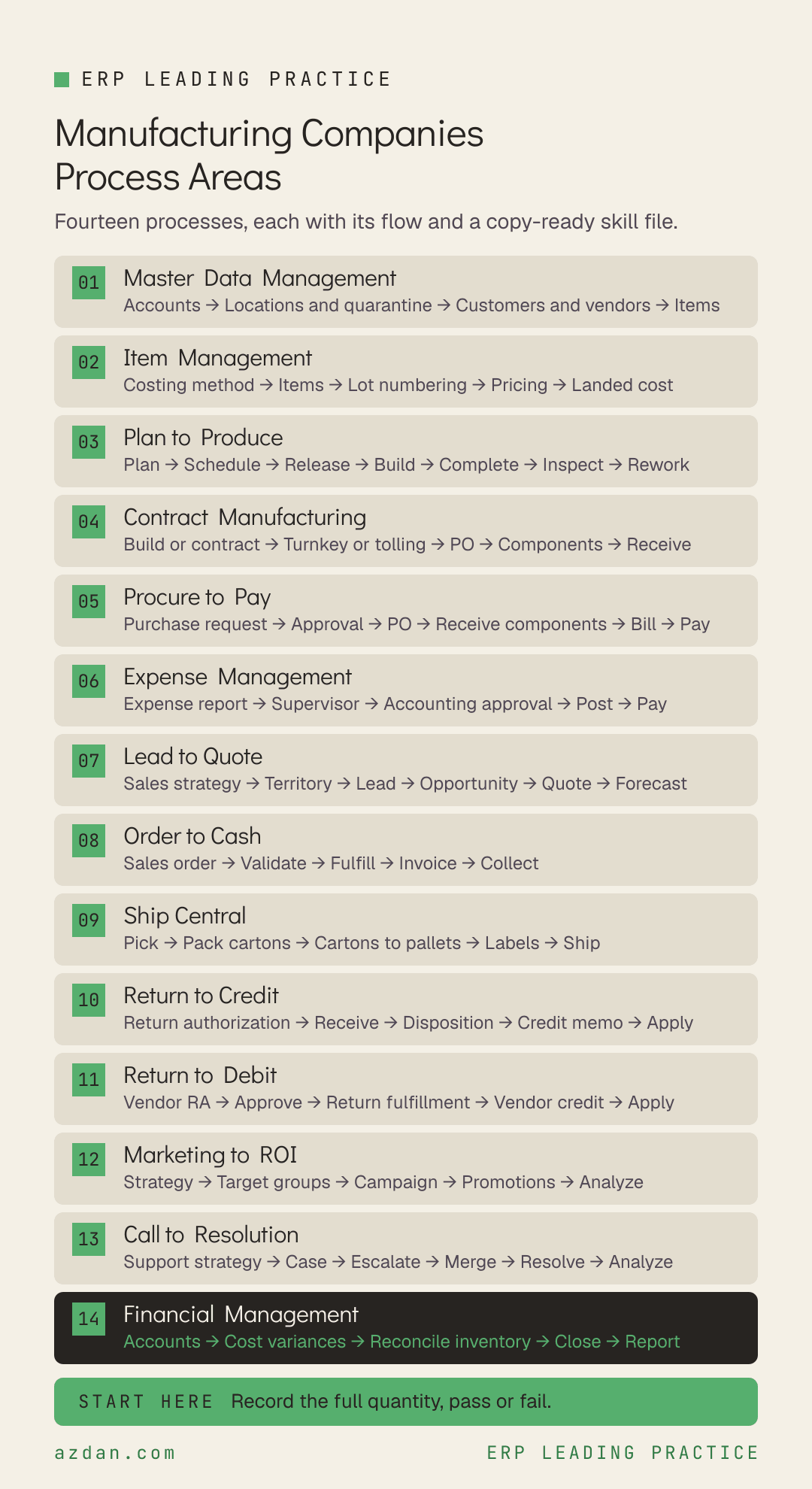
Master Data Management → Item Management → Plan to Produce → Contract Manufacturing → Procure to Pay → Expense Management → Lead to Quote → Order to Cash → Ship Central → Return to Credit → Return to Debit → Marketing to ROI → Call to Resolution → Financial Management
Process area
Primary owner
What it covers
Master Data Management
Controller
Accounts, customers, vendors, items and locations, including the locations and sublocations production depends on.
Item Management
Controller
Items, their costing method, pricing and traceability.
Plan to Produce
Production Manager
Turning demand into work orders and work orders into finished goods, including the units that fail.
Contract Manufacturing
Production Manager
Building through a third party.
Procure to Pay
Purchasing Manager
Buying the components production depends on, from request through receipt to payment.
Expense Management
Employee Center
Employee expenses, including the timing rule that decides which period they land in.
Lead to Quote
Sales Manager
Selling activities and the structure that lets a sales team scale: teams, territories, lead assignment, forecasts and quotas.
Order to Cash
Sales
Taking orders, validating them, fulfilling and collecting, with a control placed before fulfillment where it is cheapest.
Ship Central
Warehouse Manager
Packing and shipping on a tablet or kiosk, with cartons packed onto pallets.
Return to Credit
Customer Service
Customer returns, credits and refunds, where returned goods need a disposition decision before they reach stock.
Return to Debit
Purchasing Manager
Vendor returns and credits, including components that fail on the production line.
Marketing to ROI
Sales Manager
Campaigns, target groups, promotions and upsell, measured against what they produce.
Call to Resolution
Customer Service
Customer support through case management, including the quality issues that often trace back to production.
Financial Management
Controller
Accounts, the close and reporting, where standard cost variances and inventory valuation make the manufacturing close heavier than most.
1. Master Data Management
Accounts, customers, vendors, items and locations, including the locations and sublocations production depends on. Nothing downstream corrects a master record that was wrong at load.
Roles: Controller, Inventory Manager, Production Manager
Process flow
Define accounts and segments → Create locations and quarantine sublocations → Load customers and vendors → Create items → Validate
Leading practice rules
Master data must be maintained before process area transactions can be carried out.
Set up a quarantine sublocation wherever production runs, because failed inspection stock and rework are handled there.
Where contract manufacturers hold your stock, set each one up as its own location so transfers and builds are visible.
Skill file: Master Data Management
---
name: manufacturing-master-data-management
description: NetSuite leading practice for Master Data Management in manufacturing companies
---

# Master Data Management - Manufacturing Companies

## Roles
Controller, Inventory Manager, Production Manager

## Process flow
Define accounts and segments → Create locations and quarantine sublocations → Load customers and vendors → Create items → Validate

## Leading practice rules
- Master data must be maintained before process area transactions can be carried out.
- Set up a quarantine sublocation wherever production runs, because failed inspection stock and rework are handled there.
- Where contract manufacturers hold your stock, set each one up as its own location so transfers and builds are visible.

## Check before go-live
- [ ] A quarantine sublocation at every production location
- [ ] Every contract manufacturer set up as a location

## Known failure modes
- No quarantine sublocation, so failed units sit in available stock and get committed to orders

## Scope note
This reflects the Manufacturing Standard edition. Confirm against your own licensed
modules and edition before treating any rule as available.
2. Item Management
Items, their costing method, pricing and traceability. The costing method set here decides which production features can be used at all.
Roles: Controller, Inventory Manager, Production Manager, Supply Chain Manager
Process flow
Choose costing method → Create items and kits → Set lot numbering → Set pricing → Apply landed cost defaults → Release
Leading practice rules
Set the costing method on the item. Neither WIP nor Advanced Manufacturing supports FIFO or LIFO costing, so manufacturers using either feature choose between average and standard cost.
Under standard cost, the finance team sets and maintains the standards, and variances between expected and actual cost are tracked.
Use Auto Lot Numbering to assign lot numbers from your own preset formats, for traceability, quality control and product safety.
Use kit items for multi-component items fulfilled without assembly, and the Available to Build SuiteApp to see how many assemblies or kits current stock supports.
Apply estimated landed cost at receipt using cost categories such as freight, duty and insurance, and use effective date pricing for temporary or permanent mass price changes.
Skill file: Item Management
---
name: manufacturing-item-management
description: NetSuite leading practice for Item Management in manufacturing companies
---

# Item Management - Manufacturing Companies

## Roles
Controller, Inventory Manager, Production Manager, Supply Chain Manager

## Process flow
Choose costing method → Create items and kits → Set lot numbering → Set pricing → Apply landed cost defaults → Release

## Leading practice rules
- Set the costing method on the item. Neither WIP nor Advanced Manufacturing supports FIFO or LIFO costing, so manufacturers using either feature choose between average and standard cost.
- Under standard cost, the finance team sets and maintains the standards, and variances between expected and actual cost are tracked.
- Use Auto Lot Numbering to assign lot numbers from your own preset formats, for traceability, quality control and product safety.
- Use kit items for multi-component items fulfilled without assembly, and the Available to Build SuiteApp to see how many assemblies or kits current stock supports.
- Apply estimated landed cost at receipt using cost categories such as freight, duty and insurance, and use effective date pricing for temporary or permanent mass price changes.

## Check before go-live
- [ ] Costing method decided before the first item is loaded, with the WIP consequence understood
- [ ] Ownership of standard cost maintenance assigned in finance

## Known failure modes
- FIFO chosen for its familiarity, then WIP or Advanced Manufacturing switched on later, forcing a costing change mid-life

## Scope note
This reflects the Manufacturing Standard edition. Confirm against your own licensed
modules and edition before treating any rule as available.
3. Plan to Produce
Turning demand into work orders and work orders into finished goods, including the units that fail. This is the process area that defines the edition.
Roles: Production Manager, Production Operator, Supply Chain Manager
Process flow
Generate supply plan → Review planned work orders → Schedule → Mass release → Build and backflush → Complete → Inspect → Rework or scrap
Leading practice rules
Review the planned work orders created by Generate Item Supply Plan, and schedule against capacity in labor, machines and raw materials.
Work order lead time is calculated from the lead time on the item master and the quantity ordered. Use the Work Orders To Be Scheduled saved search weekly to sequence work orders by scheduling attributes.
Release to the floor only once components and sequence are confirmed, then run Mass Release on the firmed schedule.
By default, non-lot and non-serial components are backflushed from the bill of materials and the work order quantity. Where consumption differs, adjust it on the work order.
Enter the full completed quantity, pass or fail, then move failed units to the quarantine sublocation and make them unavailable for commitment.
For rework, unbuild reusable components in quarantine, scrap or return what cannot be used, transfer in the components needed, build a new work order in quarantine, and move good output to stock.
Use the Costed BOM to see the cost of an assembly by bill of materials revision, routing and template.
Skill file: Plan to Produce
---
name: manufacturing-plan-to-produce
description: NetSuite leading practice for Plan to Produce in manufacturing companies
---

# Plan to Produce - Manufacturing Companies

## Roles
Production Manager, Production Operator, Supply Chain Manager

## Process flow
Generate supply plan → Review planned work orders → Schedule → Mass release → Build and backflush → Complete → Inspect → Rework or scrap

## Leading practice rules
- Review the planned work orders created by Generate Item Supply Plan, and schedule against capacity in labor, machines and raw materials.
- Work order lead time is calculated from the lead time on the item master and the quantity ordered. Use the Work Orders To Be Scheduled saved search weekly to sequence work orders by scheduling attributes.
- Release to the floor only once components and sequence are confirmed, then run Mass Release on the firmed schedule.
- By default, non-lot and non-serial components are backflushed from the bill of materials and the work order quantity. Where consumption differs, adjust it on the work order.
- Enter the full completed quantity, pass or fail, then move failed units to the quarantine sublocation and make them unavailable for commitment.
- For rework, unbuild reusable components in quarantine, scrap or return what cannot be used, transfer in the components needed, build a new work order in quarantine, and move good output to stock.
- Use the Costed BOM to see the cost of an assembly by bill of materials revision, routing and template.

## Check before go-live
- [ ] A weekly scheduling routine with a named owner
- [ ] Failed units routed to quarantine, tested on a live work order

## Known failure modes
- Only passing units entered as completed, so the yield loss is never recorded
- Work orders released before components are confirmed, so the floor stops mid-build

## Scope note
This reflects the Manufacturing Standard edition. Confirm against your own licensed
modules and edition before treating any rule as available.
4. Contract Manufacturing
Building through a third party. The edition supports two models, and they drive supply in opposite ways, so the model has to be chosen before the flow is designed.
Roles: Production Manager, Supply Chain Manager, Purchasing Manager, Contract Manufacturer
Process flow
Decide build or contract → Choose turnkey or tolling → Raise PO → Transfer components if tolling → Contractor builds → Receive or drop ship → Close
Leading practice rules
Turnkey: the contract manufacturer sources all raw materials and charges one fee for materials and labor. Only a purchase order drives supply.
Tolling: the contract manufacturer supplies little or no material and charges for labor only. You plan and supply the components, so sub-component inventory must be visible.
For tolling, raise the tolling purchase order as a service item flagged as receivable, and transfer components to the contract manufacturer's location on a transfer order.
The contract manufacturer works through its own role, updating work orders with usage on part or full completion.
Bring finished goods back on a transfer order from the contract manufacturer's location, or have it drop ship to the customer and record the fulfillment against the sales order.
Skill file: Contract Manufacturing
---
name: manufacturing-contract-manufacturing
description: NetSuite leading practice for Contract Manufacturing in manufacturing companies
---

# Contract Manufacturing - Manufacturing Companies

## Roles
Production Manager, Supply Chain Manager, Purchasing Manager, Contract Manufacturer

## Process flow
Decide build or contract → Choose turnkey or tolling → Raise PO → Transfer components if tolling → Contractor builds → Receive or drop ship → Close

## Leading practice rules
- Turnkey: the contract manufacturer sources all raw materials and charges one fee for materials and labor. Only a purchase order drives supply.
- Tolling: the contract manufacturer supplies little or no material and charges for labor only. You plan and supply the components, so sub-component inventory must be visible.
- For tolling, raise the tolling purchase order as a service item flagged as receivable, and transfer components to the contract manufacturer's location on a transfer order.
- The contract manufacturer works through its own role, updating work orders with usage on part or full completion.
- Bring finished goods back on a transfer order from the contract manufacturer's location, or have it drop ship to the customer and record the fulfillment against the sales order.

## Check before go-live
- [ ] Turnkey or tolling decided per product family before configuration
- [ ] Component stock at each tolling contractor visible and reconciled

## Known failure modes
- Tolling run without visibility of components held at the contractor, so supply planning buys stock you already own

## Scope note
This reflects the Manufacturing Standard edition. Confirm against your own licensed
modules and edition before treating any rule as available.
5. Procure to Pay
Buying the components production depends on, from request through receipt to payment.
Purchase request → Approval → Purchase order → Receive components → Vendor bill → Pay
Leading practice rules
A purchase request is auto-approved within the requestor's purchase limit. Above it, the supervisor or next role in the chain with enough limit approves.
Receive component purchase orders from the purchase order or the Receive Orders page.
Apply estimated landed cost at receipt, then compare estimated to actual with a saved search.
Skill file: Procure to Pay
---
name: manufacturing-procure-to-pay
description: NetSuite leading practice for Procure to Pay in manufacturing companies
---

# Procure to Pay - Manufacturing Companies

## Roles
Purchasing Manager, Supply Chain Manager, Warehouse Manager, A/P Analyst

## Process flow
Purchase request → Approval → Purchase order → Receive components → Vendor bill → Pay

## Leading practice rules
- A purchase request is auto-approved within the requestor's purchase limit. Above it, the supervisor or next role in the chain with enough limit approves.
- Receive component purchase orders from the purchase order or the Receive Orders page.
- Apply estimated landed cost at receipt, then compare estimated to actual with a saved search.

## Check before go-live
- [ ] Purchase limits set per role and the approval chain tested

## Known failure modes
- Components received late into the system, so available-to-build and scheduling run on stale stock

## Scope note
This reflects the Manufacturing Standard edition. Confirm against your own licensed
modules and edition before treating any rule as available.
6. Expense Management
Employee expenses, including the timing rule that decides which period they land in.
Roles: Employee Center, A/P Analyst, Controller
Process flow
Enter expense report → Supervisor approval → Accounting approval → Post → Pay
Leading practice rules
Expense reports can be entered and paid in currencies other than the employee's subsidiary base currency.
After supervisor approval a report sits in Pending Accounting Approval and only posts once accounting approves it.
Process payments by the automated batch or by selecting expenses manually from the bill payments list.
Skill file: Expense Management
---
name: manufacturing-expense-management
description: NetSuite leading practice for Expense Management in manufacturing companies
---

# Expense Management - Manufacturing Companies

## Roles
Employee Center, A/P Analyst, Controller

## Process flow
Enter expense report → Supervisor approval → Accounting approval → Post → Pay

## Leading practice rules
- Expense reports can be entered and paid in currencies other than the employee's subsidiary base currency.
- After supervisor approval a report sits in Pending Accounting Approval and only posts once accounting approves it.
- Process payments by the automated batch or by selecting expenses manually from the bill payments list.

## Check before go-live
- [ ] An accounting approval deadline set inside the close timetable

## Known failure modes
- Expenses approved after the period closes, moving cost into a later month

## Scope note
This reflects the Manufacturing Standard edition. Confirm against your own licensed
modules and edition before treating any rule as available.
7. Lead to Quote
Selling activities and the structure that lets a sales team scale: teams, territories, lead assignment, forecasts and quotas.
Define sales strategy → Assign territory and team → Lead → Opportunity → Quote → Forecast
Leading practice rules
Use Sales Teams, territories and lead assignment to manage sales activity as the business grows.
Manage sales quotas for sales reps and sales managers.
Keep one opportunity per customer, with variations as separate quotes, so the pipeline does not overstate itself.
Skill file: Lead to Quote
---
name: manufacturing-lead-to-quote
description: NetSuite leading practice for Lead to Quote in manufacturing companies
---

# Lead to Quote - Manufacturing Companies

## Roles
Sales Manager, Chief Executive Officer, Sales

## Process flow
Define sales strategy → Assign territory and team → Lead → Opportunity → Quote → Forecast

## Leading practice rules
- Use Sales Teams, territories and lead assignment to manage sales activity as the business grows.
- Manage sales quotas for sales reps and sales managers.
- Keep one opportunity per customer, with variations as separate quotes, so the pipeline does not overstate itself.

## Check before go-live
- [ ] Territories and quotas defined before go-live

## Known failure modes
- Several open opportunities per customer, inflating the pipeline

## Scope note
This reflects the Manufacturing Standard edition. Confirm against your own licensed
modules and edition before treating any rule as available.
8. Order to Cash
Taking orders, validating them, fulfilling and collecting, with a control placed before fulfillment where it is cheapest.
Sales order → Validate → Fulfill from stock, production or contractor → Invoice → Collect
Leading practice rules
Validate orders against the customer's business rules before they proceed to fulfillment.
An order can be met from stock, from a work order, or by a contract manufacturer shipping direct to the customer.
Where a third-party logistics provider has integrated shipping, no direct carrier integration is needed.
Skill file: Order to Cash
---
name: manufacturing-order-to-cash
description: NetSuite leading practice for Order to Cash in manufacturing companies
---

# Order to Cash - Manufacturing Companies

## Roles
Sales, Sales Manager, Controller, Warehouse Manager, A/R Analyst

## Process flow
Sales order → Validate → Fulfill from stock, production or contractor → Invoice → Collect

## Leading practice rules
- Validate orders against the customer's business rules before they proceed to fulfillment.
- An order can be met from stock, from a work order, or by a contract manufacturer shipping direct to the customer.
- Where a third-party logistics provider has integrated shipping, no direct carrier integration is needed.

## Check before go-live
- [ ] Order validation rules written down before configuration

## Known failure modes
- Orders fulfilled before validation, so exceptions surface as credit notes

## Scope note
This reflects the Manufacturing Standard edition. Confirm against your own licensed
modules and edition before treating any rule as available.
9. Ship Central
Packing and shipping on a tablet or kiosk, with cartons packed onto pallets. It carries one prerequisite that cannot be worked around afterwards.
Printing integrates through PrintNode, a third-party hosted printing service.
Carrier integration runs through a ShipEngine account created using NetSuite's interface. An account created outside NetSuite cannot be integrated.
Skill file: Ship Central
---
name: manufacturing-ship-central
description: NetSuite leading practice for Ship Central in manufacturing companies
---

# Ship Central - Manufacturing Companies

## Roles
Warehouse Manager, Warehouse Operator

## Process flow
Pick → Pack cartons → Cartons to pallets → Labels → Ship

## Leading practice rules
- Printing integrates through PrintNode, a third-party hosted printing service.
- Carrier integration runs through a ShipEngine account created using NetSuite's interface. An account created outside NetSuite cannot be integrated.

## Check before go-live
- [ ] ShipEngine account created through NetSuite before go-live

## Known failure modes
- An existing ShipEngine account assumed reusable, discovered in testing

## Scope note
This reflects the Manufacturing Standard edition. Confirm against your own licensed
modules and edition before treating any rule as available.
10. Return to Credit
Customer returns, credits and refunds, where returned goods need a disposition decision before they reach stock.
Return authorization → Approve → Receive → Inspect and disposition → Credit memo → Apply or refund
Leading practice rules
Start the return with a return authorization from the originating transaction.
Receive returned goods against it and decide disposition: back to stock, to quarantine for rework, or scrap.
Generate the credit memo from the return authorization and apply it to open invoices.
Skill file: Return to Credit
---
name: manufacturing-return-to-credit
description: NetSuite leading practice for Return to Credit in manufacturing companies
---

# Return to Credit - Manufacturing Companies

## Roles
Customer Service, Sales Manager, Warehouse Operator, A/R Analyst

## Process flow
Return authorization → Approve → Receive → Inspect and disposition → Credit memo → Apply or refund

## Leading practice rules
- Start the return with a return authorization from the originating transaction.
- Receive returned goods against it and decide disposition: back to stock, to quarantine for rework, or scrap.
- Generate the credit memo from the return authorization and apply it to open invoices.

## Check before go-live
- [ ] Returned goods routed through quarantine where quality is in doubt

## Known failure modes
- Returns put straight back into available stock without inspection

## Scope note
This reflects the Manufacturing Standard edition. Confirm against your own licensed
modules and edition before treating any rule as available.
11. Return to Debit
Vendor returns and credits, including components that fail on the production line.
Create vendor return authorizations from the originating purchase transaction for unwanted or damaged items.
Unusable components found during rework can be returned to the vendor rather than scrapped.
Apply vendor credits to reduce accounts payable.
Skill file: Return to Debit
---
name: manufacturing-return-to-debit
description: NetSuite leading practice for Return to Debit in manufacturing companies
---

# Return to Debit - Manufacturing Companies

## Roles
Purchasing Manager, Inventory Manager, A/P Analyst

## Process flow
Vendor return authorization → Approve → Return fulfillment → Vendor credit → Apply

## Leading practice rules
- Create vendor return authorizations from the originating purchase transaction for unwanted or damaged items.
- Unusable components found during rework can be returned to the vendor rather than scrapped.
- Apply vendor credits to reduce accounts payable.

## Check before go-live
- [ ] A route for returning failed components to vendors, not only scrapping them

## Known failure modes
- Defective components scrapped with no vendor credit claimed

## Scope note
This reflects the Manufacturing Standard edition. Confirm against your own licensed
modules and edition before treating any rule as available.
12. Marketing to ROI
Campaigns, target groups, promotions and upsell, measured against what they produce.
Set up target groups so campaigns reach the right audience without excessive marketing traffic.
Use Standard Promotions to assign promotional discounts to items, and Upsell Manager for upsell criteria.
Analyze marketing performance against what each campaign produced.
Skill file: Marketing to ROI
---
name: manufacturing-marketing-to-roi
description: NetSuite leading practice for Marketing to ROI in manufacturing companies
---

# Marketing to ROI - Manufacturing Companies

## Roles
Sales Manager, Chief Executive Officer

## Process flow
Marketing strategy → Target groups → Campaign → Promotions → Upsell → Analyze

## Leading practice rules
- Set up target groups so campaigns reach the right audience without excessive marketing traffic.
- Use Standard Promotions to assign promotional discounts to items, and Upsell Manager for upsell criteria.
- Analyze marketing performance against what each campaign produced.

## Check before go-live
- [ ] Every campaign linked to the revenue it produced

## Known failure modes
- Campaigns repeated without measuring the orders they generated

## Scope note
This reflects the Manufacturing Standard edition. Confirm against your own licensed
modules and edition before treating any rule as available.
13. Call to Resolution
Customer support through case management, including the quality issues that often trace back to production.
Support strategy → Create case → Escalate → Merge → Resolve → Analyze
Leading practice rules
Use case management to track customer questions, issues and special requests.
Escalate cases needing another employee or group, and merge similar cases with the Merge button.
Track support performance through dashboards and KPIs, reviewed daily so issues surface early.
Skill file: Call to Resolution
---
name: manufacturing-call-to-resolution
description: NetSuite leading practice for Call to Resolution in manufacturing companies
---

# Call to Resolution - Manufacturing Companies

## Roles
Customer Service, Sales Manager, Chief Executive Officer

## Process flow
Support strategy → Create case → Escalate → Merge → Resolve → Analyze

## Leading practice rules
- Use case management to track customer questions, issues and special requests.
- Escalate cases needing another employee or group, and merge similar cases with the Merge button.
- Track support performance through dashboards and KPIs, reviewed daily so issues surface early.

## Check before go-live
- [ ] Quality-related cases linkable to the lot or work order involved

## Known failure modes
- Product complaints handled in email, so recurring defects are never traced to a lot

## Scope note
This reflects the Manufacturing Standard edition. Confirm against your own licensed
modules and edition before treating any rule as available.
14. Financial Management
Accounts, the close and reporting, where standard cost variances and inventory valuation make the manufacturing close heavier than most.
Under standard costing, review the variances between standard and actual cost every period and keep the standards current.
Use the Costed BOM and manufacturing reports to explain cost movements by assembly.
Compare estimated with actual landed cost as part of the close.
Skill file: Financial Management
---
name: manufacturing-financial-management
description: NetSuite leading practice for Financial Management in manufacturing companies
---

# Financial Management - Manufacturing Companies

## Roles
Controller, Chief Executive Officer, A/R Analyst, A/P Analyst

## Process flow
Maintain accounts → Review cost variances → Reconcile inventory → Close → Report

## Leading practice rules
- Under standard costing, review the variances between standard and actual cost every period and keep the standards current.
- Use the Costed BOM and manufacturing reports to explain cost movements by assembly.
- Compare estimated with actual landed cost as part of the close.

## Check before go-live
- [ ] Variance review in the month-end checklist with a named owner

## Known failure modes
- Standards left unmaintained, so variances grow until the standard no longer means anything

## Scope note
This reflects the Manufacturing Standard edition. Confirm against your own licensed
modules and edition before treating any rule as available.
Where to Start
Master data first, then item management, because the costing method is set on the item and decides which production features are available. Plan to produce and contract manufacturing next, designed together, since every demand is either built in house or handed to a contract manufacturer. Procure to pay follows, because components have to arrive before work orders can start. The sales, returns, marketing and support processes run alongside, with financial management and standard cost variances throughout.
The costing decision, which has to be settled before any item is loaded, is covered in full in the companion implementation guide. Once the system is running, the single highest-value habit is the one that makes yield visible: record the full quantity completed on every work order, pass or fail, and only then move failed units to quarantine. Enter only what passed and the yield loss never appears anywhere, and a manufacturer that cannot see its yield cannot manage it.
Published by Azdan, an Oracle NetSuite Solution Provider operating across the UAE, Saudi Arabia, and Egypt. Guidance in this article reflects Azdan's process design work with manufacturing companies. Content checked August 2026.
Blog
News & Insights
Fresh thinking and real-world advice to help you scale smarter, faster, and with more clarity
.svg)