.svg)


End-to-End Business Process for Manufacturing
Two companies make the same valve. One makes it to stock in high volume for plumbing distributors, competing on price and availability. The other makes it to order for oil and gas, competing on specification and certification. Same product, same machines, almost the same bill of materials. Completely different value chains. This guide maps the manufacturing value chain end to end and shows why there is no single version of it, only a version determined by two structural choices most manufacturers made long before they bought a system.
The Short Answer
The manufacturing value chain runs in seven links:
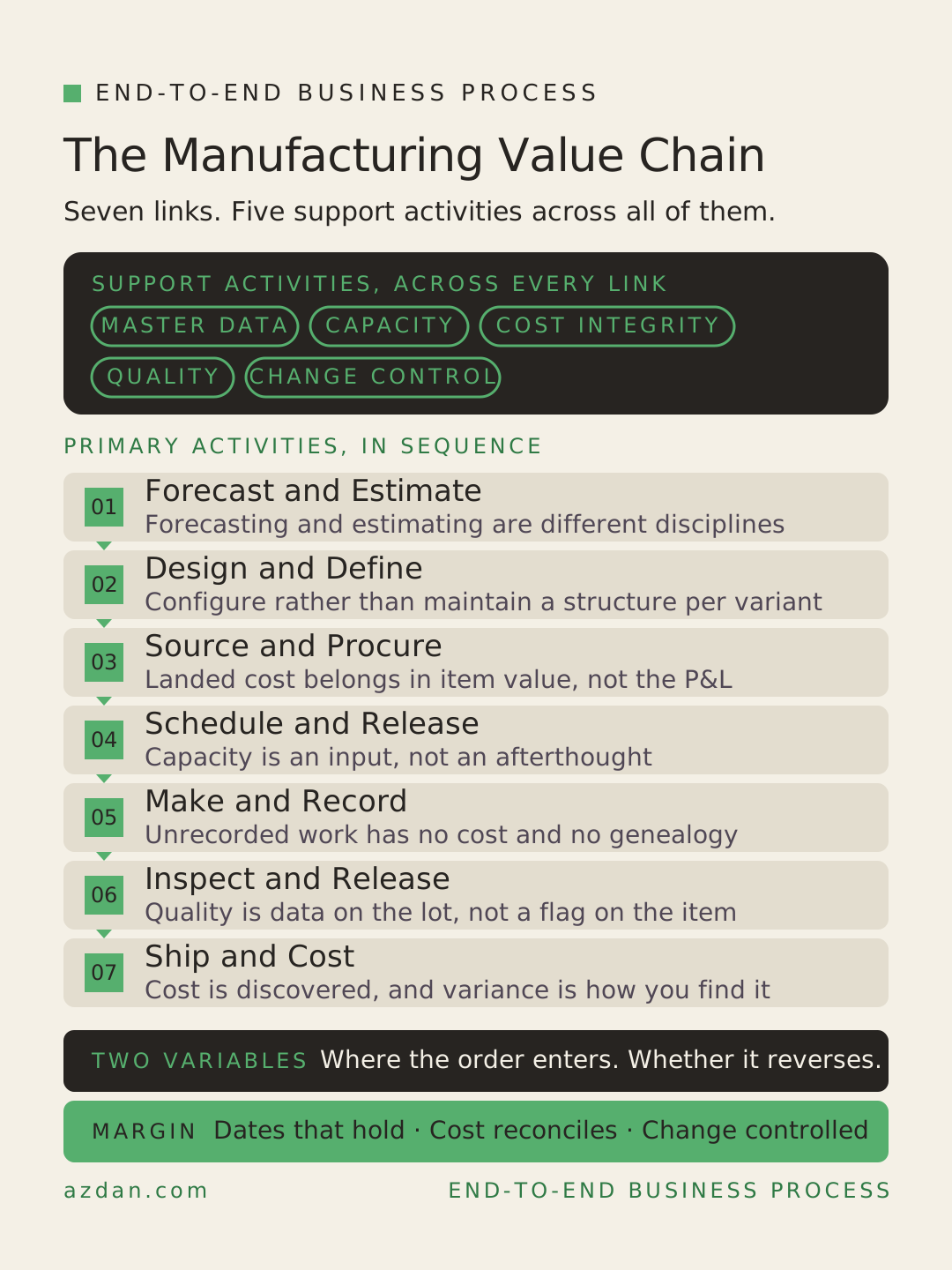
Forecast and Estimate → Design and Define → Source and Procure → Schedule and Release → Make and Record → Inspect and Release → Ship and Cost
But the shape of that chain is set by two variables, and they matter more than the links themselves.
The first is where the customer order enters. In make to stock it arrives after production is finished. In engineer to order it arrives before anything has been designed. That point, the boundary between what is forecast and what is ordered, determines what is held as inventory, where lead time is absorbed, and what the planning system is actually doing.
The second is whether the transformation can be reversed. A discrete assembly can be taken apart back into its components. A blended, cooked, or reacted product cannot. That single physical fact drives everything from the data structure to the regulatory burden.
Methodology note. This maps the end-to-end process using the value chain model, applied to the manufacturing process design Azdan works with across its NetSuite delivery in the UAE, Saudi Arabia, and Egypt. Where a point reflects delivery experience rather than measured data, it is labeled as a recommendation.
This article covers the business process. The companion piece, How to Implement NetSuite for Manufacturing, covers the implementation method and the costing decision that governs it.
Variable One: Where the Order Enters
Manufacturers are usually described by their production methodology, and the labels are familiar. What is less often said is that each label is really a statement about one thing: the point in the chain where forecasting stops and a real customer order takes over.
Read the last row carefully, because it is the one most manufacturers actually occupy. Mixed mode is not an edge case. A business that makes a standard range to stock and also takes custom orders is running two chains through one factory, two planning logics through one system, and two cost models through one ledger.
Recommendation: identify the decoupling point for each product family explicitly, and write it down. Most manufacturers can name their methodology in the abstract and cannot say which of their product families sits where. That list is the input to almost every other design decision in the chain.
The consequences ripple outward. A make to stock business absorbs lead time in inventory and lives or dies by forecast accuracy. An engineer to order business absorbs lead time in the promise and lives or dies by estimating discipline. They need different reports, different metrics, and different conversations at month end, and a system configured for one will feel wrong to the other.
Variable Two: Whether the Transformation Reverses
The second axis is physical rather than commercial, and it splits manufacturing into two families that share accounting and inventory mechanics but almost nothing else operationally.
In discrete manufacturing, solid materials are formed or assembled into a finished good through operations like cutting, bending, drilling, molding, welding, and assembly. The structure is a bill of materials, and the finished good can generally be taken apart back into the components that went into it.
In process manufacturing, liquids, powders, or gases are mixed, blended, reacted, cooked, reduced, hydrated, or infused. The structure is a recipe or formula, and the output cannot be separated back into its ingredients.
That irreversibility is not a philosophical point. It is why the two families diverge on:
- Traceability depth. Discrete work typically uses lot and serial tracking to identify units. Process work needs lot attributes carrying potency, concentration, specific gravity, and grade, because two lots of the same ingredient are not interchangeable.
- Units of measure. Discrete operations run in relatively simple units, each, pound, foot. Process operations run in multiple units with conversions, catch weights, and packaging that changes the unit as it moves down the line.
- Yield. Discrete assembly loses material to scrap. Process manufacturing has yield and loss as an intrinsic property of the reaction, which means the output quantity is a result rather than a plan.
- Regulatory weight. Process manufacturing generally carries a heavier compliance burden, with hazardous material handling, safety data sheets, and expiration dating as standard rather than exceptional.
Recommendation: if a business runs both, do not try to force one model onto the other. The mixed discrete and process operation is a genuine mixed mode case and needs both structures maintained deliberately, not a compromise that serves neither.
The Manufacturing Value Chain
Primary activities, in sequence:
Support activities, running across every link:
- Item, bill of materials, and recipe master data
- Capacity and constraint management
- Cost integrity and variance analysis
- Quality, lot attributes, and traceability
- Engineering change control
The margin: promised dates that hold, cost that reconciles to what the floor actually did, and a change controlled before it reaches the line.
Engineering change control earns its place on that list because it is the support activity most often run informally. A change to a component is simultaneously a design decision, a cost change, a stock obsolescence event, and a supplier instruction. Handled as a conversation rather than a controlled process, it produces four separate surprises over the following quarter.
The Seven Links
1. Forecast and Estimate
The opening link looks completely different depending on variable one.
A make to stock business forecasts demand, sets safety stock, and drives material requirements planning from that forecast. Forecast accuracy is the metric, and the cost of being wrong is either stockout or obsolescence.
An engineer to order or job shop business does not forecast at all in the same sense. It estimates. Material planning runs on quotations and win probability, which means the planning input is a sales judgment rather than a statistical one. The metric is estimating accuracy, and the cost of being wrong is a job that loses money after it has been won.
Recommendation: do not let a business with both run one process. The forecast side and the estimate side need different owners, different review cadences, and different accuracy measures.
2. Design and Define
The bill of materials or the recipe, the routing, and the engineering revision that governs which version is current.
This is where the two variables meet. A configure to order business needs a rules-based configurator that generates the bill of materials and routing from selected options rather than maintaining a separate structure per variant. A process business needs a formula with yield assumptions built in. A job shop may define the structure only after the order is won.
Recommendation: decide how many product structures the business genuinely needs to maintain by hand. Configurators exist because maintaining a structure per variant does not scale, and the moment to introduce one is before the variant count becomes unmanageable, not after.
3. Source and Procure
Raw material, components, subcontract operations, and for importers the landed cost that belongs in item value rather than in the profit and loss account.
The methodology shows up here too. A make to stock business buys against a plan. A job shop buys against a specific order, often with a vendor request for quote in the loop, because the material was not held and the price was not known when the job was quoted.
4. Schedule and Release
Where the plan meets the floor, and where most manufacturing systems are judged.
The planning system thinks in periods. The floor works in shifts, sequences, and machine hours. Scheduling is the translation between those two clocks, and it is constrained by capacity rather than by demand. Unlike a distributor, who can generally buy more, a manufacturer has a ceiling set by machine hours, labor availability, and tooling.
Recommendation: treat capacity as a first-class planning input rather than a check performed after the schedule is built. A schedule that is infeasible is not a plan, it is a list of things that will be late.
5. Make and Record
Material is issued, time is booked, operations are completed, and the work order accumulates the cost of what actually happened.
The recording is the point. A physical process that is not recorded produces finished goods with no traceable cost and no genealogy, which surfaces later as a variance nobody can explain or a recall nobody can scope. What differs by family is what has to be captured: discrete work records serial or lot identity and operation completion, process work records batch attributes, actual yield, and the properties of what came out.
6. Inspect and Release
Quality, and the decision about whether output can be sold.
Discrete manufacturing typically inspects against dimensional and functional specification. Process manufacturing inspects against composition, and the result is often a set of attributes attached to the lot rather than a pass or fail, because the same batch may be suitable for one customer specification and not another.
Recommendation: model quality results as data on the lot, not as a status on the item. A binary released flag cannot express a lot that meets one grade and not another, which is a routine situation in process manufacturing and an increasingly common one in discrete work with tiered customers.
7. Ship and Cost
Shipment closes the operational chain. Costing closes the financial one, and it happens afterwards.
This is the link that distinguishes manufacturing from every other chain in this series: cost is discovered rather than known. The standard was a forecast of what the product should cost. The work order records what it did cost. The difference is variance, and variance analysis is not a reporting nicety here, it is the mechanism by which the business finds out whether it made money on what it built.
Recommendation: review variance by cause, not just by amount. Material price, material usage, labor rate, labor efficiency, and overhead absorption fail for different reasons and are fixed by different people. A single unfavorable number tells nobody what to do.
What Breaks: Seven Recurring Failures
These are patterns that recur across manufacturing businesses. They are drawn from delivery experience and offered as recommendations rather than measured findings.
- The decoupling point never made explicit. The business knows its methodology in general and cannot say which product families sit where, so the system is configured for an average that fits nothing.
- Mixed mode treated as a single mode. Running make to stock and make to order through one planning logic makes both worse.
- Discrete structures forced onto process operations. A bill of materials cannot express yield, potency, or catch weight, and the workarounds accumulate.
- Capacity checked after scheduling. An infeasible schedule is a list of future delays, not a plan.
- Engineering change run informally. One change becomes four surprises: cost, stock obsolescence, supplier instruction, and a document nobody updated.
- Quality modeled as a flag. A binary release status cannot describe a lot that meets one specification and fails another.
- Variance reported as a number rather than a cause. Material, labor, and overhead variances have different owners and different fixes.
Reading Your Own Chain: Four Questions
- For each product family, where does the customer order enter? If that list does not exist, it is the first thing to build.
- What proportion of output is made to stock versus made to order? Mixed mode businesses often discover the split is not what they assumed.
- How often is the schedule infeasible when it is released? Not how often it slips. How often it was impossible on the day it was published.
- Can you explain last month's variance by cause? Not the total. The reasons, with an owner against each.
Which Manufacturing Business Are You
The chain is common to the sector, but its shape shifts with the two variables above, and Azdan maintains separate industry practices for each family.
- Discrete manufacturing. Assembly, fabrication, and machining, with a bill of materials, routings, work orders, and serial or lot identity through production. See NetSuite ERP for Manufacturing.
- Process manufacturing. Blending, mixing, and reaction, with recipes and formulas, yield and loss, lot attributes, multiple units of measure, and a heavier compliance burden. See NetSuite ERP for Process Manufacturing.
- Distribution alongside production. Where finished goods move through a distribution network as well as a factory, and the chain extends past shipment. See NetSuite ERP for Wholesale Distribution.
Most manufacturers of any scale are more than one of these. The useful question is not which one you are, but which one each product family is.
Recommendation
If you are mapping a manufacturing business end to end, produce one list before anything else: every product family, with its decoupling point and whether its transformation is discrete or process. Two columns, one row per family.
That list answers questions that otherwise get answered by assumption. It tells you which families need forecasting and which need estimating, which need a configurator, which need lot attributes rather than lot numbers, and where the business is actually running mixed mode without having said so.
Then check one number: how often the released schedule was infeasible on the day it was published. It is the cleanest available measure of whether the plan and the floor are connected or merely adjacent.
Sources
- Oracle NetSuite, Manufacturing ERP
- Oracle NetSuite, Manufacturing Execution System and Advanced Manufacturing
- Oracle NetSuite, What Is Value Chain? An Expert Guide, for the value chain model
- Michael E. Porter, Competitive Advantage: Creating and Sustaining Superior Performance, 1985, for the original value chain framework
Production methodology and discrete versus process distinctions follow standard manufacturing taxonomy. Process content reflects manufacturing leading practice as applied by Azdan, checked August 2026.
Related Azdan Resources
- How to Implement NetSuite for Manufacturing
- End-to-End Business Process for Food and Beverage
- End-to-End Business Process for Apparel, Footwear, and Accessories
- Oracle NetSuite Implementation
Published by Azdan, an Oracle NetSuite Solution Provider operating across the UAE, Saudi Arabia, and Egypt. Guidance in this article reflects Azdan's process design work with manufacturing businesses. Content checked August 2026.