.svg)


If you're running NetSuite in the UAE, Saudi Arabia, Egypt, or anywhere else in the GCC, sooner or later HR asks the same question Finance already answered years ago: can this live in NetSuite HCM too?
The honest answer: NetSuite's native HR handles the people side well, but its built-in payroll was built for the US — it doesn't run in the GCC at all. Closing that gap is exactly why we built a GCC-native HCM layer on top of it.
As an Oracle NetSuite Solution Provider working across the UAE, Saudi Arabia, and Egypt, we've run this exact setup at real scale — including localized payroll for a workforce of more than 1,000 employees at Egyptian systems integrator Alkan CIT, aligned to Egyptian labor law, social insurance, and tax, inside the same system as their finance and project costs. This guide walks through what that full NetSuite HCM setup looks like feature by feature — the employee record, leave management, payroll and gratuity, and the localization that makes it all work correctly across GCC countries. It's written from what we've learned doing it, not from the brochure.
Does NetSuite Have Built-In HR? What SuitePeople Can (and Can't) Do
NetSuite ships with SuitePeople, Oracle's native HR module. It handles core HR well — employee records, org charts, time-off requests, and basic performance reviews, all in the same UI as Finance.
There's one catch that matters enormously in this region: SuitePeople's payroll was built for the United States (and Canada). Its payroll engine, tax logic, and compliance tooling simply don't operate in GCC jurisdictions. There is no end-of-service gratuity, no Wage Protection System (WPS) file generation, no GOSI, GPSSA, or other GCC social insurance scheme, and no region-specific statutory leave like Hajj leave — not because these were overlooked, but because SuitePeople was never designed to run payroll outside North America.
That gap is exactly why we built a GCC-native HCM layer on top of SuitePeople. Rather than replacing NetSuite's HR foundation, it extends it — adding the regional payroll engine, gratuity calculations, social insurance schemes, and localization that a business in the UAE, Saudi Arabia, or Egypt actually needs, on the same employee record and inside the same NetSuite instance. The rest of this guide walks through how that fuller NetSuite HCM setup works, feature by feature.
The Employee Record: A 360° Profile Inside NetSuite HCM
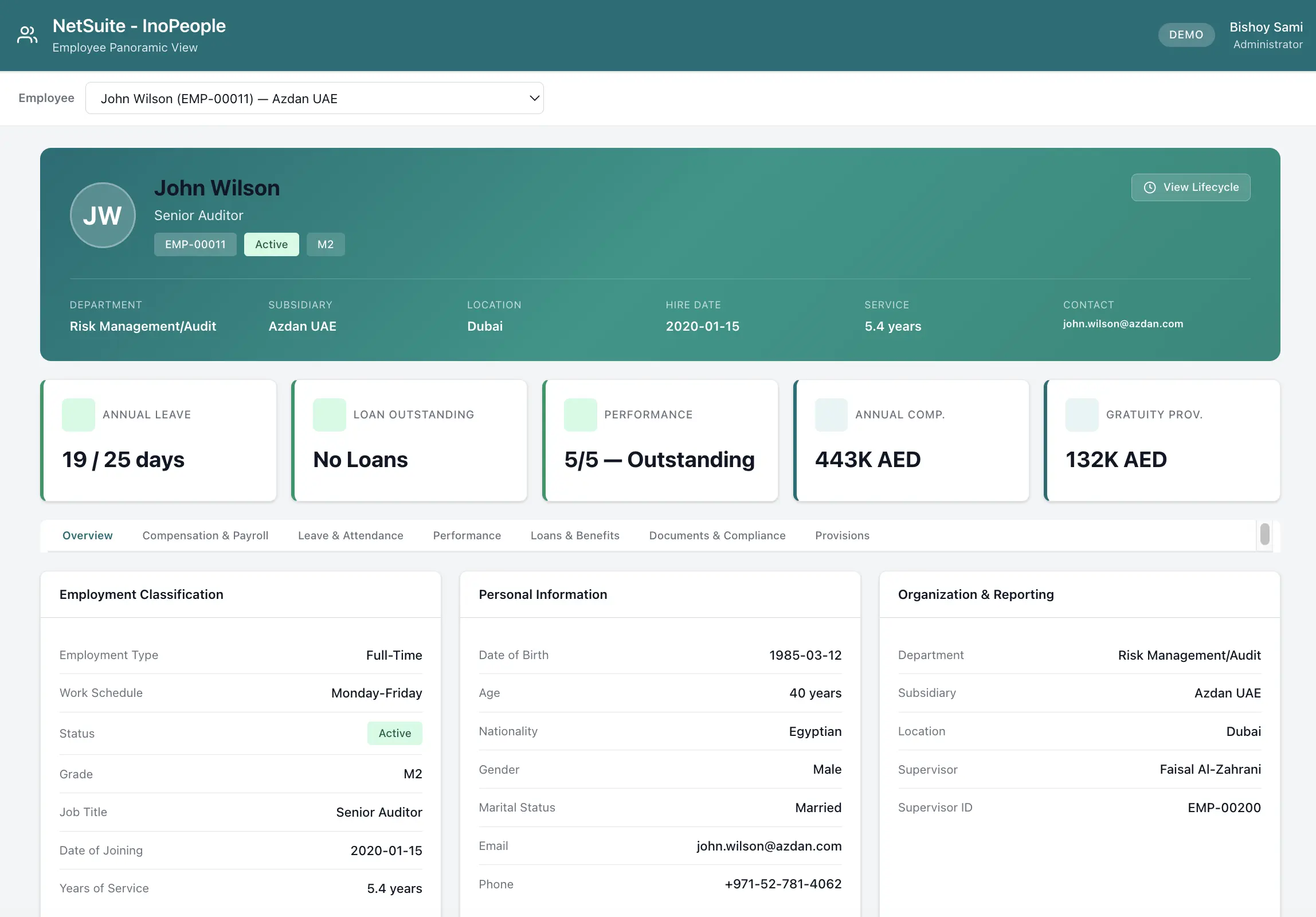
Everything else in a NetSuite HCM setup hangs off one thing: a single, complete employee profile. Rather than personal details living in one spreadsheet, compliance documents in another, and payroll history in a third, the employee record consolidates all of it — employment classification, personal information, reporting lines, compensation, leave balances, loans, and provisions — into one screen.
What makes this genuinely useful rather than just tidy is that every other module reads from and writes to the same record. A promotion updates payroll, gratuity provisioning, and performance review eligibility from one change — nobody re-enters the same fact three times across three systems. The leading-practice version also stores compliance documents structurally — passport, visa, and work-permit copies with expiry dates against the profile — so renewals are managed proactively rather than discovered when a residency lapses.
Tracking the Full Employee Lifecycle
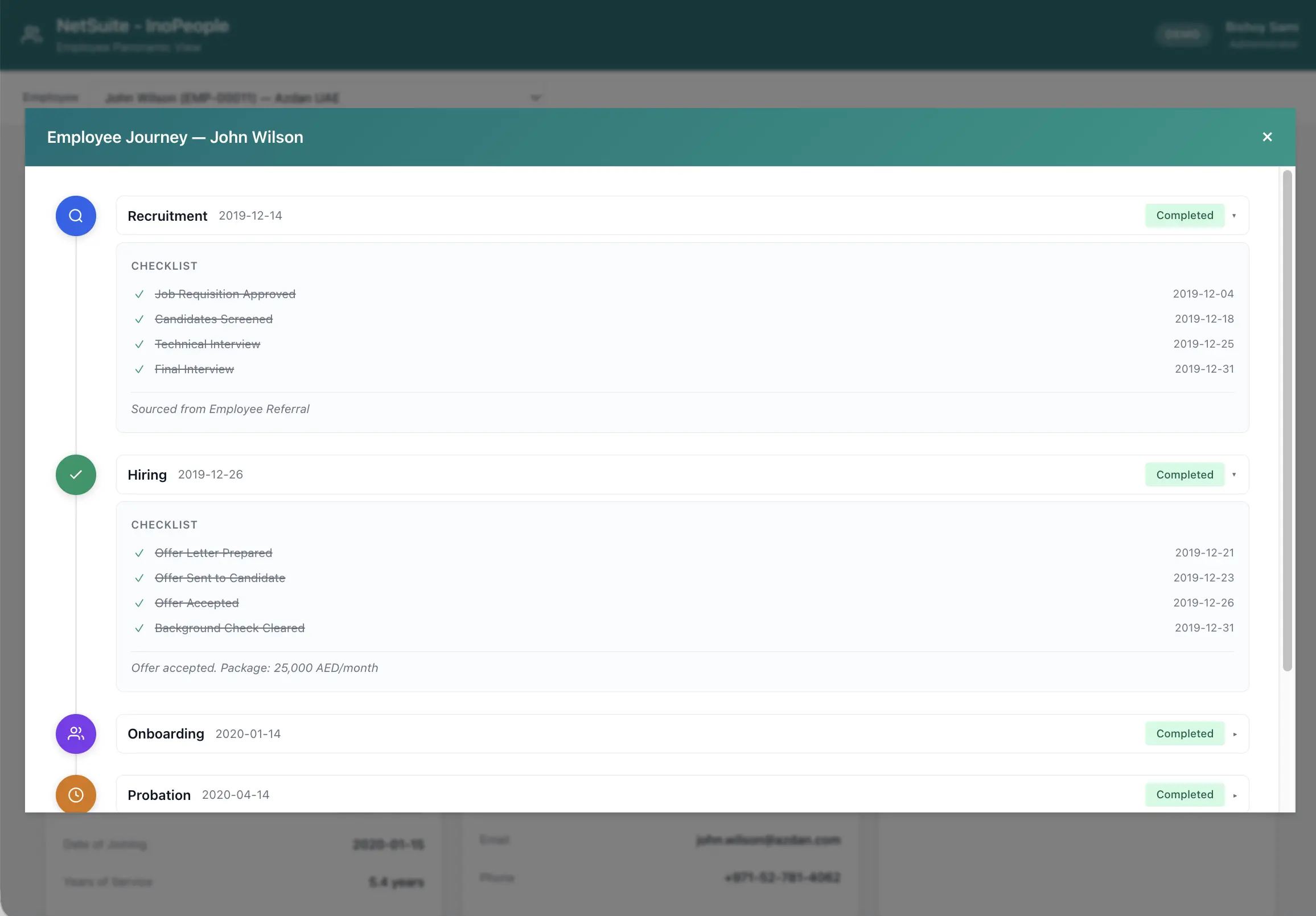
A NetSuite HCM employee record is only as useful as its history. Beyond the current snapshot, a proper setup keeps a timestamped journey for every employee — recruitment, hiring, onboarding, probation, and every promotion along the way — so HR can answer "how did we get here" without digging through email threads or old contracts.
Each stage carries its own checklist and completion record — job requisition approved, candidates screened, offer accepted, background check cleared — so the hiring trail is auditable, not just remembered. Later promotions and transfers append to the same timeline rather than overwriting it.
HR Analytics and the CHRO Dashboard
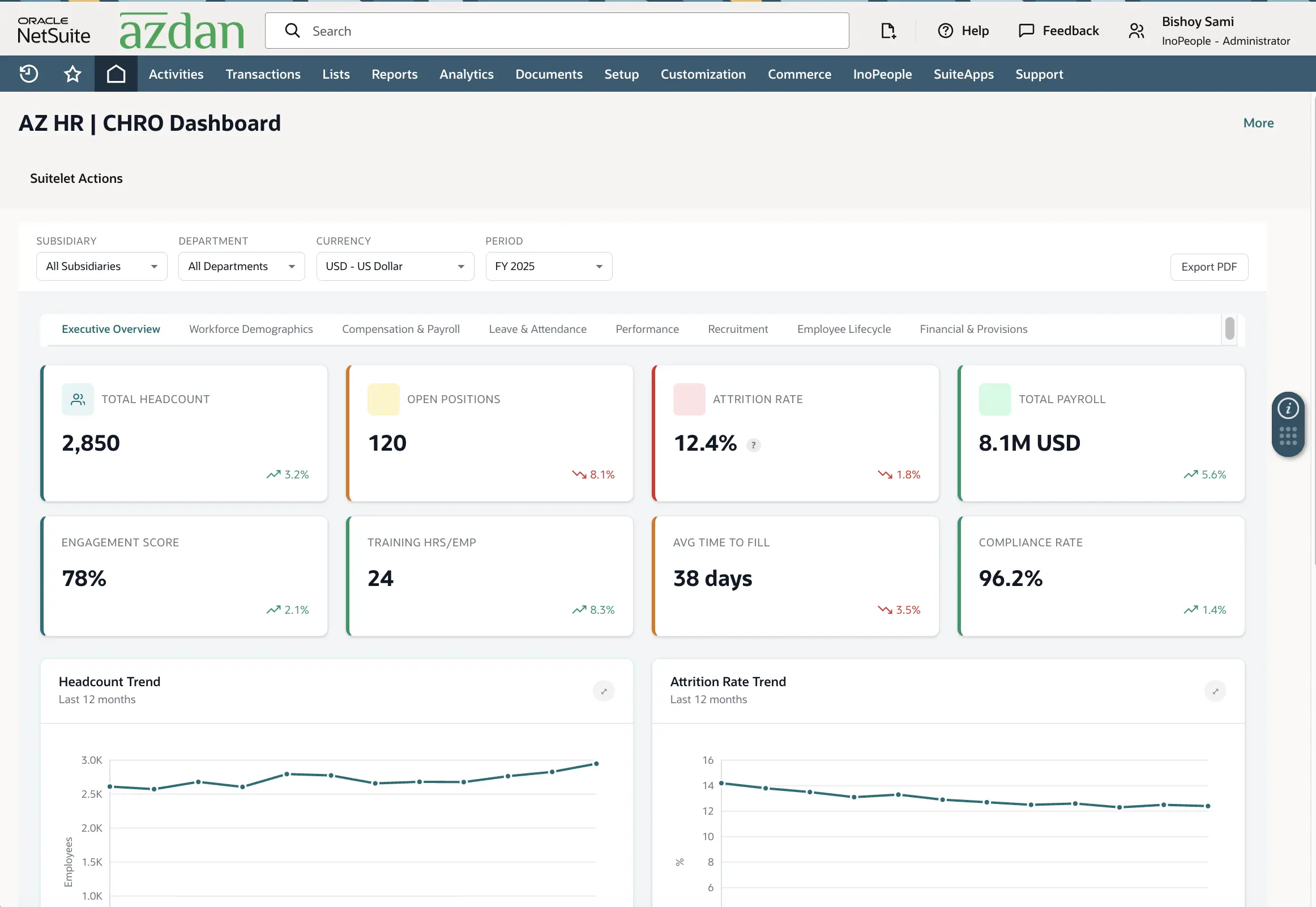
Once employee data is centralized, it becomes reportable in real time. A CHRO-level dashboard inside NetSuite HCM pulls headcount, attrition, open positions, total payroll cost, engagement scores, and compliance rate into one view — filterable by subsidiary, department, currency, and period.
For a group running multiple GCC entities, this is the difference between a monthly reporting exercise stitched together from several exports and a live number that's already correct. Headcount trend and attrition trend charts update automatically as payroll and HR transactions post, rather than being rebuilt from scratch each cycle.
This is the same multi-subsidiary architecture we used to consolidate Green Coast Enterprises, a Dubai family holding spanning four business sectors, into one live group picture — intercompany eliminations and consolidated reporting without manual workbooks. HR data rolls up the same way finance does: one group view, each subsidiary keeping its own currency and rules underneath.
Leave Management Built Around Real Policy
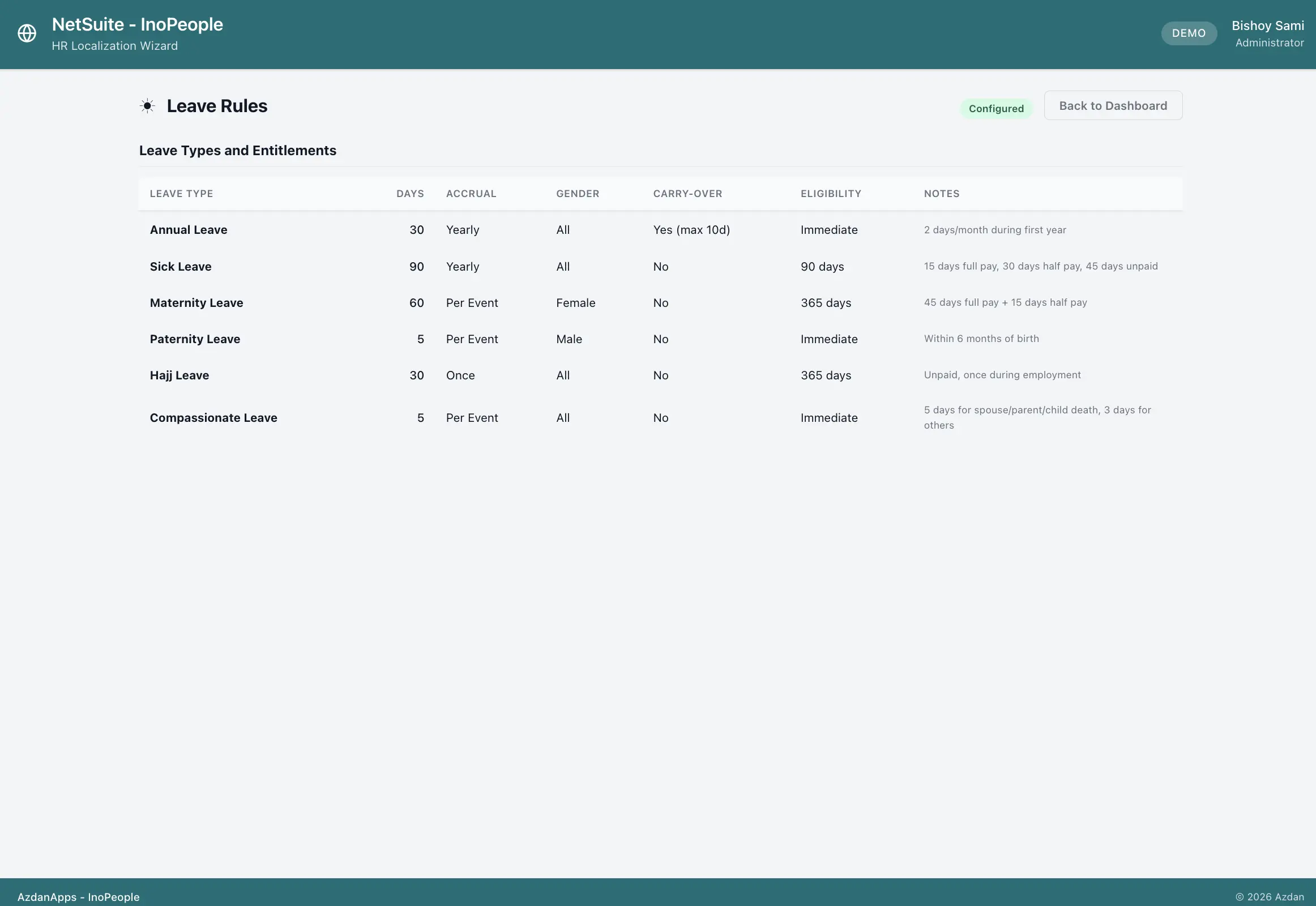
Leave is one of the areas where generic HR tools fall short fastest, because GCC leave policy has real structure to it: different day counts for annual, sick, maternity, paternity, and Hajj leave, different accrual bases, and pay tiers that step down over the length of an absence.
Configured this way, each leave type carries its own days, accrual frequency, gender restriction where relevant, carry-over rule, and eligibility waiting period. A common leading practice worth building in: setting sick leave to full pay for the first stretch (often up to 30 days) precisely because that period is already covered at 100% by social insurance in several GCC schemes — so the policy and the statutory cost recovery line up instead of quietly diverging. Once it's set up, employees see only the leave types that actually apply to them, and balances update automatically as requests are approved.
Working Hours, Overtime, and Ramadan Adjustments
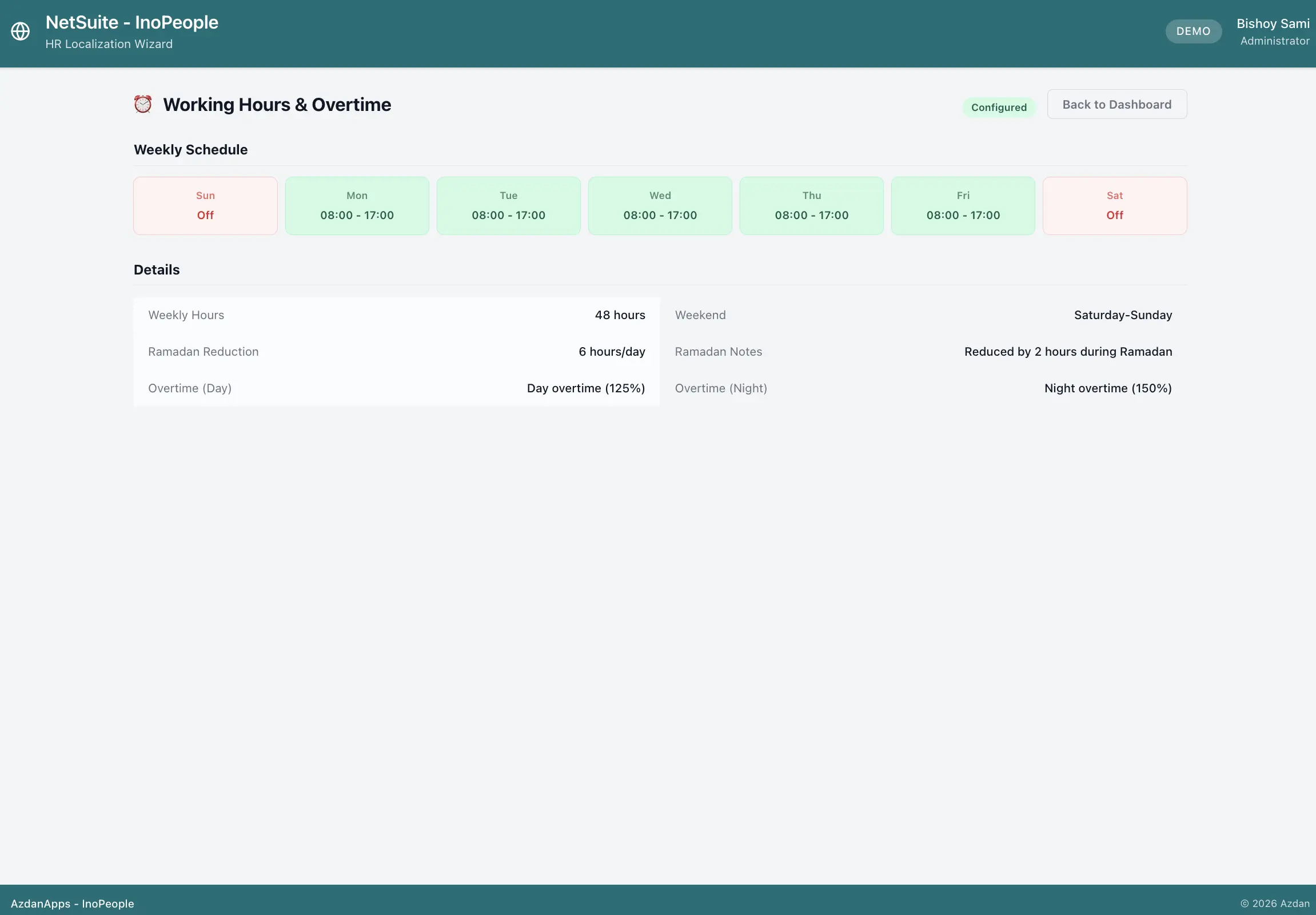
Working hours look simple until you account for weekend patterns, day-versus-night overtime rates, and the Ramadan reduction that most GCC employers apply for roughly a month every year — and then have to remember to switch back. That manual switch-back is a recurring source of payroll errors we see every year in systems that weren't set up for it.
A properly configured NetSuite HCM setup treats this as an annual rule rather than a manual adjustment someone has to remember: the weekly schedule, the Ramadan reduction in hours per day, and separate day and night overtime multipliers are all defined once and applied automatically for every payroll run that falls inside the Ramadan window.
Payroll: Automated, Reversible, and Built for Control
Payroll is where a NetSuite HCM setup earns its keep every month, and the practices that matter here are as much about control as calculation. Fixed salary elements prorate automatically against the working-day calendar, so a mid-month joiner or leaver is calculated correctly without manual math, and variable elements like loan instalments and unpaid-leave deductions flow into the same run automatically.
The control practice worth insisting on is a run you can undo before you commit. A well-run cycle sits in a Prepared status before approval — at which point the whole run can be rolled back and rebuilt, or an individual sheet recalculated in place. Only once approved does the batch lock and post its GL accrual, grouped by department, for Finance. "Prepared means correctable, approved means locked" keeps payroll both fixable and final at the right moments — and for a client running 1,000+ payslips a month, that rollback safety net is the difference between a five-minute fix and a re-run.
Two capabilities separate a mature setup from a basic one: net-to-gross (gross-up), where you define the exact net a bonus should land at and the system reverse-calculates the gross after tax; and dynamic elements — a variable payment pushed to a defined employee group as a fixed amount or percentage, inside or outside the run, one-time or recurring — removing the manual workarounds these scenarios usually invite.
How NetSuite HCM Calculates End-of-Service Gratuity
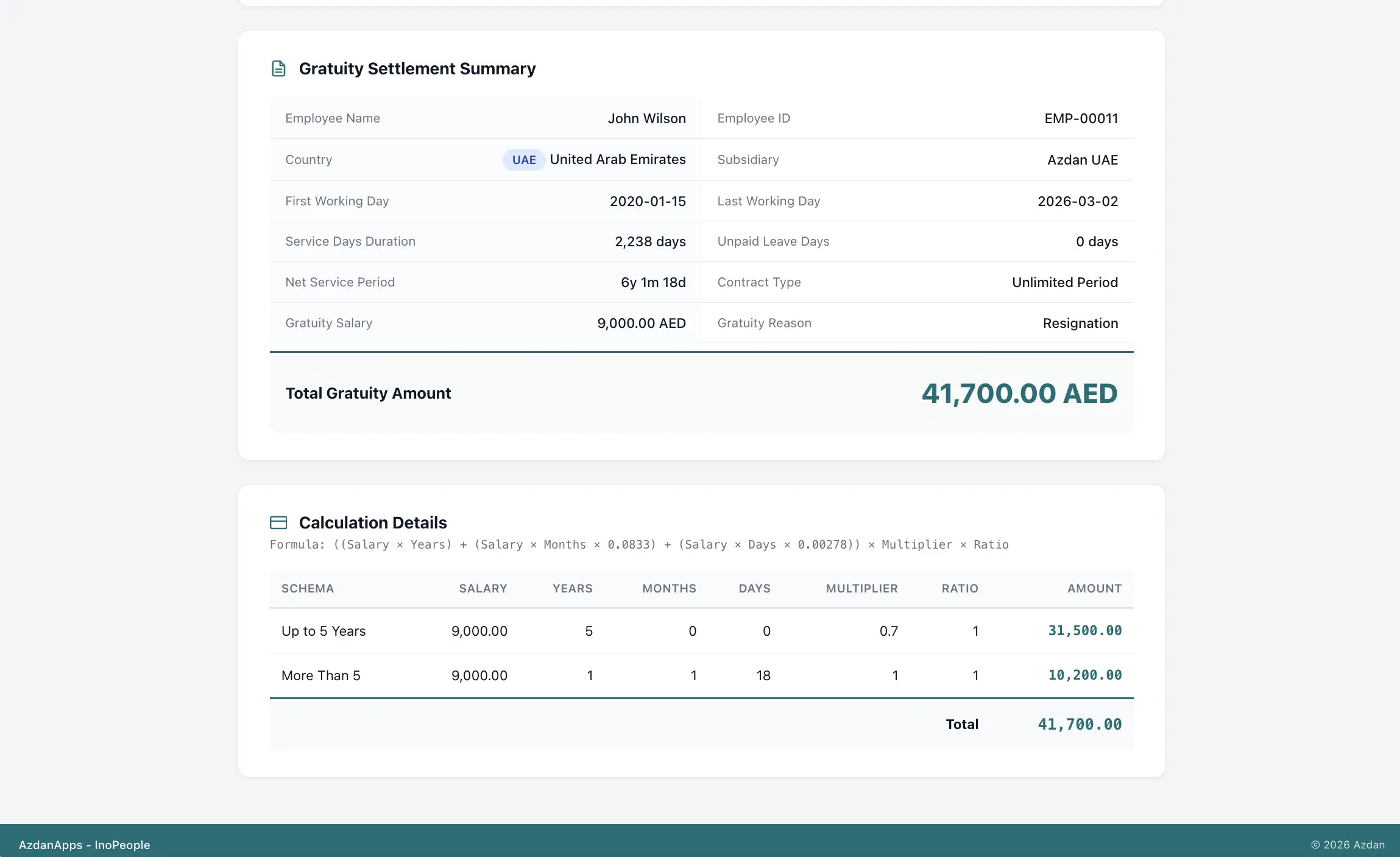
Gratuity is the calculation every GCC HR and Finance team gets nervous about — in our implementations it's the single item clients most want to see working before go-live, because getting it wrong is expensive, visible, and legally exposed. Under UAE Federal Decree-Law No. 33 of 2021, gratuity is calculated on basic salary using a tiered day-rate: 21 days' pay per year of service for the first five years, rising to 30 days' pay per year beyond that.
Entering an employee, the reason for leaving, and the last working day runs the full calculation automatically — no separate spreadsheet, no manual tier lookup.
The settlement breakdown shows exactly how the total was built: the portion of service under five years at the 0.7 multiplier, the portion beyond five years at the full 1.0 multiplier, and the two amounts combined into one final figure. The leading practice underneath this screen is the one that keeps Finance calm: the liability accrues every month against the general ledger, recognizing when an employee crosses the five-year threshold and prorating the days since the last run — so the final settlement closes out an already-accrued balance rather than landing as a surprise on someone's last day.
Social Insurance and Country Localization
Not every country handles social insurance the same way, and a NetSuite HCM setup needs to know the difference automatically rather than leaving it to whoever runs payroll that month. In the UAE, for example, GPSSA contributions apply only to UAE and GCC nationals, with rates that step up by salary band — expatriate employees fall outside the scheme entirely.
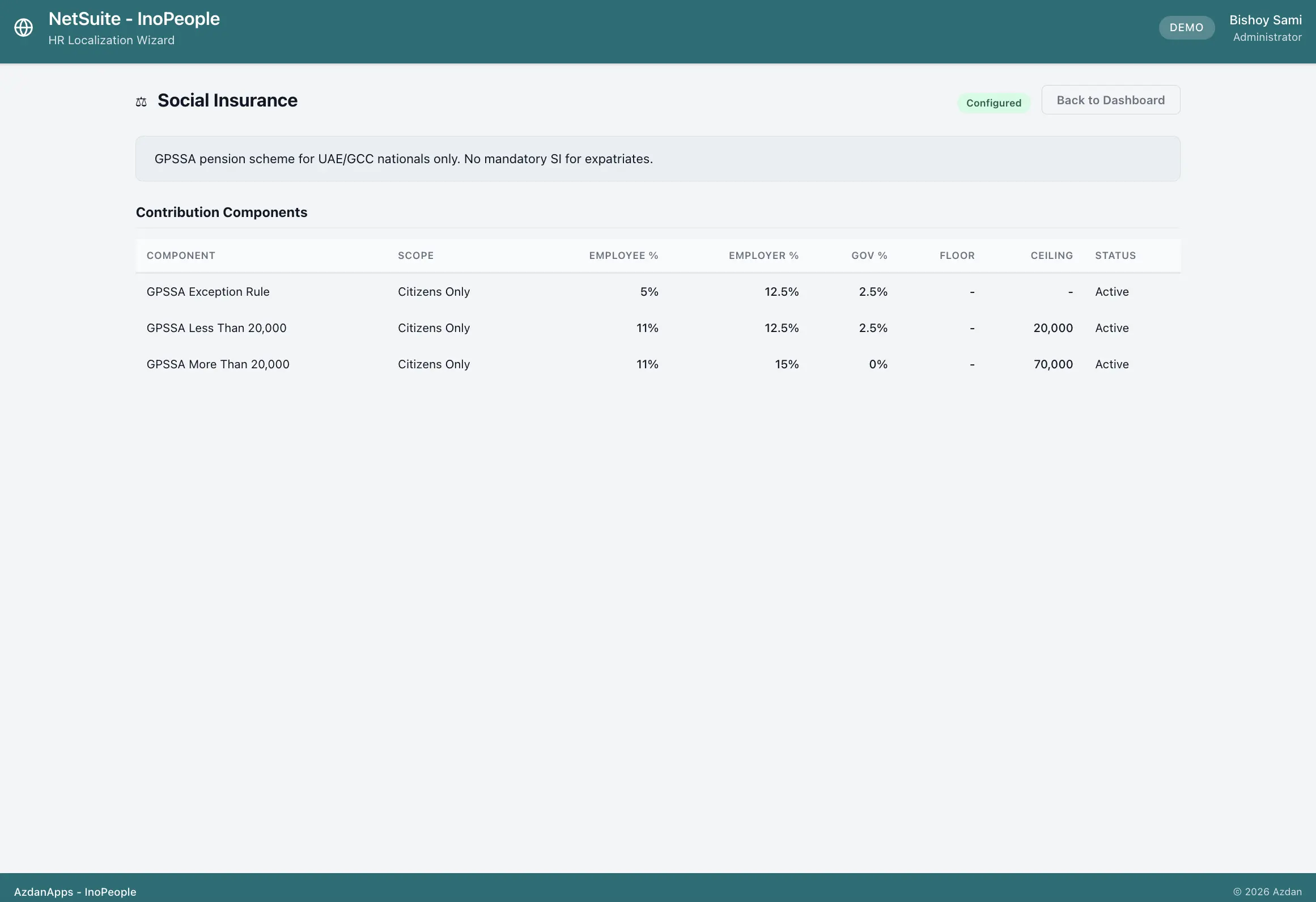
The practice that keeps this maintainable is making every rule component configurable — minimum and maximum insurable salaries, employer and employee shares, contribution percentages — so the annual changes issued by each country's social insurance authority are a configuration update, not a code change. The same applies to income tax: statutory brackets and personal exemptions held as configuration, including special treatment such as the increased exemption many jurisdictions grant to registered employees with disabilities.
Social insurance is one category among several that need their own configuration per country — alongside income tax, leave rules, gratuity, working hours, probation and notice periods, public holidays, and required documents. A localization wizard walks through each category per country and flags what's configured and what isn't, so extending into a new GCC market is a checklist, not a rebuild.
[Screenshot placeholder — NetSuite HCM localization wizard showing eight compliance categories for the UAE with configuration status. Upload the corresponding product screenshot here in the Webflow editor.]
The same structure repeats for every country in scope — UAE, Saudi Arabia, Egypt, Qatar, Kuwait, Morocco — each with its own gratuity formula, social insurance scheme, and leave rules, tracked against the same eight categories.
[Screenshot placeholder — NetSuite HCM localization wizard showing configuration progress across UAE, Saudi Arabia, Egypt, Qatar, Kuwait, and Morocco. Upload the corresponding product screenshot here in the Webflow editor.]
It's worth being clear that these aren't small regional variations on one formula — Saudi Arabia reduces gratuity on resignation in tiers, Qatar applies a flat rate with no five-year step-up, and Egypt and Kuwait handle end-of-service differently again. A NetSuite HCM setup that hard-codes one country's rules will silently miscalculate the moment it's applied somewhere else.
This per-country structure is exactly what a multi-national employer needs. AESG — a specialist engineering and sustainability consultancy with 300-plus professionals and entities across seven countries, and an InoPeople HCM client — runs on a single NetSuite instance under one group hierarchy, each subsidiary in its own currency and compliance context. Layering the HCM localization on top of that structure is what lets one HR and finance team run people operations across the whole group rather than country by country.
Connecting It All: NetSuite HCM vs. Third-Party Integration
Since SuitePeople's payroll doesn't run in the GCC, the real choice is between three paths: build the entire regional payroll engine, gratuity logic, and social insurance schemes yourself as custom scripting (a large surface area to build and keep current as labour law changes); run a separate GCC HR/payroll system and integrate it with NetSuite (a real two-way integration to maintain for every hire, salary change, and termination); or use a GCC-native HCM SuiteApp built directly on the SuitePeople data model, so payroll, gratuity, leave, and localization all live on the same employee record with no integration layer at all.
For a business running payroll across one or more GCC jurisdictions — with gratuity provisioning, WPS, and audit-ready records — that native layer is what turns NetSuite from a North American HR system into one that actually runs your regional payroll. It's the setup we've built for organisations from single-entity companies to 1,000-plus-employee groups across the UAE, Saudi Arabia, and Egypt — and it's the difference between HR that sits beside NetSuite and HR that runs inside it.
Whichever direction you're evaluating, the underlying question is the same one every feature above answers a little differently: does the system apply the right rule to the right employee automatically, every time, without someone checking by hand.
By Jack Tadros, Azdan — Oracle NetSuite Solution Provider for the UAE, Saudi Arabia & Egypt