.svg)


End-to-End Business Process for Media
An unsold sofa is still a sofa tomorrow. An unsold 30-second slot at eight o'clock on Tuesday is nothing at all on Wednesday. Media is the only business in this series whose inventory has no salvage value, no clearance route, and no second chance, because it is not a thing but a moment. Everything about how a media business plans, prices, sells, and bills follows from that. This guide maps the media value chain end to end.
The Short Answer
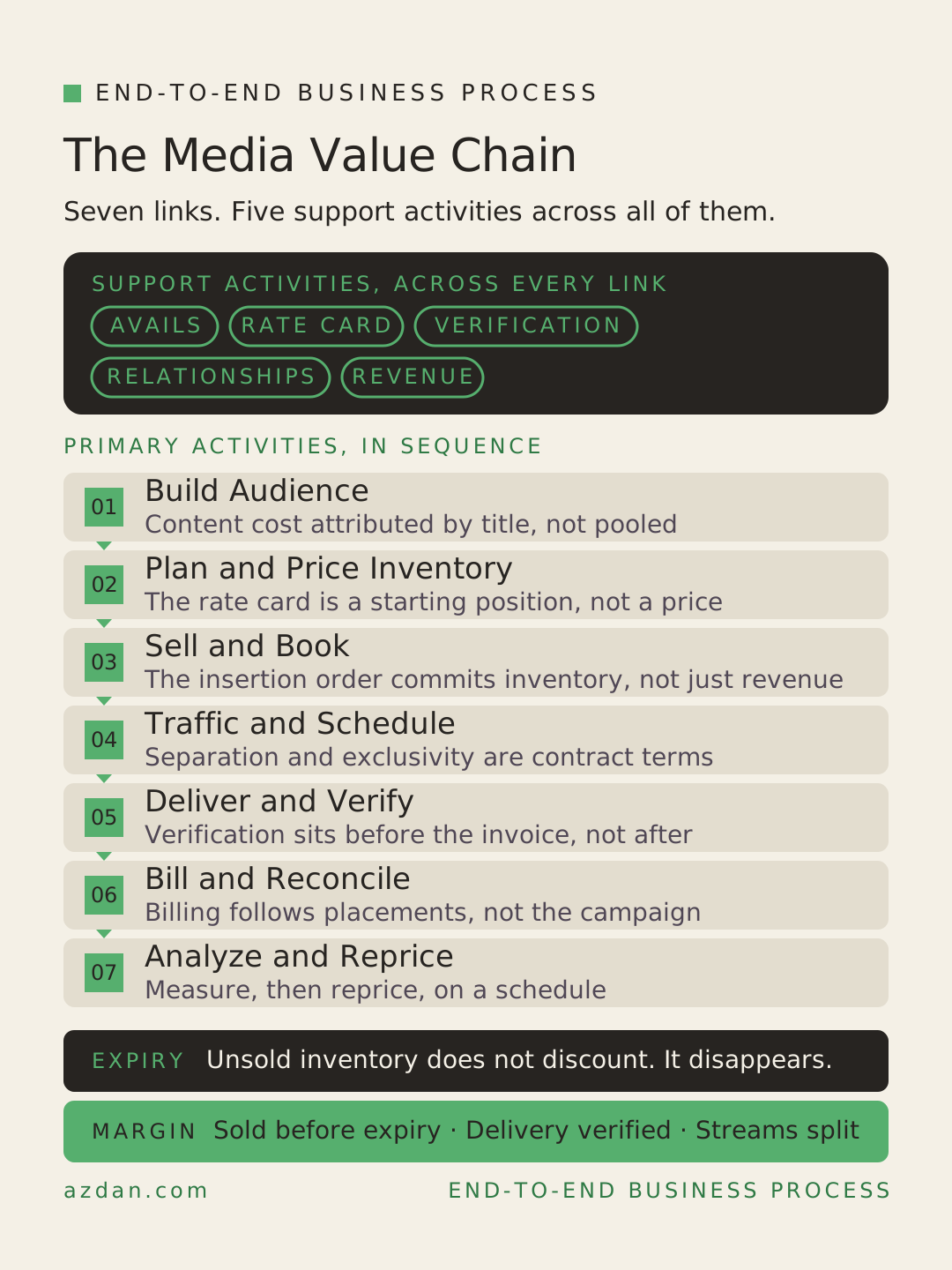
The media value chain runs in seven links:
Build Audience → Plan and Price Inventory → Sell and Book → Traffic and Schedule → Deliver and Verify → Bill and Reconcile → Analyze and Reprice
Three things make it unlike any other chain in this series. Inventory expires to zero rather than depreciating, so there is no equivalent of a markdown or a clearance line. The business has two customers who never meet, an audience and an advertiser, and the first is what the second is buying. And revenue is contingent on verified delivery rather than on the order, so the chain runs from insertion order through fulfillment and verification before anything is invoiced.
Methodology note. This maps the end-to-end process using the value chain model, applied to the media and advertising process design Azdan works with across its NetSuite delivery in the UAE, Saudi Arabia, and Egypt. Where a point reflects delivery experience rather than measured data, it is labeled as a recommendation.
A companion piece covers the other side of the same market. End-to-End Business Process for Advertising maps the agency chain, where media is bought rather than sold and the defining mechanic is pass-through cost.
Inventory That Expires to Zero
Start here, because it is the fact every other link inherits.
A media owner's inventory is time and space: a break in a schedule, a page in an issue, a panel for a two-week cycle, a volume of impressions on a site. It exists only at its appointed moment. Before then it cannot be sold twice. After then it cannot be sold at all.
The last row is the one that surprises people arriving from distribution. A distributor who oversells creates a backorder and a late delivery. A media owner who oversells, or who sells against an audience guarantee and under-delivers, creates a make-good: replacement inventory supplied at no charge. That is not a service failure to be apologized for, it is a liability that consumes future sellable inventory, and it should be visible as one.
Recommendation: report unsold inventory as expired value, not as an absence. A sell-through percentage tells you what was sold. The same data expressed as revenue that ceased to exist tends to change the pricing conversation faster.
Two Customers Who Never Meet
The second structural fact, and the reason media financials look unusual.
A media business manages two entirely different customer populations in one system: subscribers and readers on one side, advertisers on the other. NetSuite's media and publishing capability is explicitly built around managing both, selling insertion orders to advertisers and subscriptions to the readership within the same suite.
They are not two market segments. They are two sides of one machine. The audience is served content, and the attention that produces is the product sold to the advertiser. Which creates a dependency the finance system has to respect:
- Audience revenue is a subscription business. Recurring, deferred, renewal-driven, with churn as the governing metric.
- Advertising revenue is a perishable inventory business. Booked, trafficked, delivered, verified, and billed, with sell-through as the governing metric.
- The second depends on the first. Audience decline shows up in advertising revenue one or two quarters later, through lower delivery and softer rates.
Recommendation: report the two revenue streams separately and never blend them into a single top line. They have different unit economics, different working capital profiles, and different leading indicators, and a combined number conceals which half of the machine is failing.
The Media Value Chain
Primary activities, in sequence:
Support activities, running across every link:
- Inventory and availability management
- Rate card and yield management
- Verification and delivery data integration
- Advertiser and subscriber relationship management
- Revenue recognition and rights
The margin: inventory sold before it expires, delivery verified before it is billed, and two revenue streams reported separately enough to manage.
Verification heads toward the top of that list for a reason peculiar to this sector. In most industries, delivery is self-evident because something physical arrived. Here, whether the advertisement ran, where, and to how many people is a data question answered by a system that often is not the ERP.
The Seven Links
1. Build Audience
Content, programming, and the editorial or scheduling decisions that create the audience.
This link is upstream of everything commercial and is usually managed outside the finance system entirely, which is appropriate. What has to cross into it is cost: production spend, rights and licensing, and the royalties owed on what was used.
Recommendation: attribute content cost to the property or title that generated it, not to a general production cost center. Media businesses run portfolios, and a portfolio you cannot analyze by title is a portfolio you cannot prune.
2. Plan and Price Inventory
Availability is calculated, the rate card is set, and packages are defined.
This is where yield management lives, and it is the closest analogue in this series to an airline pricing seats. The same slot has a different value depending on how far out it is sold, who is buying, and how full the surrounding schedule already is. Rate cards are therefore a starting position rather than a price.
Recommendation: track achieved rate against rate card by period and by property. The gap between the two is the single best measure of commercial discipline in a media business, and it is frequently not measured at all.
3. Sell and Book
The insertion order is the central transaction of this vertical, and NetSuite's media capability treats it as a foundation-level object rather than a variation on a sales order.
An insertion order commits inventory across a campaign that may span multiple placements, issues, or runs. That structure matters, because the commercial agreement is at campaign level while the delivery and billing happen per placement.
Subscriptions run in parallel here, with their own order, renewal, and deferral behavior.
4. Traffic and Schedule
Placement. Which advertisement runs where, when, and next to what.
Trafficking is the link with the least financial visibility and the most operational consequence. It carries constraints that no other industry has in quite this form: competitive separation so two rival advertisers do not appear together, category exclusivity where it has been sold, and creative rotation across a campaign.
Recommendation: treat trafficking conflicts as a commercial risk, not a scheduling inconvenience. A separation breach is a credit note and a difficult client conversation, and it originates in a decision made by someone with no visibility of the contract terms that created the obligation.
5. Deliver and Verify
The advertisement runs, and then the fact that it ran has to be established.
NetSuite's media capability tracks advertisements from insertion order through fulfillment and verification, and integrates with third-party verification servers for the delivery data itself. That sequence is the important part. Verification sits between delivery and billing, not after it.
This is also where make-goods originate. Where inventory was sold against an audience or impression guarantee and the delivery fell short, the shortfall becomes an obligation to supply replacement inventory. Recommendation: record make-good obligations when they arise rather than when they are fulfilled. Until they are recorded, they are unsold inventory in the forecast and a liability in reality.
6. Bill and Reconcile
Invoices are generated per the customized billing schedules attached to the campaign, which is why the insertion order structure matters. A campaign spanning six placements across three months does not produce one invoice at the end.
Reconciliation here has a wrinkle specific to media: much of the revenue arrives through agencies, which introduces commission, net versus gross billing conventions, and a payment chain where the party who booked is not the party who benefits and may not be the party who pays.
7. Analyze and Reprice
The closing link, and the one that feeds link two.
The analysis that matters is not last month's revenue. It is sell-through by daypart, property, and placement type; achieved rate against card; make-good volume as a percentage of delivered inventory; and audience trend feeding into next period's availability and pricing.
Recommendation: close this loop formally, on a schedule, with the pricing team in the room. In a business where unsold inventory evaporates, the interval between measuring and repricing is itself a cost.
What Breaks: Seven Recurring Failures
These are patterns that recur in media businesses. They are drawn from delivery experience and offered as recommendations rather than measured findings.
- Unsold inventory treated as an absence rather than a loss. Nothing focuses a pricing discussion like expressing expired availability in currency.
- Advertising and subscription revenue blended. Two businesses with different economics reported as one number, so neither can be managed.
- Make-goods recorded on fulfillment rather than on occurrence. The obligation exists from the moment delivery falls short, and until it is recorded the forecast is overstated twice.
- Verification treated as a billing formality. It sits between delivery and invoice for a reason, and skipping it produces disputes that cost more than the check would have.
- Achieved rate never compared to rate card. The rate card becomes a document nobody tests, and discounting drifts without anyone deciding that it should.
- Trafficking constraints invisible to the scheduler. Separation and exclusivity are contract terms, and enforcing them at the point of placement requires the placement system to know them.
- Content cost pooled rather than attributed. A portfolio business that cannot cost a title cannot decide what to stop making.
Reading Your Own Chain: Four Questions
- What was the currency value of inventory that expired unsold last quarter? Not the sell-through percentage. The money.
- What is achieved rate against rate card, by property? If the answer is not produced routinely, pricing is being set by whoever negotiates hardest.
- What proportion of delivered inventory went to make-goods? It is a direct measure of how well selling and delivery are connected.
- Can you report advertising and audience revenue separately, with their own cost bases? If not, the two halves of the machine cannot be managed independently.
Which Media Business Are You
The chain is common to the sector, but the shape of the inventory changes with the medium, and Azdan maintains separate industry practices for each.
- Broadcast, publishing, and digital. Insertion orders against a schedule or an issue, subscription revenue alongside advertising, and verification through third-party delivery data. See NetSuite ERP for Advertising and Media.
- Out of home. The asset-heavy variant, where inventory is physical sites, panels, and screens with permits, leases, occupancy history, and maintenance cost, and revenue is recognized against booked display periods. See NetSuite ERP for Outdoor Advertising.
- Events and experiential. Where the inventory is a stand, a slot in a program, or a sponsorship tier, and the entire chain compresses into a fixed date. See NetSuite ERP for Event Management.
What all three share is the expiry. What differs is how much capital is tied up in producing the inventory in the first place.
Recommendation
If you are mapping a media business end to end, produce one number before anything else: the currency value of inventory that expired unsold last quarter, by property and by daypart or placement type.
Most media businesses report sell-through as a percentage, which is a performance measure. Expressing the same thing as revenue that ceased to exist turns it into a decision. It tells you where the rate card is wrong, where the sales effort is misdirected, and where inventory should not have been created at all.
Then check whether advertising and audience revenue can be reported separately with their own cost bases. If they cannot, the business is managing a machine with two halves through a single dial.
Sources
- Oracle NetSuite, ERP for Media and Publisher Management, for the scope covering advertising, subscription, licensing, and royalty revenue streams
- Oracle NetSuite, Accounting Software for Media and Publishers, which also notes that some described capabilities require partner integrations
- Oracle NetSuite, Media and Publishing Industry Insights, for insertion order to verification tracking and advertiser and subscriber management
- Oracle NetSuite, What Is Value Chain? An Expert Guide, for the value chain model
- Michael E. Porter, Competitive Advantage: Creating and Sustaining Superior Performance, 1985, for the original value chain framework
Process content reflects media and advertising leading practice as applied by Azdan, checked August 2026.
Related Azdan Resources
- End-to-End Business Process for Manufacturing
- How to Implement NetSuite ERP
- Oracle NetSuite Implementation
Published by Azdan, an Oracle NetSuite Solution Provider operating across the UAE, Saudi Arabia, and Egypt. Guidance in this article reflects Azdan's process design work with media and advertising businesses. Content checked August 2026.