.svg)


End-to-End Business Process for Publishing
In most businesses a shipped order is a sale. In publishing it is a loan with optimistic paperwork. Books go out to the trade on sale or return, which means the retailer can send back what does not sell, months later, for full credit. Revenue recognized at shipment can reverse. And because the author is paid a share of what was actually kept rather than what was originally sent, the royalty owed reverses with it. This guide maps the publishing value chain end to end, around the fact that a sale here is provisional until it is not.
The Short Answer
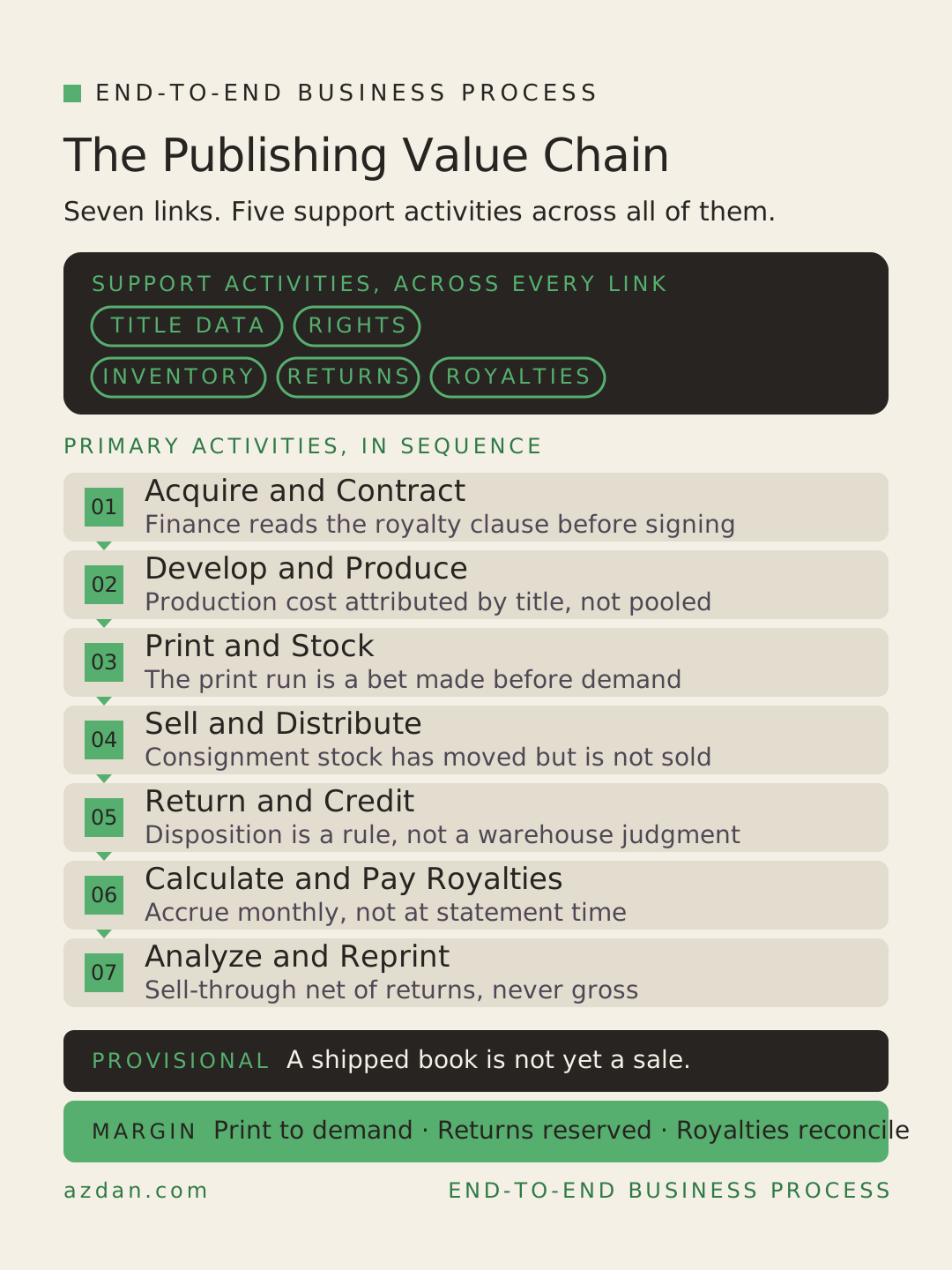
The publishing value chain runs in seven links:
Acquire and Contract → Develop and Produce → Print and Stock → Sell and Distribute → Return and Credit → Calculate and Pay Royalties → Analyze and Reprint
Three things make it unlike the other chains in this series. Revenue is provisional, because sale or return means a shipment is not a settled sale until the return window closes. The person who made the product is modeled as a supplier, because royalties are paid to the author through the accounts payable side of the system. And the print run is committed before demand is known, which makes the inventory decision a bet rather than a replenishment.
Methodology note. This maps the end-to-end process using the value chain model, applied to the publishing process design Azdan works with across its NetSuite delivery in the UAE, Saudi Arabia, and Egypt. Where a point reflects delivery experience rather than measured data, it is labeled as a recommendation.
A companion piece covers the other publishing model. End-to-End Business Process for Media maps the chain where the product is advertising inventory rather than physical stock, and where nothing can be returned because nothing was ever shipped.
A Sale That Can Be Taken Back
Start here, because every downstream number inherits it.
Trade publishing operates on sale or return. Stock ships to a bookseller, an invoice is raised, revenue is recognized, and then some proportion of that stock comes back for credit at a point the publisher does not control. The return is not a quality failure or a service problem. It is the commercial term on which the industry has always operated.
The consequence is that the ledger and reality diverge for a period measured in months, and the size of the gap is a forecast rather than a fact.
You can see the assumption written into the system's own mechanics. When NetSuite calculates the royalty owed on a title, the calculation runs across sales invoices, credit memos, cash sales and return authorizations together. The royalty engine is built on the premise that some of what was invoiced will come back, because in this industry it always does.
Recommendation: carry a returns reserve as a standing provision, sized from title-level history rather than a single company-wide percentage. A literary hardback and a genre paperback do not behave the same way, and one blended rate hides both.
The Author Is a Vendor
The second structural fact, and the one that surprises people most.
In publishing, the person who created the product sits on the payables side of the system. Royalties are a percentage or flat amount owed to a vendor, calculated from the sale of specific items, and settled through a vendor bill. The author record is a vendor record, the contract is a vendor agreement, and the payment runs through accounts payable like any other supplier.
That is not a workaround. It is the correct modeling, because the economic relationship genuinely is a supply relationship with a variable, revenue-linked price. But it has consequences worth designing for: author payment terms live in vendor settings, royalty renewals appear in vendor agreement reporting, and the confidentiality expectations around author contracts have to be handled through vendor record permissions.
How the Royalty Mechanic Actually Works
The leading practice here is unusually candid about what the platform does and does not do natively.
Read the third row. There is no native royalty engine. The calculation is a saved search over transaction data, and the resulting vendor bills are created by export and import rather than by a posting routine. That is a workable and supported approach for straightforward rate structures, and it stops being workable at a predictable point.
Recommendation: establish the complexity of the royalty terms during scoping, not during testing. Flat or single-rate percentages fit this pattern well. Escalating rates by volume band, split rights across territories or formats, advances that must earn out before payment begins, and multiple contributors sharing one title are the cases that outgrow it, and they need either a dedicated royalty application or a deliberate custom build. Assuming otherwise misprices the project and disappoints the editorial director.
The Publishing Value Chain
Primary activities, in sequence:
Support activities, running across every link:
- Title and edition master data
- Rights and contract management
- Inventory and warehouse operations
- Returns and credit control
- Royalty accrual and reporting
The margin: a print run sized close to demand, returns reserved before they arrive, and royalties that reconcile to what was actually kept.
Title and edition master data heads that list because of a distinction the chain depends on. A work and an edition are different objects. One manuscript becomes a hardback, a paperback, an ebook, an audio edition, and a territorial variant, each with its own identifier, price, cost, and often its own royalty rate. The work is what the author wrote. The edition is what the warehouse holds.
The Seven Links
1. Acquire and Contract
Rights are acquired, an advance is agreed, and the royalty terms are set.
Everything in link six is determined here, which is why the two links belong to the same conversation even though they sit at opposite ends of the chain. The rate structure agreed in a contract negotiation becomes a configuration problem eighteen months later.
Recommendation: have someone from finance read the royalty clause before the contract is signed, specifically for whether the structure can be calculated by the system that will have to calculate it. This costs nothing and prevents the most common source of manual royalty work.
2. Develop and Produce
Editorial, design, and production. Costs accumulate against a title long before it earns anything.
The design decision here is whether title-level profitability is a requirement. If it is, production cost has to be attributed to the title rather than pooled into a general editorial or production cost center, and that attribution has to happen as costs are incurred.
Recommendation: decide this before the first title is set up, because retrospectively allocating a year of pooled production cost across a list is a project rather than a report.
3. Print and Stock
The print run decision, and the point where publishing becomes an inventory business.
This is a commitment made before demand is known. Print too few and you miss the sales window and pay more per unit on a rushed reprint. Print too many and the surplus becomes a write-down. The publishing capability includes full inventory and warehouse management for exactly this reason, unlike the media model where inventory management does not appear at all.
Inventory status codes are worth knowing here: they make stock unavailable for commitment without requiring a separate virtual location, which is the clean way to quarantine damaged returns or hold stock back for a launch.
4. Sell and Distribute
Trade sales to booksellers and wholesalers, direct to consumer through a webstore or marketplace, and in some cases the publisher's own shops or concession locations.
Consignment deserves attention where it applies. Stock placed on consignment moves through a transfer order to the customer's location while remaining owned by the publisher, and returns come back the same way. It is stock that has moved without being sold, and it needs counting and valuing as such.
5. Return and Credit
The link most chains do not have as a primary activity.
Return to credit covers initiating the customer return, recording and applying the credit, and issuing a refund where required. In publishing this runs at a volume that makes it operational rather than exceptional, and each return has a disposition: back to saleable stock, to damaged, or to write-off.
Recommendation: give returns disposition a rule and an owner rather than leaving it to whoever opens the carton. The difference between restocking and writing off is a margin decision, and at publishing volumes it compounds quickly.
6. Calculate and Pay Royalties
The mechanic described above, run as a cycle: accrue the royalty as sales occur, calculate the amount owed net of credits and returns, generate the vendor bills, and pay.
The forecast matters as much as the payment. The same calculation run forward tells the publisher what is accruing this month, which is a liability building against titles that have not yet finished returning.
Recommendation: accrue monthly rather than at statement time. Royalty statements are usually semi-annual, and a liability that only becomes visible twice a year is a liability that surprises the cash forecast twice a year.
7. Analyze and Reprint
The closing link, and the one that feeds link three.
Reprint decisions are the same bet as the original print run, made with better information: actual sell-through, actual return rate, and the shape of the backlist. What makes them hard is that the return data lags, so the decision is often taken before the true net sale of the first printing is known.
Recommendation: report sell-through net of returns by title and by edition, with the return rate shown separately. A gross sell-through number will justify a reprint that the net number would not.
What Breaks: Seven Recurring Failures
These are patterns that recur in publishing businesses. They are drawn from delivery experience and offered as recommendations rather than measured findings.
- Revenue treated as settled at shipment. Sale or return means the number moves later, and without a reserve the correction arrives as a surprise.
- One blended returns rate across the list. Different formats and genres return at different rates, and a single percentage conceals both.
- Royalty complexity discovered during testing. Escalating bands, split rights, advances earning out, and multiple contributors outgrow the saved search pattern.
- Production cost pooled rather than attributed. Title-level profitability cannot be reconstructed after the fact.
- Work and edition conflated. One manuscript becomes many products with different prices, costs, and sometimes rates, and the master data has to hold both levels.
- Royalties accrued only at statement time. A semi-annual liability that appears twice a year damages the cash forecast twice a year.
- Returns disposition left to the warehouse. Restock or write off is a margin decision being made by whoever opens the box.
Reading Your Own Chain: Four Questions
- What is the return rate by format and by title, and how long does the return tail run? If only a company-wide average exists, the reserve is a guess.
- Can the royalty terms in your last ten contracts be calculated by your system without manual work? The answer determines whether royalties are a process or a monthly project.
- Can you produce profitability for a single title, including production cost? Most publishers assume yes and discover the cost was pooled.
- What is sell-through net of returns, by edition? Not gross. Gross justifies reprints that net would not.
Which Publishing Business Are You
The chain is common to the sector, but its weight shifts by model, and Azdan maintains separate industry practices for each.
- Trade and consumer publishing. The chain is heaviest at print, distribute, and return, with inventory, warehouse operations, and returns credit carrying the volume. See NetSuite ERP for Wholesale Distribution.
- Direct and ecommerce publishing. Where the publisher sells to the reader rather than the trade, returns behave differently and the customer relationship is owned outright. See NetSuite ERP for E-Commerce.
- Own retail and concessions. Publishers running their own shops or concession locations, where stock sits at a location the publisher does not operate but still owns. See NetSuite ERP for Retail.
- Advertising-funded publishing. Where the revenue comes from advertisers rather than readers, and the inventory is space rather than stock. See NetSuite ERP for Advertising and Media.
Most publishers of any scale run at least two of these from one list and one warehouse.
Recommendation
If you are mapping a publishing business end to end, produce two things before anything else is designed.
First, the return rate by format with the length of the return tail. It sizes the reserve, it corrects every sell-through number, and it is the input to the reprint decision. A single company-wide percentage is not sufficient for any of those.
Second, a read of your ten most recent author contracts against one question: can these royalty terms be calculated by a saved search over transactions, or do they need something more? That answer decides whether royalties are a monthly cycle or a monthly project, and it is far cheaper to establish now than during user acceptance testing.
Sources
- Oracle NetSuite, ERP for Media and Publisher Management, for the scope connecting ads, subscriptions, licensing, and royalties with production and finance data
- Oracle NetSuite, Accounting Software for Media and Publishers, for royalty and revenue stream visibility, and the note that some described capabilities require partner integrations
- Oracle NetSuite, What Is Value Chain? An Expert Guide, for the value chain model
- Michael E. Porter, Competitive Advantage: Creating and Sustaining Superior Performance, 1985, for the original value chain framework
Process content reflects publishing leading practice as applied by Azdan, checked August 2026.
Related Azdan Resources
- End-to-End Business Process for Advertising
- End-to-End Business Process for Manufacturing
- Oracle NetSuite Implementation
Published by Azdan, an Oracle NetSuite Solution Provider operating across the UAE, Saudi Arabia, and Egypt. Guidance in this article reflects Azdan's process design work with publishing businesses. Content checked August 2026.