.svg)


End-to-End Business Process for Technology Services
A technology services firm sells a customer an implementation project, a managed service contract, and a rack of hardware, often on the same purchase order. Those three things look like one sale. They are three different businesses with three different margin profiles, three different working capital patterns, and three different reasons to succeed or fail. Reported as one number, none of them can be managed. This guide maps the technology services value chain end to end, around the fact that it is really three chains sharing a customer.
The Short Answer
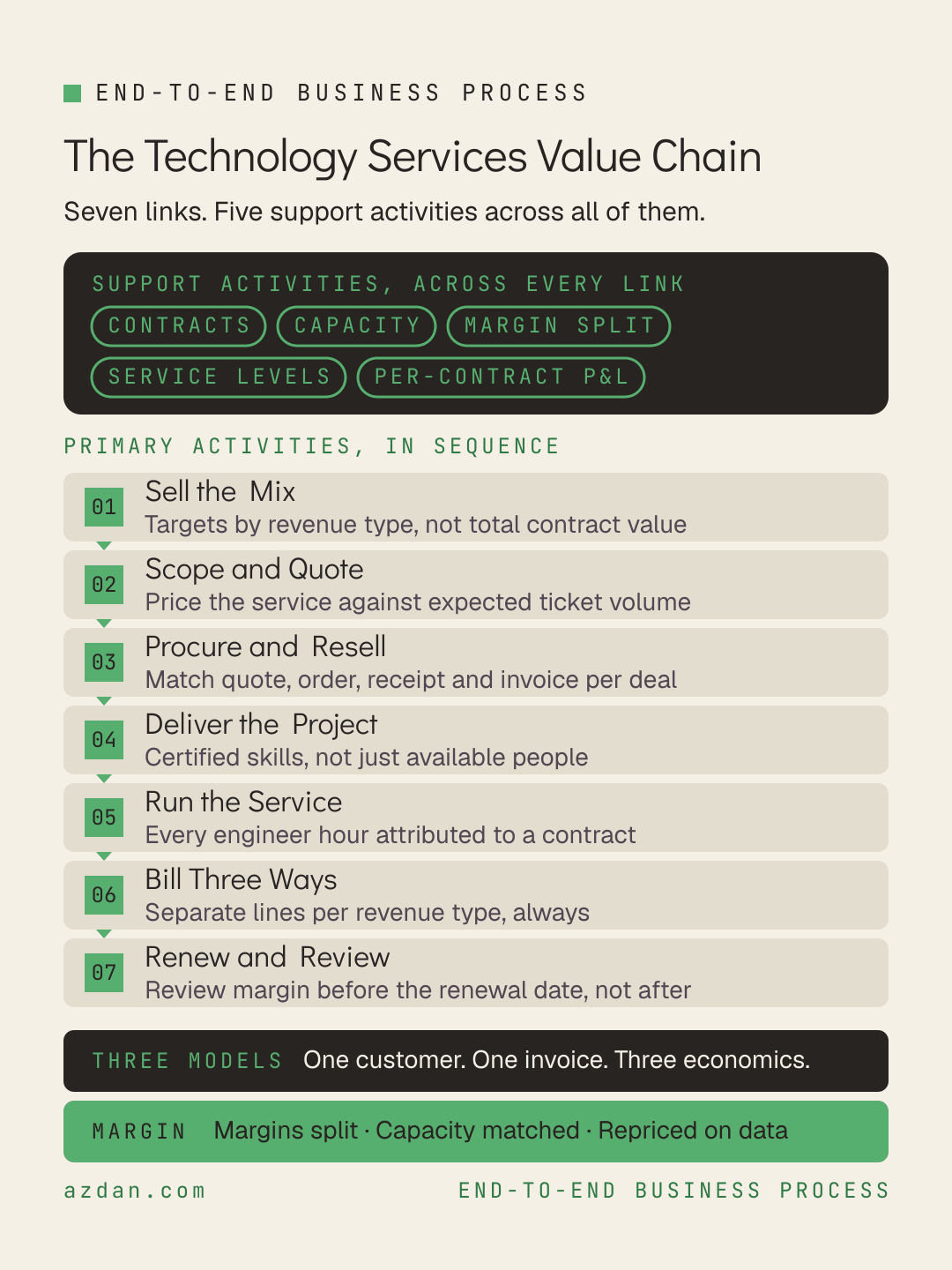
The technology services value chain runs in seven links:
Sell the Mix → Scope and Quote → Procure and Resell → Deliver the Project → Run the Service → Bill Three Ways → Renew and Review
Three things make it unlike the neighboring chains in this series. One customer buys three economically different things and usually receives one invoice. In the recurring half of the business, revenue is fixed and cost is driven by the customer's environment rather than by your effort. And the resale half moves large sums through the business that are mostly not yours.
Methodology note. This maps the end-to-end process using the value chain model. The process detail is grounded in NetSuite's published material for managed service providers and IT services organizations, and in the adjacent project-based and subscription practices, rather than in a dedicated technology services practice. Where a point is inference from the structure of the business, it is labeled as a recommendation.
A companion chain covers the project half in more depth. Services maps estimating, utilization and realization for project delivery.
Three Businesses, One Logo
Start here, because it is the reason technology services firms are so often profitable in aggregate and unable to say why.
Read the working capital row on its own. Project work consumes cash, recurring service generates it in advance, and resale can consume a great deal of it for a short period at thin margin. A firm growing all three at once can be profitable and still run out of money, and the cash forecast will not explain why unless the three are modeled separately.
Recommendation: report gross margin by revenue type before reporting it by customer or by business unit. Most technology services firms can produce a blended margin and cannot produce the three underneath it, which is the only view that says where the business actually earns.
In the Recurring Half, You Are Paid the Same Either Way
The second structural fact, and the one that has no equivalent in the project chain or the subscription chain.
A managed service contract fixes revenue for the term. It does not fix cost. The cost of serving that contract is driven by how much goes wrong in the customer's environment, which is determined by the customer's estate, their users, and their own discipline, none of which the provider controls.
That produces an economics unlike anything else in this series. A quiet month and a catastrophic month pay identically. Margin per contract is therefore a function of the customer, not of effort, and it can swing from excellent to negative without a single commercial term changing.
It also creates an incentive worth noticing: doing the work well increases margin, because a stabilized estate raises fewer tickets. In project work, efficiency and revenue pull against each other on time and materials. Here they align, which is one of the few places in professional services where they do.
Recommendation: measure cost to serve per contract, using engineer time attributed to the contract rather than to a general support pool. Without that attribution, a loss-making contract is invisible until renewal, and at renewal the provider has no evidence to reprice with.
The Resale Half Is Mostly Not Your Money
The third structural fact, and the one that distorts every top-line number.
Hardware and third-party software resale moves substantial value through the business at thin margin. It inflates revenue, flatters growth, and tells you almost nothing about the health of the firm. A provider that wins one large hardware refresh can post a spectacular quarter while its actual earning capacity is unchanged.
This is structurally the same problem an advertising agency has with media spend, and the same discipline applies: separate the money that is yours from the money that is passing through, at the point it enters the chain rather than at reporting time.
Recommendation: never present a revenue number without the resale component shown separately. Gross revenue including resale is a size measure. Revenue excluding it is a performance measure, and only one of them belongs in a board pack.
The Technology Services Value Chain
Primary activities, in sequence:
Support activities, running across every link:
- Contract and entitlement structure
- Resource capacity and skills matching
- Pass-through and margin separation
- Service level and ticket data
- Per-contract profitability
The margin: three margins visible separately, capacity that matches the mix, and contracts you can reprice with evidence.
Margin separation heads that list because it is the discipline all three business models depend on and the one most easily deferred. It costs almost nothing at design time and is close to unrecoverable afterwards.
The Seven Links
1. Sell the Mix
One opportunity, several revenue types, and a commercial conversation that spans all of them.
The distinctive risk is that the three are sold by the same person against a single quota. A blended target rewards whichever component closes most easily, which is usually resale, and resale is the component that earns least.
Recommendation: set targets by revenue type rather than in aggregate. A sales team compensated on total contract value will sell hardware, and the business will grow without earning more.
2. Scope and Quote
The estimate for the project portion, the service definition for the recurring portion, and the bill of materials for the resale portion.
NetSuite's positioning for this sector puts project profitability at the center here: reviewing timelines, resource needs and profitability in order to develop more accurate quotes and identify where margin can improve. The quote is where all three margins are set, and it is the last moment before they are fixed.
Recommendation: quote the recurring portion against an expected ticket volume, not just a headcount or device count. A service priced per device with no view of how noisy those devices are is a guess with an invoice attached.
3. Procure and Resell
Vendor purchase orders, drop shipments, and the cash that leaves before it arrives.
The control that matters is matching: what was quoted, what was ordered, what was received, and what was invoiced, all reconciled per deal. Resale margin is thin enough that a single mismatch consumes the profit on the transaction.
4. Deliver the Project
Implementation, migration, integration, and the utilization economics covered in full in the services chain.
What differs here is the skills constraint. Resourcing is not just about who is available but who is certified, and matching the right skills to the right project is the difference between a profitable engagement and a rescue.
5. Run the Service
Tickets, incidents, service levels, and the ongoing cost that the fixed fee has to cover.
This is the link with the least financial visibility and the largest effect on margin. Every hour an engineer spends is either attributed to a contract or lost into a general pool, and only the first version lets the business see which customers it is subsidizing.
Recommendation: treat service level breaches as a financial event, not just an operational one. Where penalties apply they are a direct margin reduction, and where they do not, a breach is still the leading indicator of a renewal at risk.
6. Bill Three Ways
Project milestones or time, recurring fees in advance, and resale on fulfillment, frequently consolidated onto one invoice for the customer's convenience.
That convenience is where the separation gets lost. One invoice line that blends a monthly service fee with a hardware item and a block of consultancy hours is an invoice nobody can analyze afterwards.
Recommendation: keep the revenue types on separate lines with separate items, however the invoice is presented. Presentation is a formatting decision. The underlying transaction structure is not, and it determines what can ever be reported.
7. Renew and Review
The closing link, and the one that feeds link two.
Renewal in this sector is a repricing opportunity with evidence, provided the evidence exists. Cost to serve, ticket volume, service level performance and margin per contract are all available if the attribution was done, and all absent if it was not.
Recommendation: run a margin review on every recurring contract before its renewal date, far enough ahead to act. A contract that has been loss-making for a year is not renegotiated in the week before it expires.
What Breaks: Seven Recurring Failures
These follow from the structure described above and from the adjacent practices. They are offered as recommendations rather than measured findings.
- Three revenue types reported as one margin. The blended number conceals which of the three businesses is actually earning.
- Resale included in headline revenue without separation. Growth looks strong while earning capacity is flat.
- Engineer time pooled rather than attributed to contracts. Loss-making contracts stay invisible until renewal.
- Recurring work priced per device without a ticket volume assumption. The price is a guess and the margin is the customer's to determine.
- Sales targets set on total contract value. The team sells the component that closes fastest and earns least.
- Blended invoice lines. Presentation convenience destroys the analysis permanently.
- Renewal reviewed at renewal. Too late to act on anything the data shows.
Reading Your Own Chain: Four Questions
- What is gross margin for project, recurring and resale, separately, last quarter? If only the blended figure exists, the business is being run on an average of three unlike things.
- What proportion of engineer hours are attributed to a specific contract? The unattributed remainder is where loss-making contracts hide.
- Which of your recurring contracts lost money last year? If the answer is none, the attribution is probably wrong rather than the contracts being uniformly good.
- What is revenue excluding resale, and how has it moved? That is the growth number that reflects earning capacity.
Which Technology Services Business Are You
The chain is common to the sector, but the mix shifts by model, and Azdan maintains separate industry practices for each.
- Managed services and IT services. Heaviest at run the service and renew, with cost to serve per contract as the governing measure. See NetSuite ERP for IT Services.
- Systems integration and consultancy. Heaviest at scope, quote and deliver, where the economics are those of a project business. See NetSuite ERP for Professional Services.
- Technology and software vendors with a services arm. Where a product business carries a delivery organization alongside it. See NetSuite ERP for Software Companies.
Recommendation
If you are mapping a technology services business end to end, produce one table before anything else: gross margin for project, recurring and resale, separately, for the last eight quarters.
Most firms in this sector can produce a blended margin and cannot produce the three underneath it. Separated, that table usually shows that one of the three is carrying the other two, and that the one everybody talks about is not the one paying for the business.
Then check what proportion of engineer time is attributed to a specific contract rather than to a general pool. That percentage is the ceiling on how well you can ever understand the recurring half, and it is usually lower than anyone expects.
Sources
- Oracle NetSuite, ERP for IT Services Companies, for managed service provider and IT services positioning, resource utilization, skills matching, and project profitability
- Oracle NetSuite, Professional Services Automation
- Oracle NetSuite, What Is Value Chain? An Expert Guide, for the value chain model
- Michael E. Porter, Competitive Advantage: Creating and Sustaining Superior Performance, 1985, for the original value chain framework
Process content reflects project-based and subscription leading practice as applied by Azdan, checked August 2026.
Related Azdan Resources
Published by Azdan, an Oracle NetSuite Solution Provider operating across the UAE, Saudi Arabia, and Egypt. Content checked August 2026.