.svg)


End-to-End Business Process for Software Companies
In most businesses the sale ends the transaction. Goods move, an invoice goes out, and the commercial relationship resets to zero until the customer buys again. In software the sale starts the transaction. Signing a contract opens an obligation that runs for years, and whether the value that was booked is ever actually earned depends entirely on what happens after the signature. That inversion is the structural fact of software, and it reorganizes every link in the chain. This guide maps it end to end.
The Short Answer
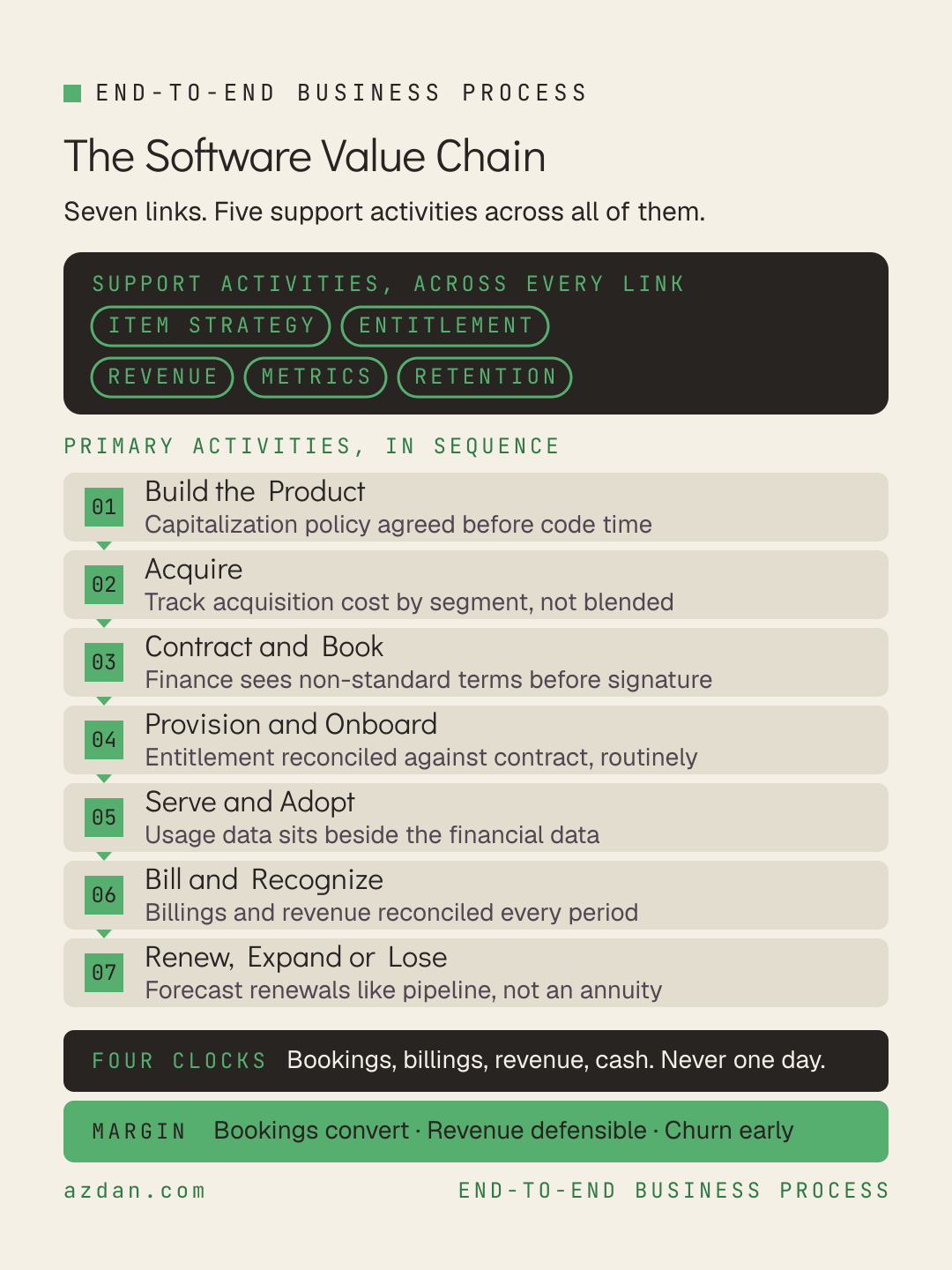
The software value chain runs in seven links:
Build the Product → Acquire → Contract and Book → Provision and Onboard → Serve and Adopt → Bill and Recognize → Renew, Expand or Lose
Three things make it unlike the other chains in this series. The sale is the beginning of revenue rather than the end of it, so the links after signature are where booked value is either realized or lost. Four different numbers describe the same contract and none of them move on the same day. And the chain crosses more system boundaries than any other here, because quotes, usage, billing and revenue recognition frequently live in four different systems.
Methodology note. This maps the end-to-end process using the value chain model, applied to the software and SaaS process design Azdan works with across its NetSuite delivery in the UAE, Saudi Arabia, and Egypt. Where a point reflects delivery experience rather than measured data, it is labeled as a recommendation.
A companion piece covers the implementation itself. How to Implement NetSuite for Software Companies sets out the seven-phase method and the item-level revenue design that has to be right before any of this runs.
Four Numbers, Four Clocks
Start here, because more reporting arguments in this sector come from this than from anything else.
A single three-year subscription produces four numbers that people routinely treat as interchangeable. They are not, and they do not move together.
In a product business these four collapse into roughly one moment. In software they can sit years apart. A three-year deal signed in January might be billed annually in advance, recognized ratably across thirty-six months, and collected forty-five days after each invoice. One contract, four timelines, four owners.
The failure is not arithmetic, it is conversational. A board hears "we closed two million" and models cash. A sales team hears a revenue number and thinks their quarter shrank. Recommendation: publish all four side by side, for the same period, and never report one without the others. The gap between bookings and revenue is not a discrepancy, it is the business model.
The Sale Is the Start, Not the End
The second structural fact, and the one that redraws the chain.
Subscriptions renew, customers expand or churn, pricing evolves, and usage scales unpredictably. None of that is an exception to the sale. It is the sale, unfolding over time. A contract signed is a forecast of revenue, and the links after signature decide whether the forecast holds.
Which means the metric set is about movement rather than level. The subscription metrics that matter are a rollforward of monthly recurring revenue, showing what was added, expanded, contracted and churned, alongside total ARR, MRR and bookings, net and gross revenue retention trends, and customer acquisition cost.
Read that list carefully, because the pairing matters. Gross revenue retention asks whether you kept what you had. Net revenue retention asks whether you grew it. A business with strong net retention and weak gross retention is losing customers and hiding it behind expansion in the ones that remain, which works until the expansion stops.
Recommendation: review the MRR rollforward as the primary growth report, not the revenue line. The revenue line tells you what happened. The rollforward tells you why, and it is the only view that separates a good quarter from a lucky one.
The Chain Crosses More Systems Than Any Other
The third structural fact, and the one that decides implementation scope.
What makes software unusual is the number of system boundaries the process has to cross. A company may create quotes in a CRM or a configure-price-quote tool, meter customer usage somewhere else for consumption billing, bill through a subscription platform, and recognize revenue under an accounting standard in a fourth system.
Every one of those boundaries is a place where a subscription change has to be replicated, an invoice has to reconcile, and a revenue event has to translate. Recommendation: count the boundaries before scoping. The number of systems a subscription change has to traverse predicts the integration effort more reliably than the number of customers does.
The Software Value Chain
Primary activities, in sequence:
Support activities, running across every link:
- Item strategy and price book
- Contract and entitlement data
- Revenue and deferred revenue assurance
- Subscription metrics and reporting
- Customer health and retention
The margin: bookings that convert to cash, revenue you can defend to an auditor, and a rollforward that explains itself.
Item strategy heads the list because in software the item record is where commercial intent becomes accounting behavior. The companion implementation guide covers that design in full; for the chain, the thing to know is that every downstream number inherits it.
The Seven Links
1. Build the Product
Engineering, release, and the cost that accumulates before anything is sold.
The distinctive question is capitalization: which development cost is expensed and which is capitalized as an asset, under which policy, and who decides. It is a finance decision made about an engineering activity, and the two functions rarely share a vocabulary.
Recommendation: agree the capitalization policy and the mechanism for capturing it before the engineering team is asked to code time. Retrospective reconstruction of what was maintenance and what was new development is an unpleasant exercise.
2. Acquire
Marketing, pipeline, and the cost of winning a customer.
Customer acquisition cost belongs to this link and it only means something when set against what the customer is worth over a lifetime. Recommendation: track acquisition cost by segment rather than in aggregate. Blended CAC hides the segment that is unprofitable to sell into, and that segment is usually the one the sales team likes best because the deals close quickly.
3. Contract and Book
The signature, and the commercial terms that will govern the next several years.
This is where software contracts acquire mechanics that simply do not exist in traditional sales: proration when a change lands mid-period, and co-termination when several subscriptions are aligned to end on the same date so the customer gets one renewal conversation instead of four.
Both are ordinary in this sector and both are configuration consequences of a negotiation. Recommendation: give finance sight of non-standard terms before signature, not after. A payment or term structure invented in a negotiation becomes a manual workaround for the life of the contract, and multi-year contracts have long lives.
4. Provision and Onboard
The customer gets access, and the entitlement becomes real.
This link is short, unglamorous, and the most common place for revenue leakage to start. If what was provisioned does not match what was contracted, the business is either giving away capability it should be charging for or charging for capability the customer cannot use. The first shows up as margin erosion nobody can explain. The second shows up as a churn conversation.
Recommendation: reconcile entitlement against contract as a routine control, not as an investigation triggered by a complaint.
5. Serve and Adopt
Support, success, and the usage that determines whether the renewal happens.
In a product business, post-sale service protects reputation. In software it protects revenue, directly and measurably, because a customer who does not use the product does not renew it. That makes adoption a financial metric wearing a customer-success costume.
Recommendation: get usage data into the same place as the financial data. Retention analysis that cannot join usage to contract value is describing the symptom.
6. Bill and Recognize
Invoices go out on the billing schedule; revenue is recognized on the revenue plan; the two are different processes with different timing.
Pricing models compound this. Flat rate, tiered, usage-based and hybrid models all have to be billed correctly and recognized correctly, and usage-based revenue in particular cannot be invoiced until the period it measures has closed.
Recommendation: reconcile billings to revenue every period as a standing control. Deferred revenue is the balance between them, and it is the account most likely to accumulate errors quietly because nobody looks at it until an audit.
7. Renew, Expand or Lose
The closing link, and the one that feeds link three.
Every subscription reaches a decision point, and there are only three outcomes. The renewal is not an administrative event. It is a re-sale conducted with far better information than the original, by whoever happens to own the relationship.
Recommendation: forecast renewals like pipeline, with stages and probability, rather than assuming a historical rate. A renewal base treated as an annuity is the most expensive assumption in this sector.
What Breaks: Seven Recurring Failures
These are patterns that recur in software and SaaS businesses. They are drawn from delivery experience and offered as recommendations rather than measured findings.
- Bookings, billings, revenue and cash used interchangeably. They describe the same contract on four different clocks, and conflating them misleads everybody in the room.
- Net retention reported without gross retention. Expansion can conceal customer loss for several quarters.
- Non-standard contract terms unseen by finance until after signature. They become manual workarounds for the life of a multi-year deal.
- Entitlement never reconciled to contract. Revenue leakage starts here and surfaces as unexplained margin erosion.
- Usage data separated from financial data. Retention analysis then describes symptoms rather than causes.
- Deferred revenue left unreconciled between periods. It is the quietest account on the balance sheet and the one auditors look at hardest.
- Renewals assumed rather than forecast. Treating the base as an annuity is how a forecast misses without warning.
Reading Your Own Chain: Four Questions
- Can you show bookings, billings, revenue and cash for the same period, side by side? If producing that takes a week, the four clocks are not being managed.
- What are gross and net revenue retention, separately? One without the other is not an answer.
- How many systems does a mid-term subscription change have to touch? That number is your integration risk.
- When was entitlement last reconciled against contracted terms? If the answer is never, revenue is leaking somewhere.
Which Software Business Are You
The chain is common to the sector, but its weight shifts by model, and Azdan maintains separate industry practices for each.
- Subscription and SaaS. The chain is heaviest at bill, recognize, and renew, with subscription metrics and deferred revenue carrying the reporting load. See NetSuite ERP for Software Companies.
- Software with a services arm. Where implementation and professional services revenue sits alongside subscription, running two revenue models through one delivery organization. See NetSuite ERP for IT Services.
- Perpetual and hybrid licensing. Where license revenue recognized on fulfillment coexists with recurring support and maintenance, and the item design has to carry both.
The services half of that second model is covered in its own chain. End-to-End Business Process for Services maps estimating, utilization and realization, which is where a software company's services arm usually loses money.
Recommendation
If you are mapping a software business end to end, produce one view before anything else: bookings, billings, revenue and cash for the last eight quarters, on one page, for the same periods.
Most software companies can produce each of those numbers and few can produce them together. Side by side they show where the model actually converts and where it does not, and they end the recurring argument about whose number is right. All four are right. They are answering different questions.
Then look at gross revenue retention on its own, without expansion in it. It is the least flattering number in the business and the one that predicts the most.
Sources
- Oracle NetSuite, ERP for SaaS, Subscription, and Technology Companies, for subscription, usage-based and hybrid models, retention and expansion tracking
- Oracle NetSuite, ERP for Software Companies: The Ultimate Guide, for proration, co-termination, and the system boundaries a software process crosses
- Oracle NetSuite, The Complete Guide to Billing for SaaS Companies, for flat rate, tiered, usage-based and hybrid billing
- Oracle NetSuite, What Is Value Chain? An Expert Guide, for the value chain model
- Michael E. Porter, Competitive Advantage: Creating and Sustaining Superior Performance, 1985, for the original value chain framework
Process content reflects software and SaaS leading practice as applied by Azdan, checked August 2026.
Related Azdan Resources
Published by Azdan, an Oracle NetSuite Solution Provider operating across the UAE, Saudi Arabia, and Egypt. Guidance in this article reflects Azdan's process design work with software and SaaS businesses. Content checked August 2026.