A media company sells attention to advertisers and content to an audience, two customers who never meet. It pays the people whose work it uses, and it earns nothing from inventory that goes unsold, because an empty slot at eight on Tuesday is worth nothing on Wednesday. Each of those facts shapes a process, and each process has a practice worth getting right before the system goes live. This is the leading practice reference for media companies: every process area, the flow it follows, the rules that govern it, and a copy-ready skill file for each one.
How to Use This
Each process area below carries three things. A flow, which is the sequence the process actually runs in. A short set of rules specific to media companies rather than generic ERP advice. And a skill file you can copy straight out of the page, written as markdown so it can be handed to an AI assistant, dropped into a project repository, or used as the basis for a design document.
The skill files are deliberately short. They are checklists for people who already know the domain, not tutorials. Each one names the roles that own the process, the flow, the rules, what to verify before go-live, and the failure modes that recur.
Methodology note. Unlike the other posts in this series, this one is not built from a documented edition leading practice. It draws on NetSuite's published media and publishing capabilities and the NetSuite stairway for media, applied through Azdan's delivery work across the UAE, Saudi Arabia, and Egypt. NetSuite notes that some of the capabilities it describes require partner integrations, so confirm what your own configuration includes before treating any capability as available. Where a point is Azdan's recommendation rather than a published NetSuite capability, it is labeled as one.
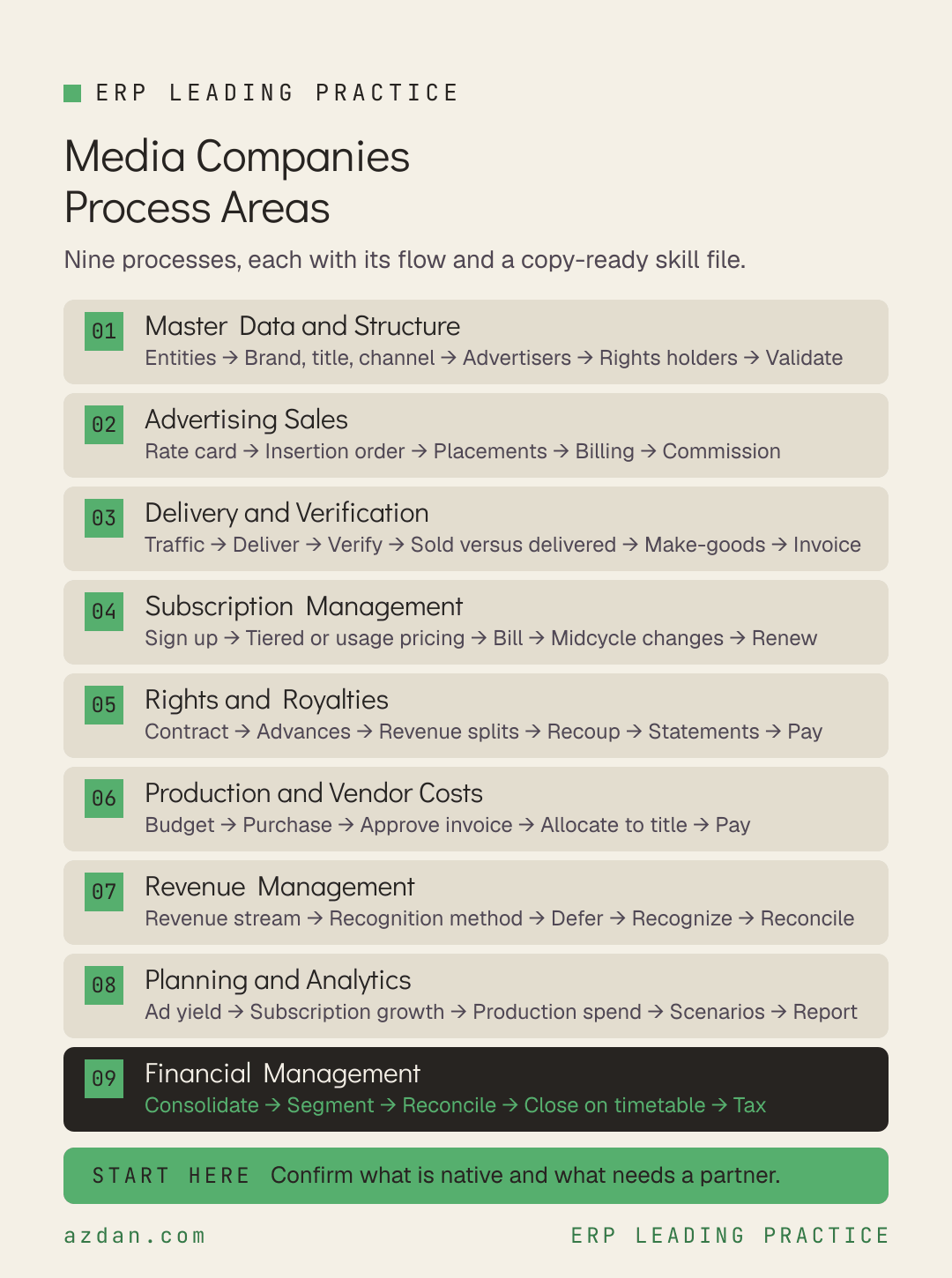
The 9 Process Areas
Master Data and Structure → Advertising Sales → Delivery and Verification → Subscription Management → Rights and Royalties → Production and Vendor Costs → Revenue Management → Planning and Analytics → Financial Management
Process area
Primary owner
What it covers
Master Data and Structure
Controller
Advertisers, agencies, subscribers, rights holders and vendors, and the structure that lets a media business see profit by brand, title and channel rather than only in total.
Advertising Sales
Advertising sales
The insertion order is the central commercial record of an advertising business, and the NetSuite media stairway places insertion order management in its foundation tier rather than treating it as an add-on.
Delivery and Verification
Ad operations
Establishing whether an advertisement ran, where and to how many people, before it is invoiced.
Subscription Management
Subscriptions
The audience side of the business runs on recurring revenue, with its own lifecycle, pricing and churn, and it needs managing on its own terms rather than as a variant of advertising.
Rights and Royalties
Rights and royalties
Media companies pay the people whose work they use, under contracts with advances and revenue splits that differ by channel, and those payments have to reconcile to the revenue they depend on.
Production and Vendor Costs
Production
Content costs money before it earns any, and in media those costs arrive from many creative, print and production vendors at once, which makes allocation harder than payment.
Revenue Management
Controller
A media company recognizes three kinds of revenue under the same standards: subscriptions over the term, advertising as it is delivered, and licensing under the terms of each deal.
Planning and Analytics
Finance
A media business forecasts two machines at once, advertising yield and audience growth, and the second drives the first a quarter or two later.
Financial Management
Controller
Consolidation, the close and compliance across a portfolio of properties, often spread over several entities as titles and channels are acquired.
1. Master Data and Structure
Advertisers, agencies, subscribers, rights holders and vendors, and the structure that lets a media business see profit by brand, title and channel rather than only in total.
Roles: Controller, advertising sales, subscriptions, rights and royalties
Process flow
Define entities → Set brand, title and channel segments → Load advertisers, agencies and subscribers → Load rights holders and vendors → Validate
Leading practice rules
NetSuite manages subscribers and advertisers in one customer base alongside the financials, so both sides of the business share one set of records.
NetSuite's general ledger consolidates multi-entity results in real time and segments them by brand, title or channel.
Recommendation: define the brand, title and channel segments before loading any history, because profitability by property only exists if every transaction carries them.
Recommendation: model agencies separately from the advertisers they buy for, since the party that books, the party that benefits and the party that pays can be three different entities.
Skill file: Master Data and Structure
---
name: media-master-data-and-structure
description: NetSuite leading practice for Master Data and Structure in media companies
---

# Master Data and Structure - Media Companies

## Roles
Controller, advertising sales, subscriptions, rights and royalties

## Process flow
Define entities → Set brand, title and channel segments → Load advertisers, agencies and subscribers → Load rights holders and vendors → Validate

## Leading practice rules
- NetSuite manages subscribers and advertisers in one customer base alongside the financials, so both sides of the business share one set of records.
- NetSuite's general ledger consolidates multi-entity results in real time and segments them by brand, title or channel.
- Recommendation: define the brand, title and channel segments before loading any history, because profitability by property only exists if every transaction carries them.
- Recommendation: model agencies separately from the advertisers they buy for, since the party that books, the party that benefits and the party that pays can be three different entities.

## Check before go-live
- [ ] Brand, title and channel segments agreed before the first transaction
- [ ] Agency and advertiser relationships modeled explicitly

## Known failure modes
- Properties reported only in aggregate, so a loss-making title stays hidden inside a profitable brand

## Scope note
This reflects NetSuite's published media and publishing capabilities, some of which
require partner integrations. Confirm against your own licensed modules and
configuration before treating any capability as available.
2. Advertising Sales
The insertion order is the central commercial record of an advertising business, and the NetSuite media stairway places insertion order management in its foundation tier rather than treating it as an add-on.
Plan and price inventory → Build insertion order → Commit placements → Set billing schedule → Track commission
Leading practice rules
NetSuite's advertising management tracks campaigns from insertion order through fulfillment and invoicing, and manages multichannel ad inventory.
Invoices generate on customized billing schedules, so a campaign spanning several placements over several months bills on its own schedule rather than once at the end.
NetSuite manages sales commissions, including auditable structures for complex sales incentives.
Recommendation: record the commercial agreement at campaign level and delivery and billing at placement level, because that is how media is sold and how it is delivered.
Recommendation: report achieved rate against rate card by property and period. The gap is the clearest measure of commercial discipline in the business, and it is often not measured at all.
Skill file: Advertising Sales
---
name: media-advertising-sales
description: NetSuite leading practice for Advertising Sales in media companies
---

# Advertising Sales - Media Companies

## Roles
Advertising sales, sales management, Controller

## Process flow
Plan and price inventory → Build insertion order → Commit placements → Set billing schedule → Track commission

## Leading practice rules
- NetSuite's advertising management tracks campaigns from insertion order through fulfillment and invoicing, and manages multichannel ad inventory.
- Invoices generate on customized billing schedules, so a campaign spanning several placements over several months bills on its own schedule rather than once at the end.
- NetSuite manages sales commissions, including auditable structures for complex sales incentives.
- Recommendation: record the commercial agreement at campaign level and delivery and billing at placement level, because that is how media is sold and how it is delivered.
- Recommendation: report achieved rate against rate card by property and period. The gap is the clearest measure of commercial discipline in the business, and it is often not measured at all.

## Check before go-live
- [ ] A billing schedule on every insertion order before the campaign starts
- [ ] Achieved rate against rate card reported monthly by property

## Known failure modes
- Long campaigns billed once at completion rather than per placement, so cash arrives months after the inventory ran

## Scope note
This reflects NetSuite's published media and publishing capabilities, some of which
require partner integrations. Confirm against your own licensed modules and
configuration before treating any capability as available.
3. Delivery and Verification
Establishing whether an advertisement ran, where and to how many people, before it is invoiced. In most businesses delivery is self-evident because something arrived; in media it is a data question, usually answered by a system that is not the ERP.
Roles: Ad operations, advertising sales, Controller
Process flow
Traffic placements → Deliver → Import verification data → Compare sold, delivered and billed → Record make-goods → Invoice
Leading practice rules
NetSuite tracks advertisements from insertion order through fulfillment and verification, and integrates with ad verification platforms for the delivery data.
NetSuite's advertising dashboards show sold, billed and delivered ads side by side.
Media integration sits in the expand tier of the NetSuite media stairway.
Recommendation: place verification between delivery and invoicing rather than after it, so disagreements are settled before billing instead of through credit notes.
Recommendation: record make-good obligations when a delivery shortfall occurs, not when the replacement inventory runs, because the obligation exists from the moment delivery falls short.
Recommendation: treat trafficking constraints such as competitive separation and sold category exclusivity as commercial risk rather than scheduling detail.
Skill file: Delivery and Verification
---
name: media-delivery-and-verification
description: NetSuite leading practice for Delivery and Verification in media companies
---

# Delivery and Verification - Media Companies

## Roles
Ad operations, advertising sales, Controller

## Process flow
Traffic placements → Deliver → Import verification data → Compare sold, delivered and billed → Record make-goods → Invoice

## Leading practice rules
- NetSuite tracks advertisements from insertion order through fulfillment and verification, and integrates with ad verification platforms for the delivery data.
- NetSuite's advertising dashboards show sold, billed and delivered ads side by side.
- Media integration sits in the expand tier of the NetSuite media stairway.
- Recommendation: place verification between delivery and invoicing rather than after it, so disagreements are settled before billing instead of through credit notes.
- Recommendation: record make-good obligations when a delivery shortfall occurs, not when the replacement inventory runs, because the obligation exists from the moment delivery falls short.
- Recommendation: treat trafficking constraints such as competitive separation and sold category exclusivity as commercial risk rather than scheduling detail.

## Check before go-live
- [ ] Verification data reaching the system before invoices are generated
- [ ] Make-good obligations recorded at the point of shortfall

## Known failure modes
- Invoicing before verification, then issuing credit notes when the delivery data disagrees
- Make-goods recorded only when fulfilled, which overstates both the revenue forecast and the inventory available to sell

## Scope note
This reflects NetSuite's published media and publishing capabilities, some of which
require partner integrations. Confirm against your own licensed modules and
configuration before treating any capability as available.
4. Subscription Management
The audience side of the business runs on recurring revenue, with its own lifecycle, pricing and churn, and it needs managing on its own terms rather than as a variant of advertising.
Roles: Subscriptions, Controller, customer service
Process flow
Sign up → Price by tier, volume or usage → Bill on schedule → Handle midcycle changes → Renew or churn → Report recurring revenue
Leading practice rules
NetSuite's subscription management automates the lifecycle from sign-up through renewal.
It handles tiered, volume-based and usage pricing, and prorates billing for midcycle changes.
It gives a real-time view of recurring revenue performance across channels.
Content subscriptions can be sold through NetSuite's ecommerce solution, with unified recurring billing integrated to the general ledger.
Recommendation: report subscription and advertising revenue separately and never as one blended line, because they have different economics, and a decline in one is easily hidden by the other.
Skill file: Subscription Management
---
name: media-subscription-management
description: NetSuite leading practice for Subscription Management in media companies
---

# Subscription Management - Media Companies

## Roles
Subscriptions, Controller, customer service

## Process flow
Sign up → Price by tier, volume or usage → Bill on schedule → Handle midcycle changes → Renew or churn → Report recurring revenue

## Leading practice rules
- NetSuite's subscription management automates the lifecycle from sign-up through renewal.
- It handles tiered, volume-based and usage pricing, and prorates billing for midcycle changes.
- It gives a real-time view of recurring revenue performance across channels.
- Content subscriptions can be sold through NetSuite's ecommerce solution, with unified recurring billing integrated to the general ledger.
- Recommendation: report subscription and advertising revenue separately and never as one blended line, because they have different economics, and a decline in one is easily hidden by the other.

## Check before go-live
- [ ] Proration tested for upgrades, downgrades and cancellations
- [ ] Churn reported by property

## Known failure modes
- Audience and advertising revenue blended into one top line, so the half of the business in decline cannot be seen

## Scope note
This reflects NetSuite's published media and publishing capabilities, some of which
require partner integrations. Confirm against your own licensed modules and
configuration before treating any capability as available.
5. Rights and Royalties
Media companies pay the people whose work they use, under contracts with advances and revenue splits that differ by channel, and those payments have to reconcile to the revenue they depend on.
Roles: Rights and royalties, Controller, accounts payable
Process flow
Record contract and terms → Record advances → Calculate splits from revenue → Recoup advances → Issue statements → Pay
Leading practice rules
NetSuite's rights and royalties management covers contracts, advances and revenue splits across print, digital and streaming.
It generates royalty statements and supports payouts to authors, artists and licensors.
NetSuite notes that some described capabilities require partner integrations, so confirm how rights and royalties are delivered in your configuration before designing around them.
Recommendation: link each rights contract to the titles and revenue streams it covers, so royalties calculate from the same revenue the finance team reports.
Recommendation: track unrecouped advances as their own balance. An advance paid ahead of earnings is an asset until it earns out, and it needs reviewing for recoverability.
Skill file: Rights and Royalties
---
name: media-rights-and-royalties
description: NetSuite leading practice for Rights and Royalties in media companies
---

# Rights and Royalties - Media Companies

## Roles
Rights and royalties, Controller, accounts payable

## Process flow
Record contract and terms → Record advances → Calculate splits from revenue → Recoup advances → Issue statements → Pay

## Leading practice rules
- NetSuite's rights and royalties management covers contracts, advances and revenue splits across print, digital and streaming.
- It generates royalty statements and supports payouts to authors, artists and licensors.
- NetSuite notes that some described capabilities require partner integrations, so confirm how rights and royalties are delivered in your configuration before designing around them.
- Recommendation: link each rights contract to the titles and revenue streams it covers, so royalties calculate from the same revenue the finance team reports.
- Recommendation: track unrecouped advances as their own balance. An advance paid ahead of earnings is an asset until it earns out, and it needs reviewing for recoverability.

## Check before go-live
- [ ] Whether rights and royalties run natively or through a partner confirmed before design
- [ ] Advances tracked separately from royalties payable

## Known failure modes
- Royalties calculated in a spreadsheet from a different revenue figure than the ledger, producing statements that cannot be reconciled

## Scope note
This reflects NetSuite's published media and publishing capabilities, some of which
require partner integrations. Confirm against your own licensed modules and
configuration before treating any capability as available.
6. Production and Vendor Costs
Content costs money before it earns any, and in media those costs arrive from many creative, print and production vendors at once, which makes allocation harder than payment.
Roles: Production, accounts payable, Controller
Process flow
Budget production → Raise purchase → Approve vendor invoice → Allocate cost to title or project → Pay
Leading practice rules
Production management sits in the expand tier of the NetSuite media stairway, alongside accounts payable automation.
NetSuite's payment management handles invoice approvals and cost allocations for creative, print and production vendors.
Recommendation: attribute production cost to the title or property that generated it rather than to a pooled production cost center, because a portfolio that cannot be costed by title cannot be pruned.
Recommendation: track content made over time as a project, so cost accumulates against the thing being made.
Skill file: Production and Vendor Costs
---
name: media-production-and-vendor-costs
description: NetSuite leading practice for Production and Vendor Costs in media companies
---

# Production and Vendor Costs - Media Companies

## Roles
Production, accounts payable, Controller

## Process flow
Budget production → Raise purchase → Approve vendor invoice → Allocate cost to title or project → Pay

## Leading practice rules
- Production management sits in the expand tier of the NetSuite media stairway, alongside accounts payable automation.
- NetSuite's payment management handles invoice approvals and cost allocations for creative, print and production vendors.
- Recommendation: attribute production cost to the title or property that generated it rather than to a pooled production cost center, because a portfolio that cannot be costed by title cannot be pruned.
- Recommendation: track content made over time as a project, so cost accumulates against the thing being made.

## Check before go-live
- [ ] Every production cost carrying a title or property
- [ ] Approval routing agreed for creative and production spend

## Known failure modes
- Production cost pooled, so the profitability of individual titles cannot be seen

## Scope note
This reflects NetSuite's published media and publishing capabilities, some of which
require partner integrations. Confirm against your own licensed modules and
configuration before treating any capability as available.
7. Revenue Management
A media company recognizes three kinds of revenue under the same standards: subscriptions over the term, advertising as it is delivered, and licensing under the terms of each deal.
Roles: Controller, revenue accounting
Process flow
Identify the revenue stream → Apply its recognition method → Defer where required → Recognize on delivery or over time → Reconcile deferred revenue → Close
Leading practice rules
NetSuite's advanced revenue management automates compliance with ASC 606 and IFRS 15 for subscription, advertising and licensing revenue.
It applies recognition methods, tracks deferred revenue, and supports the month-end close with policy-driven automation.
Revenue management sits in the foundation tier of the NetSuite media stairway.
Recommendation: agree the recognition policy for each revenue stream before configuration, since subscriptions, delivered advertising and licenses each recognize on a different basis.
Recommendation: where revenue arrives through agencies, decide whether it is reported gross or net of commission under the principal and agent guidance, document it, and apply it consistently.
Skill file: Revenue Management
---
name: media-revenue-management
description: NetSuite leading practice for Revenue Management in media companies
---

# Revenue Management - Media Companies

## Roles
Controller, revenue accounting

## Process flow
Identify the revenue stream → Apply its recognition method → Defer where required → Recognize on delivery or over time → Reconcile deferred revenue → Close

## Leading practice rules
- NetSuite's advanced revenue management automates compliance with ASC 606 and IFRS 15 for subscription, advertising and licensing revenue.
- It applies recognition methods, tracks deferred revenue, and supports the month-end close with policy-driven automation.
- Revenue management sits in the foundation tier of the NetSuite media stairway.
- Recommendation: agree the recognition policy for each revenue stream before configuration, since subscriptions, delivered advertising and licenses each recognize on a different basis.
- Recommendation: where revenue arrives through agencies, decide whether it is reported gross or net of commission under the principal and agent guidance, document it, and apply it consistently.

## Check before go-live
- [ ] Recognition policy documented for each revenue stream
- [ ] Deferred revenue reconciled every period

## Known failure modes
- Advertising recognized when booked rather than when delivered, so reported revenue runs ahead of what actually ran

## Scope note
This reflects NetSuite's published media and publishing capabilities, some of which
require partner integrations. Confirm against your own licensed modules and
configuration before treating any capability as available.
8. Planning and Analytics
A media business forecasts two machines at once, advertising yield and audience growth, and the second drives the first a quarter or two later.
Forecast ad yield → Forecast subscription growth → Forecast production spend → Test scenarios → Report revenue mix, churn and campaign performance
Leading practice rules
NetSuite's planning and budgeting forecasts advertising yield, subscription growth and production spend, and tests pricing, campaign, distribution and partnership strategies.
Its reporting covers revenue mix, churn and campaign performance through dashboards and scenarios.
Financial planning and budgeting sits in the expand tier of the NetSuite media stairway, and advanced planning and reporting in the lead tier.
Recommendation: report unsold inventory in currency, not only as a sell-through percentage. Inventory that did not sell ceased to exist, and expressing it as lost revenue changes pricing conversations faster.
Recommendation: close the loop between analysis and pricing on a fixed schedule, with the pricing team in the room.
Skill file: Planning and Analytics
---
name: media-planning-and-analytics
description: NetSuite leading practice for Planning and Analytics in media companies
---

# Planning and Analytics - Media Companies

## Roles
Finance, advertising sales, subscriptions, leadership

## Process flow
Forecast ad yield → Forecast subscription growth → Forecast production spend → Test scenarios → Report revenue mix, churn and campaign performance

## Leading practice rules
- NetSuite's planning and budgeting forecasts advertising yield, subscription growth and production spend, and tests pricing, campaign, distribution and partnership strategies.
- Its reporting covers revenue mix, churn and campaign performance through dashboards and scenarios.
- Financial planning and budgeting sits in the expand tier of the NetSuite media stairway, and advanced planning and reporting in the lead tier.
- Recommendation: report unsold inventory in currency, not only as a sell-through percentage. Inventory that did not sell ceased to exist, and expressing it as lost revenue changes pricing conversations faster.
- Recommendation: close the loop between analysis and pricing on a fixed schedule, with the pricing team in the room.

## Check before go-live
- [ ] Unsold inventory reported in currency by property
- [ ] Audience trend feeding next period's availability and pricing

## Known failure modes
- Sell-through reported only as a percentage, which describes performance without prompting a pricing decision

## Scope note
This reflects NetSuite's published media and publishing capabilities, some of which
require partner integrations. Confirm against your own licensed modules and
configuration before treating any capability as available.
9. Financial Management
Consolidation, the close and compliance across a portfolio of properties, often spread over several entities as titles and channels are acquired.
Roles: Controller, finance leadership
Process flow
Consolidate entities → Segment by brand, title and channel → Reconcile → Close on timetable → Report → Meet tax obligations
Leading practice rules
NetSuite consolidates multi-entity results in real time and segments them by brand, title or channel.
Multi-subsidiary growth sits in the expand tier of the NetSuite media stairway, and global expansion and governance and compliance in the lead tier.
NetSuite positions its media capabilities as supporting ASC 606 and IFRS 15 and digital-tax obligations through automated controls and audit trails.
Recommendation: confirm digital tax obligations market by market early, since subscription and digital advertising revenue can be treated differently from print.
Recommendation: lock periods on an agreed timetable, because verification data and royalty adjustments tend to arrive late and would otherwise reopen closed months.
Skill file: Financial Management
---
name: media-financial-management
description: NetSuite leading practice for Financial Management in media companies
---

# Financial Management - Media Companies

## Roles
Controller, finance leadership

## Process flow
Consolidate entities → Segment by brand, title and channel → Reconcile → Close on timetable → Report → Meet tax obligations

## Leading practice rules
- NetSuite consolidates multi-entity results in real time and segments them by brand, title or channel.
- Multi-subsidiary growth sits in the expand tier of the NetSuite media stairway, and global expansion and governance and compliance in the lead tier.
- NetSuite positions its media capabilities as supporting ASC 606 and IFRS 15 and digital-tax obligations through automated controls and audit trails.
- Recommendation: confirm digital tax obligations market by market early, since subscription and digital advertising revenue can be treated differently from print.
- Recommendation: lock periods on an agreed timetable, because verification data and royalty adjustments tend to arrive late and would otherwise reopen closed months.

## Check before go-live
- [ ] Tax treatment confirmed for each digital revenue stream in each market
- [ ] A close timetable that includes verification and royalty cut-offs

## Known failure modes
- Late verification data and royalty adjustments posted into closed periods, so reported results move after sign-off

## Scope note
This reflects NetSuite's published media and publishing capabilities, some of which
require partner integrations. Confirm against your own licensed modules and
configuration before treating any capability as available.
Where to Start
Master data first, with the brand, title and channel segments in place, because profitability by property only exists if every transaction carries them. Then advertising sales and delivery together, since the insertion order and the verification data meet at the invoice. Subscription management runs alongside. Rights and royalties next, once it is clear how they will be delivered. Revenue management, production costs, planning and financial management run throughout.
The single highest-value check comes before design: confirm what is native and what needs a partner. NetSuite states that some of the media capabilities it describes require partner integrations, without saying which. List rights and royalties, ad verification and any ad server connection, and confirm for each whether it comes from the core product, a SuiteApp or a partner. A design that assumes everything is native tends to find the gap in testing, when it is most expensive to close.
Published by Azdan, an Oracle NetSuite Solution Provider operating across the UAE, Saudi Arabia, and Egypt. Guidance in this article reflects Azdan's process design work with media companies. Content checked August 2026.
Blog
News & Insights
Fresh thinking and real-world advice to help you scale smarter, faster, and with more clarity
.svg)