.svg)


End-to-End Business Process for Wholesale Distribution
A distributor sells a pallet on Tuesday and finds out what it cost on the following month's freight invoice. By then the goods are gone, the margin has been reported, and the accounting period may already be closed. Everything difficult about wholesale distribution follows from that gap: you commit to a price before you know your cost, on thin margins, across thousands of items where no two customers pay the same. This guide maps the wholesale distribution value chain end to end.
The Short Answer
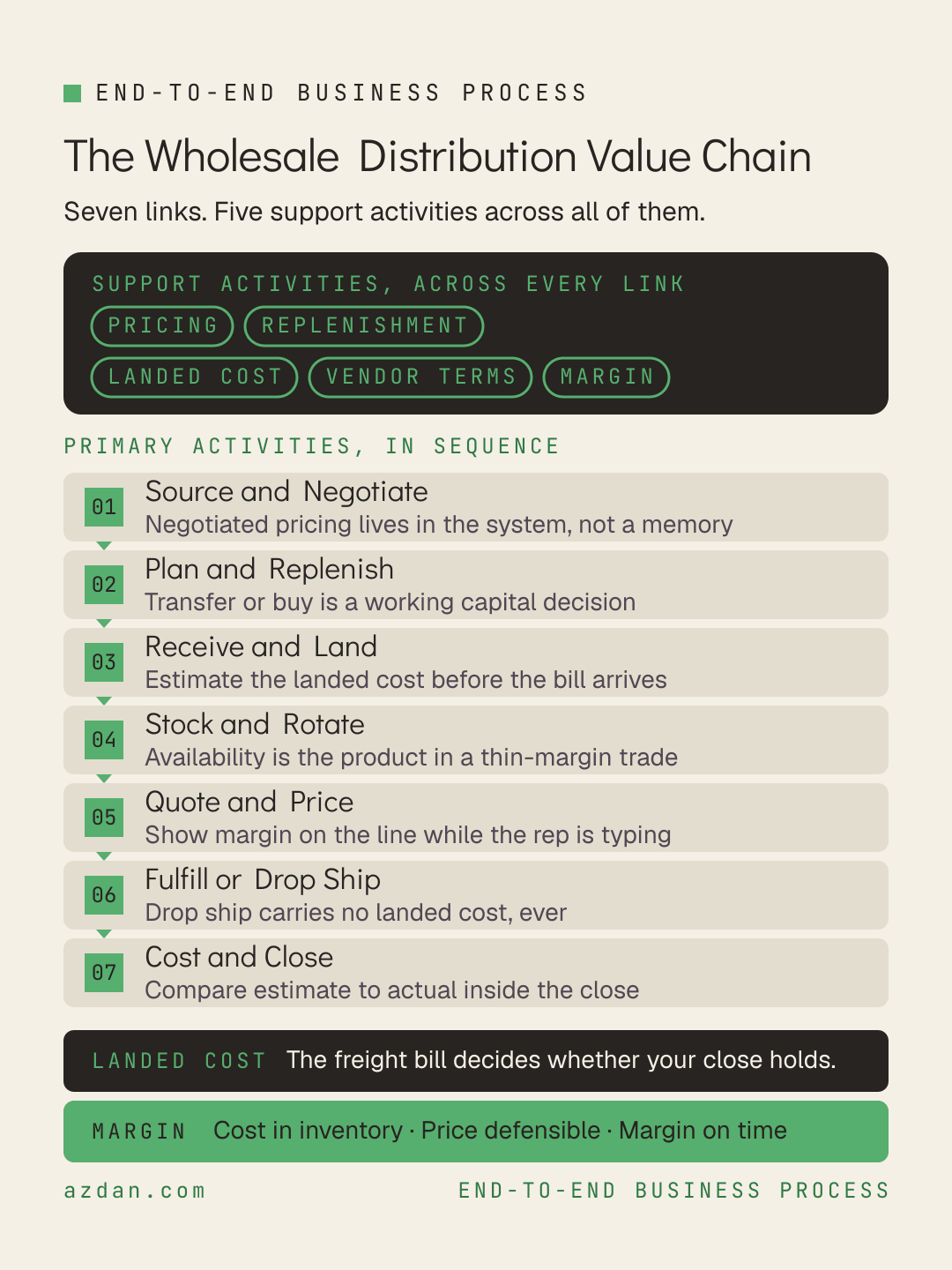
The wholesale distribution value chain runs in seven links:
Source and Negotiate → Plan and Replenish → Receive and Land → Stock and Rotate → Quote and Price → Fulfill or Drop Ship → Cost and Close
Three things make it unlike the other chains in this series. The true cost of an item arrives after the item has been sold, on a document from a different vendor. There is no such thing as the price, because the same item carries a different price for every customer group, volume band and contract. And a meaningful share of what you sell never touches your warehouse at all.
Methodology note. This maps the end-to-end process using the value chain model, applied to the wholesale distribution process design Azdan works with across its NetSuite delivery in the UAE, Saudi Arabia, and Egypt. Where a point reflects delivery experience rather than measured data, it is labeled as a recommendation.
The Freight Bill Decides Whether Your Close Holds
Start here, because it is the hardest mechanic in the sector and the one most often discovered too late.
Landed cost is freight, duty and insurance, and it belongs in the value of the inventory rather than in the profit and loss account. The problem is timing. Goods arrive and are receipted. The vendor bill carrying the freight and duty arrives later, sometimes much later, and when it does the accountant links it back to the item receipt and allocates it across the transaction by weight, value or quantity.
If that happens before the period closes, everything is clean. If it happens afterwards, there are exactly two options and neither is comfortable:
Read the middle row carefully. Reopening is not a neutral act. Applying landed cost retrospectively reaches forward through every sale made since the receipt and restates them, which means a number the finance team signed off at close quietly changes.
The mitigation is to stop relying on the actual bill. Leading practice is to apply estimated landed costs at receipt, using cost categories such as freight, duty and insurance with the correct general ledger accounts and defaults assigned per item. Inventory is then valued at purchase price plus estimate from the moment it lands, and when the real bill arrives it is compared against the estimate rather than being the first version of the truth.
Recommendation: set estimated landed cost per item category and run a standing comparison of estimate against actual. The gap between the two is a data quality measure, and it is also the size of the restatement risk you are carrying at any moment.
Two limitations worth knowing before design, because both force manual work:
- Landed cost templates cannot be associated with inbound shipment records. Components have to be entered manually on the inbound shipment.
- Landed cost cannot be applied to drop ship purchase orders at all, because the goods are never received into a location and the platform applies landed cost on item receipts. Drop ship purchase orders also cannot be added to inbound shipment records.
There Is No Such Thing as the Price
The second structural fact, and the reason margin reporting in this sector is per-transaction or it is nothing.
A distributor does not have a price list. It has a pricing structure with several layers working together:
- Price levels offer different pricing to different types of customer, so the same item is one price to a national account and another to a walk-in trade buyer.
- Price groups cluster items so a customer can be given a negotiated position across a whole category rather than item by item.
- Quantity pricing schedules carry the prices negotiated with a vendor, with one vendor per schedule but a schedule applicable to any number of items.
The consequence is that gross margin is only meaningful at the line. An item-level average margin across all customers describes nothing that exists. Leading practice is to use reporting to find items, customers and sales reps sitting outside the expected margin rate, high or low, both to catch errors and to find the accounts that are quietly being sold at a loss.
Recommendation: report margin by customer and by rep as well as by item, and look at both tails. An unusually high margin is as likely to be a pricing error as an unusually low one, and it is the one nobody reports.
Not Everything You Sell Touches Your Warehouse
The third structural fact, and the one that complicates every inventory number.
Drop shipping is routine here. The purchase order is created from the sales order and the goods travel from the vendor directly to the customer without entering your inventory at all. Items can be flagged as drop ship or special order on the item record, and the decision can be overridden per line: a stocked item shipped direct because the customer needs it urgently, or a drop ship item consumed from stock because it happens to be there.
That flexibility is genuinely useful and it means the same item can behave two ways on two lines of the same order. Recommendation: set the cost estimate type on drop ship and special order items to purchase order rate, so the estimated cost reflects what the vendor is actually charging on that order rather than a standing figure.
The Wholesale Distribution Value Chain
Primary activities, in sequence:
Support activities, running across every link:
- Item and pricing structure
- Inventory accuracy and replenishment rules
- Landed cost discipline
- Vendor terms and programs
- Margin reporting by item, customer and rep
The margin: cost that lands in inventory where it belongs, prices you can defend per customer, and margin visible before the period closes rather than after.
Landed cost discipline heads that list because it is the only support activity here that can retroactively change a reported result. Everything else affects the next period. This one reaches backwards.
The Seven Links
1. Source and Negotiate
Vendor selection, terms, and the quantity pricing schedules that record what was agreed.
The commercial reality is that much of a distributor's margin is negotiated here rather than earned later, in purchase price, payment terms, and vendor programs. Recommendation: hold negotiated vendor pricing in the system rather than in a buyer's memory. A schedule applies to many items and only one vendor, so the structure is designed for exactly this.
2. Plan and Replenish
Reorder points, preferred stock levels, lead times and safety stock, driving purchase orders and transfer orders between warehouses.
The judgment is where to hold stock rather than how much. An item can often be replenished from another location instead of bought again, and the choice between a transfer and a purchase order is a working capital decision made daily by someone looking at a screen.
3. Receive and Land
Goods arrive, the receipt is posted, and estimated landed cost attaches to inventory value.
This is the link the whole first section of this article is about. Get the estimate right here and the close is protected. Leave it until the vendor bill arrives and the close is exposed.
4. Stock and Rotate
Bins, lots, locations, cycle counts, and transfers.
Accuracy here is what every promise downstream depends on, and in a distribution business the promise is the product. A distributor competes on availability and reliability far more than on price, because the price is largely set by what was negotiated upstream.
5. Quote and Price
The pricing structure described above, applied to a specific customer on a specific order.
Recommendation: make the expected margin visible at quote entry, not at month end. A sales rep who can see the margin on the line they are typing makes a different decision from one who finds out in a report six weeks later, and in a thin-margin business that difference compounds quickly.
6. Fulfill or Drop Ship
Pick, pack and ship from stock, or send the purchase order to the vendor and let it go direct.
Kit items deserve a note here, because distributors use them heavily for multi-component orders that need no assembly, and they carry three constraints: the kit's sales price is defined in its own right rather than aggregated from components, kits cannot be added to purchase orders so the components are purchased instead, and quantity on hand is not visible on the kit record, only when a kit is added to a sales transaction.
7. Cost and Close
Actual landed cost, margin analysis, and the period close that either holds or does not.
Recommendation: run the estimate against actual comparison as part of the close checklist rather than as an exception report. It is the control that tells you whether the numbers you are about to sign off are going to move.
What Breaks: Seven Recurring Failures
These are patterns that recur in wholesale distribution businesses. They are drawn from delivery experience and offered as recommendations rather than measured findings.
- No estimated landed cost at receipt. Inventory is valued at purchase price alone, and the correction arrives as a restatement or a misstatement.
- Landed cost applied after close by reopening the period. It reaches back through every sale since the receipt and moves a balance already agreed.
- Drop ship assumed to carry landed cost. It cannot, because the goods are never received into a location.
- Margin reported as an item average. With price levels, groups and schedules in play, the average describes a price nobody pays.
- Only the low margin tail reviewed. An unusually high margin is just as likely to be an error.
- Kits treated as stockable items. They cannot be purchased and their quantity on hand is not visible.
- Margin invisible at the point of quoting. The rep finds out weeks after the decision was made.
Reading Your Own Chain: Four Questions
- What is the gap between estimated and actual landed cost, by category? That number is the restatement risk you are carrying.
- How many periods were reopened last year, and why? If landed cost is among the reasons, the estimate is not doing its job.
- Can a rep see margin on the line while quoting? If not, pricing discipline depends on memory.
- Which customers sit outside the expected margin band, in both directions? The high side is the one nobody looks at.
Which Distribution Business Are You
The chain is common to the sector, but its weight shifts by model, and Azdan maintains separate industry practices for each.
- General wholesale distribution. Heaviest at receive, price and fulfill, with landed cost and pricing structure carrying the margin. See NetSuite ERP for Wholesale Distribution.
- Distribution feeding retail. Where the same stock serves trade customers and a consumer channel on different terms. See NetSuite ERP for Retail.
- Distribution alongside production. Where finished goods from your own plant move through the same network as bought-in stock. See NetSuite ERP for Manufacturing.
One adjacent chain goes deeper on a category with its own rules. Food and beverage covers shelf life, lot traceability and route delivery, which sit on top of everything described here.
Recommendation
If you are mapping a wholesale distribution business end to end, check one thing before anything else: whether estimated landed cost is applied at receipt, per item category, with defaults that someone maintains.
If it is, the close is protected and the actual bill becomes a variance to review. If it is not, every freight invoice that arrives after a period close forces a choice between restating a signed-off result and carrying inventory at the wrong value, and the business will be making that choice quietly, every month, without anyone framing it as a decision.
Then look at margin by customer in both tails. The loss-making accounts are usually known. The ones priced far above the expected band are usually errors, and they are usually found by the customer first.
Sources
- Oracle NetSuite, Wholesale Distribution ERP and Management Software, for multi-entity operations, complex pricing and high-volume fulfillment
- Oracle NetSuite, Wholesale Distribution Accounting Software, for landed costs, tariffs, rebates and multi-entity books as the sector's financial pressures, and the note that some described capabilities require partner integrations
- Oracle NetSuite, What Is Value Chain? An Expert Guide, for the value chain model
- Michael E. Porter, Competitive Advantage: Creating and Sustaining Superior Performance, 1985, for the original value chain framework
Process content reflects wholesale distribution leading practice as applied by Azdan, checked August 2026.
Related Azdan Resources
Published by Azdan, an Oracle NetSuite Solution Provider operating across the UAE, Saudi Arabia, and Egypt. Guidance in this article reflects Azdan's process design work with wholesale distribution businesses. Content checked August 2026.